
Discover why addressing scars early is crucial. Learn how timely treatment can enhance healing and improve your scar's appearance.

Treating a new scar within the first weeks measurably improves long-term appearance and reduces symptoms. A systematic review and meta-analysis found that laser treatment applied within one month of surgery produced statistically significant improvements in scar quality. The S2k international guidelines define a realistic treatment goal as a 30%–50% reduction in scar volume or greater than 50% decrease in symptoms after 3–6 months of consistent therapy. Waiting until a scar matures is the single most common reason patients end up with worse outcomes than they needed to have.
Before you read further, run this quick check:
- Is your wound fully closed or recently sutured?
- Do you know your suture removal date?
- Do you have darker skin (Fitzpatrick types IV–VI) or a personal or family history of keloids?
- Are you experiencing pain, itching, or tightness at the scar site?
If you answered yes to any of those, an early dermatology evaluation is worth scheduling now. Raodermatology offers early-scar assessments across California, New Jersey, and New York.
Who benefits most: People with surgical incisions, burn scars, or a genetic predisposition to keloids. What to expect: Multi-month therapy with gradual, measurable improvement.
Pro Tip: The window for the most responsive treatment is the first 1–3 months after wound closure. Don’t wait for the scar to “settle” before asking a dermatologist whether intervention is appropriate.
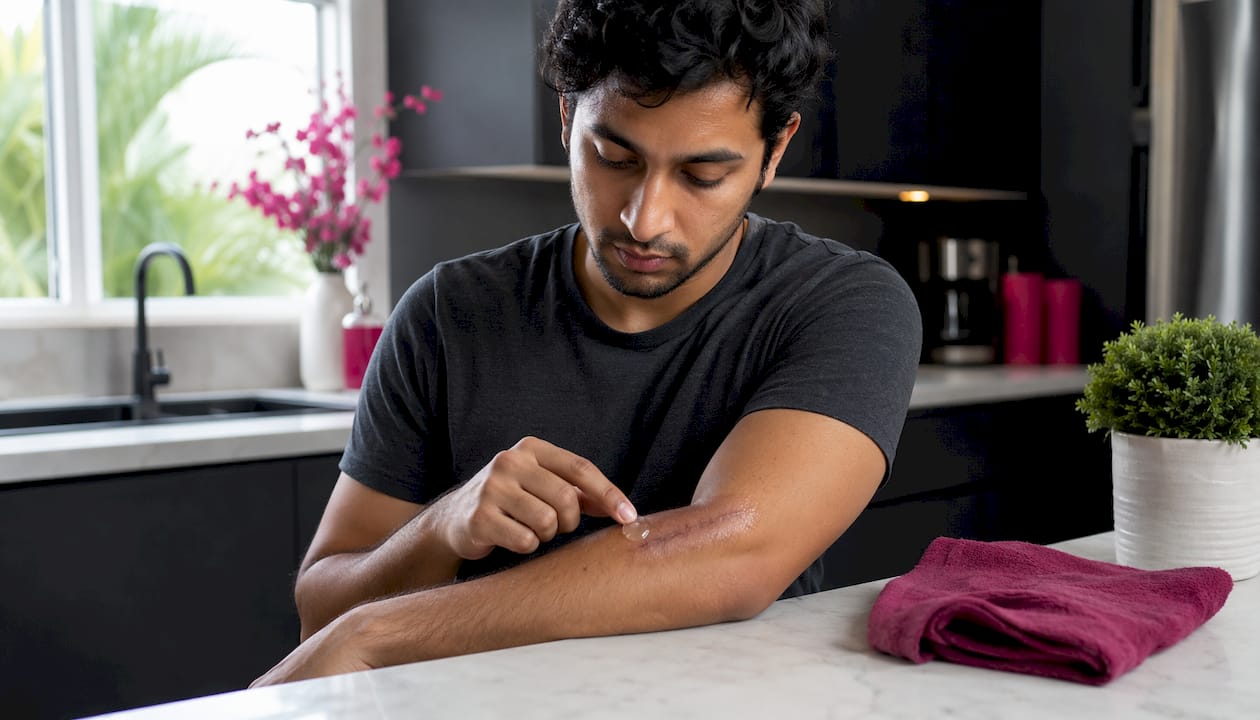
Table of Contents
- Why early scar treatment changes long-term outcomes
- What “early” actually means and what outcomes to expect
- Common early clinical treatments and when clinicians use each
- Who should prioritize an early dermatology evaluation
- Immediate wound-care steps you can start today
- Red flags that mean you should see a dermatologist now
- What a realistic treatment course looks like
- Key Takeaways
- A clinician’s note on early evaluation
- Raodermatology’s early-scar evaluation services
- Useful sources
- FAQ
Why early scar treatment changes long-term outcomes
Immature scars are biologically different from mature ones, and that difference is the whole argument for acting quickly. In the first days after injury, the body launches an inflammatory response. Fibroblasts flood the wound site and begin producing collagen. Around 1–2 weeks post-injury, some of those fibroblasts differentiate into myofibroblasts, which contract the wound and drive the dense, disorganized collagen deposition that becomes a raised or thickened scar.
Here is the critical point: once that collagen cross-links and the extracellular matrix reorganizes, the structural changes become permanent. Early interventions work precisely because they target excessive inflammation before that cross-linking locks in. Newer lesions respond better to silicone, pressure, laser, and injections than mature tissue does. A Frontiers in Immunology review confirmed that high levels of inflammation directly correlate with excessive dermal scarring and that early anti-inflammatory strategies reduce that cascade.
Statistic callout: A meta-analysis published in Aesthetic Plastic Surgery analyzed 475 patients across 12 randomized controlled trials and found that laser or intense pulsed light therapy for early surgical scars was superior to controls in every included study, with a significant and meaningful benefit compared to controls.
| Scar phase | Biological state | Responsiveness to treatment |
|---|---|---|
| Acute (0–2 weeks) | Active inflammation, fibroblast recruitment | High — inflammation still modulable |
| Immature (2 weeks–3 months) | Myofibroblast activity, early collagen deposition | High — best window for most interventions |
| Maturing (3–12 months) | Collagen remodeling, cross-linking begins | Moderate — some interventions still effective |
| Mature (12+ months) | Cross-linked collagen, reduced vascularity | Lower — structural changes largely fixed |
What “early” actually means and what outcomes to expect
“Early” is not a single moment. It spans three overlapping windows, each with its own priorities.
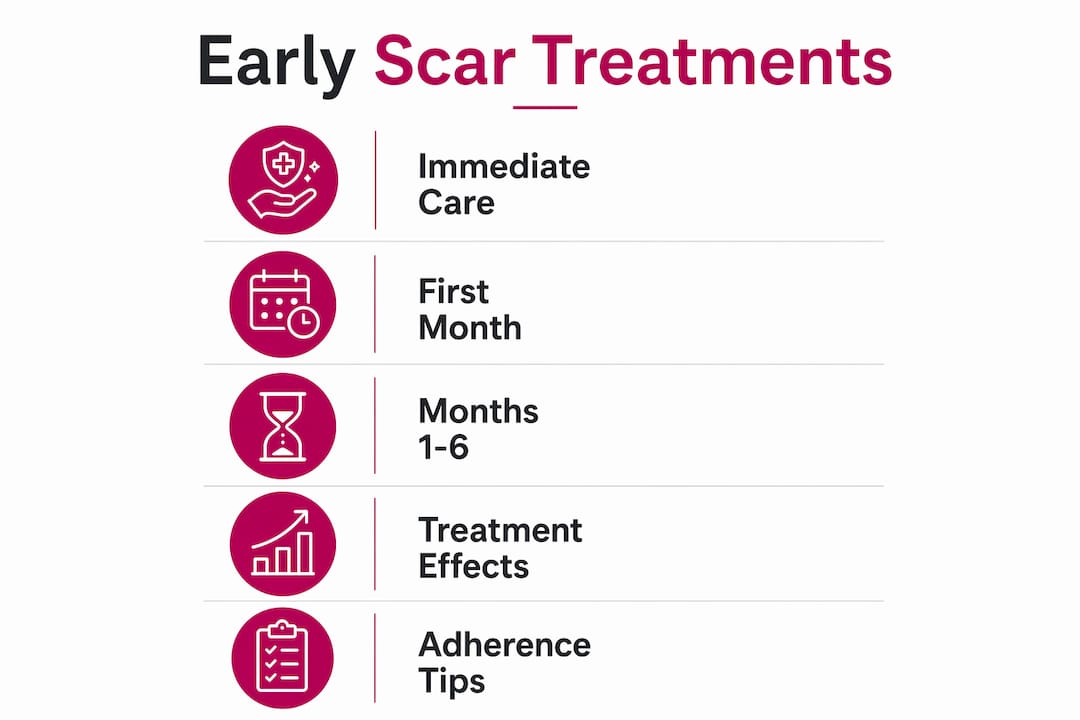
Immediate care (wound still closing): Focus on wound hygiene, tension reduction, and sun protection. For surgical wounds, this is also when perioperative planning matters. Early excision within 72 hours for certain burn injuries reduces long-term hypertrophic scarring compared to delayed excision.
First month after closure: This is when silicone sheeting or gel should begin, and when laser treatment has the strongest evidence. The meta-analysis on early laser intervention specifically studied treatment applied within one month of surgery.
Months 1–6: Consistent therapy during this window targets the S2k guideline benchmarks: a 30%–50% reduction in scar volume or greater than 50% decrease in symptoms after 3–6 months of consistent therapy. Intralesional steroid injections are typically timed here, often every 4–6 weeks.
Variability is real. Scar type, body location, Fitzpatrick skin type, and genetic predisposition all shift both timing and likely outcomes. A scar over a joint faces constant tension and may need longer or more aggressive management than one on the trunk.
Common early clinical treatments and when clinicians use each
Silicone sheeting and gel: First-line for immature and hypertrophic scars. Applied as soon as the wound epithelializes, typically for 12–23 hours daily. Evidence from NCBI Bookshelf supports silicone for reducing height and improving pliability with consistent use over weeks to months.
Pressure garments: Used primarily for burn scars once the epithelium is stable. Daily wear, often for months.
Topical agents: Onion extract formulations and hypoallergenic paper tape are used alongside silicone for erythematous or immature scars per international clinical recommendations.
Intralesional corticosteroid injections: Indicated when silicone alone is insufficient, or when the scar is pruritic or rapidly thickening. Typically scheduled every 4–6 weeks.
Pulsed-dye laser (PDL): Targets scar vascularity and erythema. Recommended once monthly for 2–3 months for persistent erythema. Strong meta-analytic support for early use. See laser therapy options for a clinical breakdown of PDL versus fractional approaches.
Fractional lasers: Second-line or adjunct for hypertrophic and burn scars. Ablative fractional lasers require fewer sessions than nonablative options.
Cryotherapy: Used for smaller keloids or hypertrophic nodules, sometimes combined with intralesional steroids.
| Treatment | When to start | Main benefit | Common risks | Adherence burden |
|---|---|---|---|---|
| Silicone sheeting/gel | At wound closure | Reduces height, improves pliability | Skin irritation, rash | Daily application over an extended period |
| Pressure garments | Once epithelium stable | Flattens burn scars | Discomfort, skin breakdown | Regular use over a lengthy timeframe |
| Intralesional steroids | Several weeks post-closure | Reduces volume, pruritus | Atrophy, hypopigmentation | Periodic treatments |
| PDL / fractional laser | Early post-closure period | Reduces erythema, height | Temporary pigment change | Multiple sessions |
| Cryotherapy | Variable | Flattens small keloids | Hypopigmentation | As needed |
Pro Tip: Combining silicone or taping with early laser or steroid injections produces better outcomes than any single modality alone. For post-excision keloids, adjuvant therapy starting immediately after surgery is not optional — recurrence rates approach 45%–100% when surgery is used without it.
Who should prioritize an early dermatology evaluation
Some scars and some patients carry significantly higher risk for pathological scarring. If any of the following apply, early evaluation is not optional.
High-risk scar types:
- Deep surgical incisions, especially over the chest, shoulders, or joints
- Burn injuries covering significant surface area
- Piercings or wounds in high-tension anatomical zones
- Wounds with infection, delayed closure, or reopening
High-risk patient factors:
- Fitzpatrick skin types IV–VI — higher baseline risk for keloids and hypertrophic scars, and early vascular changes are harder to detect visually
- Personal history of keloid or hypertrophic scarring
- Family history of keloids
- Wounds located over joints or areas of constant movement
Consequences of delayed care: Untreated pathological scars can cause chronic pain, persistent pruritus, contracture limiting joint movement, and significant psychosocial distress. The functional and emotional burden of a neglected keloid or contracture scar is far harder to reverse than the original scar would have been to manage.
Immediate wound-care steps you can start today
- Keep the wound clean and moist. Use gentle cleansing and a non-occlusive ointment until the wound fully closes. Dry wounds heal more slowly and scar more.
- Start silicone as soon as the wound epithelializes. Apply silicone gel or sheeting for 12–23 hours daily. Consistency matters more than any single application. Review cosmetic procedure aftercare steps for a practical protocol.
- Protect from the sun. UV exposure darkens immature scars and delays fading. Use SPF 30+ on any exposed scar for at least 6 months.
- Reduce wound tension. Paper tape or hypoallergenic scar tape applied along the incision line offloads mechanical stress, one of the primary drivers of hypertrophy.
- Begin gentle scar massage at 6–8 weeks post-closure, once the wound is fully healed. Two minutes of firm circular pressure twice daily improves pliability and reduces tethering.
- Document your scar with photos. Consistent lighting, same angle, same distance. This is invaluable for tracking progress and for any telehealth or in-office follow-up. A clinical guide to documenting skin lesions walks through the method.
Pro Tip: Set a phone reminder for daily silicone application. Adherence is the single biggest predictor of silicone’s effectiveness — the product only works when it is actually on the skin.
Red flags that mean you should see a dermatologist now
Most new scars do not need urgent care. These do.
- The scar is growing beyond the original wound boundaries
- You have severe or worsening itching, burning, or pain
- The scar is limiting movement at a joint
- There are signs of infection: increasing redness, warmth, swelling, or discharge
- The scar is in a cosmetically or functionally critical location and you have known risk factors
What to bring to your first visit:
- Photos of the scar taken at regular intervals since injury
- Dates of injury and suture removal
- List of any topical products currently in use
- Personal and family history of keloids or abnormal scarring
- Insurance information and current medication list
A dermatologist will examine the scar type, assess your Fitzpatrick skin type and risk profile, and build a treatment plan that may include early modalities or a watchful monitoring schedule. Many immature scars respond well to conservative measures when caught early, which prevents escalation to more aggressive interventions later.
What a realistic treatment course looks like
Expect multi-month therapy with gradual improvement, not a single fix. The S2k guideline benchmarks of 30%–50% reduction in scar volume or greater than 50% decrease in symptoms after 3–6 months of consistent therapy are targets, not guarantees after one session.
Typical pathway:
- Weeks 0–4: Wound care, silicone initiation, sun protection, tension offloading
- Month 1: First dermatology evaluation; laser treatment if indicated; steroid injection if scar is already thickening
- Months 1–3: Consistent silicone or pressure therapy; repeat laser sessions monthly if prescribed
- Months 3–6: Reassessment against guideline benchmarks; adjust modalities based on response
- Beyond 6 months: If conservative therapy has not achieved adequate improvement, surgical revision with immediate adjuvant therapy may be considered
Common side effects to know about:
- Silicone: skin irritation or contact rash in some patients
- Intralesional steroids: risk of skin atrophy or hypopigmentation with repeated injections
- Laser: temporary redness, swelling, or pigment changes, especially in darker skin tones
- Cryotherapy: risk of hypopigmentation, particularly in Fitzpatrick types IV–VI
| Milestone | What to assess |
|---|---|
| 4 weeks | Scar height, erythema, symptom level; start or adjust silicone |
| 3 months | Volume change, pliability, symptom response to therapy |
| 6 months | Compare against S2k benchmarks: 30%–50% reduction in scar volume or greater than 50% decrease in symptoms after 3–6 months of consistent therapy; decide on continuation or escalation |
| 12+ months | Consider surgical revision if conservative therapy has plateaued |
Key Takeaways
Addressing scars early, ideally within the first month after wound closure, gives you the best chance of reaching the S2k guideline targets of meaningful volume reduction or symptom relief within several months.
| Point | Details |
|---|---|
| Act within the first month | Early laser and silicone therapy have the strongest evidence when started before collagen cross-linking. |
| Know your risk level | Fitzpatrick types IV–VI, keloid history, and high-tension wound sites all warrant faster evaluation. |
| Combine modalities | Silicone plus laser or steroid injections outperforms any single treatment in most clinical scenarios. |
| Set realistic expectations | S2k guidelines target 30%–50% reduction in scar volume or greater than 50% decrease in symptoms after 3–6 months of consistent therapy. |
| Raodermatology | Offers early-scar evaluation and treatment across CA, NJ, and NY, with board-certified dermatologists and multi-modality protocols. |
A clinician’s note on early evaluation
The patients I see with the best long-term scar outcomes are almost never the ones who waited. They are the ones who came in while the scar was still red, still changing, still biologically active. That window is not infinite. Once collagen cross-links and the tissue matures, the options narrow and the effort required to achieve the same result multiplies.
What I look for at an early visit is not just scar type. I want to know the injury date, the closure method, the skin type, and whether there is any pain or pruritus, because those symptoms often signal a scar that is heading toward pathological territory. Variability is real, and I am honest with patients about that. Not every immature scar becomes a keloid. But the ones that do, and the ones that cause functional limitation or significant distress, are almost always the ones where early triage would have changed the trajectory. Document your scar, note the date it started changing, and call a dermatologist if any of the red flags above apply.
Raodermatology’s early-scar evaluation services
Patients with recent scars who want a clear, evidence-based plan have a concrete option: an early-scar evaluation at Raodermatology. With board-certified dermatologists and 25+ years of clinical experience across California, New Jersey, and New York, the practice offers risk stratification, Fitzpatrick skin type assessment, and individualized treatment plans that may include silicone protocols, intralesional injections, PDL, or fractional laser services.

At your first visit, you will receive a full scar history review, a treatment recommendation tailored to your scar type and risk profile, and a follow-up schedule aligned with guideline benchmarks. Medically necessary scar treatments may be covered by insurance; cosmetic procedures are direct-pay. Bring your scar photos, injury dates, and any topical products you are currently using.
Book an early-scar evaluation at Raodermatology in CA, NJ, or NY to get a personalized plan before the most responsive treatment window closes.
Useful sources
The claims in this article draw from peer-reviewed meta-analyses, international clinical guidelines, and evidence-based reviews. Sources were selected by prioritizing international guidelines and randomized controlled trial data over opinion pieces.
- Effectiveness of Early Laser Treatment in Surgical Scar Minimization: A Systematic Review and Meta-analysis
- S2k Guidelines for the Therapy of Pathological Scars (Update 2020)
- Management of Keloids and Hypertrophic Scars, American Family Physician (2024)
- Treatment of Immature Scars: Evidence-Based Techniques and Treatments, NCBI Bookshelf
- Hypertrophic and Keloid Scar Management: Advances and Disparities, PMC
- Cutaneous Scarring: Basic Science, Current Treatments, and Future Directions, PMC
- Safety and Effectiveness of Laser or Intense Pulsed Light Treatment for Early Surgical Scar: A Meta-analysis, Aesthetic Plastic Surgery
- Controlling Inflammation Pre-Emptively or at the Time of Cutaneous Injury, Frontiers in Immunology
- Updated International Clinical Recommendations on Scar Management, Part 2
- Raodermatology Services
This article is general educational information, not medical advice. Consult a board-certified dermatologist or qualified clinician to evaluate your specific scar and determine the appropriate treatment plan.
FAQ
How soon after a wound closes should I start scar treatment?
Start silicone gel or sheeting as soon as the wound fully epithelializes, typically within days of closure. For laser treatment, the strongest evidence supports application within the first month after surgery.
What improvement can I realistically expect from early scar treatment?
S2k international guidelines define a meaningful response as a 30%–50% reduction in scar volume or greater than 50% decrease in symptoms after 3–6 months of consistent therapy.
Who is at highest risk for developing a problematic scar?
Patients with Fitzpatrick skin types IV–VI, a personal or family history of keloids, and wounds over high-tension areas like the chest or joints face the greatest risk and benefit most from early dermatology evaluation.
Does silicone sheeting actually work, and how long do I need to use it?
Yes. Clinical evidence supports silicone for reducing scar height and improving pliability when applied consistently for 12–23 hours daily over weeks to months. Adherence is the primary factor in its effectiveness.
When should I see a dermatologist instead of managing a scar at home?
Seek evaluation promptly if the scar is growing beyond the wound boundary, causing severe itching or pain, limiting joint movement, or if you have known risk factors for keloid formation. Raodermatology offers early-scar evaluations across CA, NJ, and NY.
Recommended
Filed under: