
Stop Retinoids, Keep SPF: Pregnancy Skincare With Dermatologist Triage
September 22, 2026
Dermatologist backed guidance on what to stop in pregnancy (retinoids, hydroquinone), safe swaps like azelaic acid and vitamin C, sunscreen essentials,...
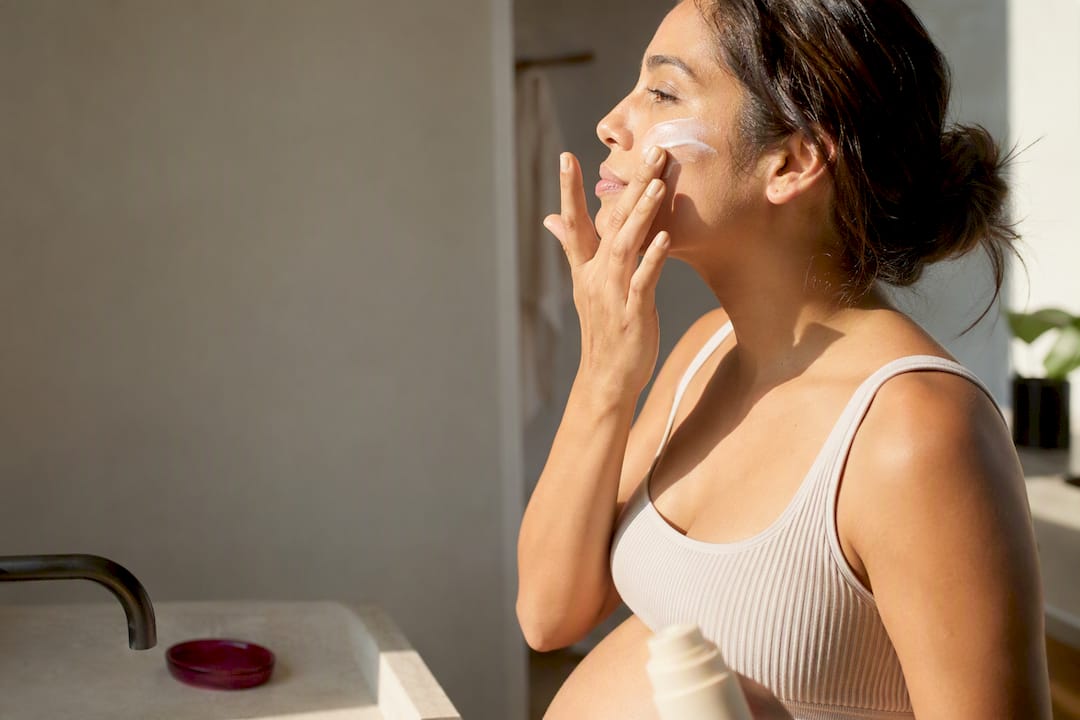
Stop topical retinoids (tretinoin, adapalene), hydroquinone, and any oral isotretinoin the moment you find out you’re pregnant. Keep it simple otherwise: a gentle cleanser, a non-irritating moisturizer, and a daily broad-spectrum mineral sunscreen with zinc oxide or titanium dioxide. Safer active alternatives, like azelaic acid, vitamin C, and niacinamide, can fill in the gaps. If you’re on a prescription for acne, melasma, or anything else, call your OB or dermatologist before you swap or stop anything.
TL;DR:
- Topical retinoids, hydroquinone, and oral isotretinoin should be discontinued immediately once pregnancy is confirmed.
- Safe ingredient options include azelaic acid, vitamin C, niacinamide, and moderate use of benzoyl peroxide or salicylic acid, with cautious introduction.
- Daily mineral sunscreen with zinc oxide or titanium dioxide at SPF 30 or higher is highly effective in preventing melasma and should be prioritized.
- Most aggressive skin procedures and chemical peels are best postponed until after delivery due to safety uncertainties, while lighter treatments require case-by-case evaluation.
- Patch testing new skincare products during pregnancy helps identify sensitivities early, ensuring safer routine adjustments without unnecessary risks.
Table of Contents
- How Pregnancy Changes Your Skin and Why Safety Matters
- Ingredients and Products to Avoid During Pregnancy
- Safe Alternatives and a Pregnancy Safe Skincare Routine
- Managing Acne Safely While Pregnant
- Sun Protection and Melasma Prevention: Your Primary Defense
- Body Care: Stretch Marks, Itching, and Safe Moisturization
- In-Clinic Procedures: What to Postpone or Discuss First
- How to Read Product Labels and When to See a Dermatologist
- Clinical Perspective: Why a Dermatologist’s Input Still Matters
- Safe Skincare Routine Adaptations for Each Trimester
- Managing Sensitive Skin or Allergies During Pregnancy
- Potential Effects of Pregnancy Safe Skincare Products on Breastfeeding
- Guidance on Patch Testing New Skincare Products During Pregnancy
- The Real Priority Isn’t the Ingredient List
- How Rao Dermatology Can Help With Pregnancy Skincare Concerns
- Authoritative Resources to Learn More
- Sources
- FAQ
How Pregnancy Changes Your Skin and Why Safety Matters
Pregnancy hormones rewire your skin from the inside out. Rising estrogen and progesterone push melanin production into overdrive, which is why so many pregnant people develop melasma, blotchy brown patches across the cheeks and forehead. The same hormonal surge ramps up sebum output, which explains why acne that had been calm for years can flare in the second trimester. Skin stretching over a growing belly and chest produces striae, better known as stretch marks, as the deeper skin layers tear faster than they can rebuild collagen.
None of this is dangerous to your baby on its own. It does change the calculus on what you put on your skin, because:
- Melasma is heavily sun-triggered, so prevention leans almost entirely on photoprotection rather than active ingredients.
- Oilier skin means more breakouts, but it also means some acne actives need to be dosed differently than before pregnancy.
- Stretched skin is more reactive, so introducing new products slowly matters more now than it did last year.
Most of these changes are cosmetic and often fade after delivery, though melasma in particular can linger for months. That timeline is exactly why the ingredient choices below matter, since a pregnancy lasts nine months but some melanin changes outlast it.
Ingredients and Products to Avoid During Pregnancy
Some ingredients carry enough theoretical or documented risk that dermatologists recommend stopping them the moment you’re expecting, even when direct evidence of topical harm is thin. The caution exists because the closely related oral versions are proven to cause birth defects, and safer swaps exist, so there’s little reason to take the risk. Here’s the core stop list:
- Topical retinoids (tretinoin, adapalene, and OTC retinol). Oral retinoids are established teratogens, and dermatology guidance extends that caution to the topical versions as a class precaution rather than firm proof of topical harm, according to research on retinoids in pregnancy.
- Oral isotretinoin. This is an absolute contraindication in pregnancy, full stop, no exceptions for severity of acne.
- Hydroquinone. Its absorption profile and the availability of gentler brighteners make it one dermatologist routinely ask patients to pause, a point echoed in clinical guidance on skin conditions during pregnancy.
- Certain prescription systemic drugs, including spironolactone (hormonal antiacne medication), finasteride (hair loss treatment), and oral tetracyclines (antibiotics linked to fetal bone and tooth effects). All three need a conversation with your prescriber, not a unilateral stop.
- High-concentration chemical peels and aggressive resurfacing. These are typically postponed until after delivery, since the depth of penetration and downtime aren’t worth the uncertainty during pregnancy.
Notice what’s absent from this list: mild exfoliating acids and most everyday actives. The overcorrection so many people make, tossing an entire routine because one ingredient is risky, isn’t necessary and often isn’t good for your skin either.
Safe Alternatives and a Pregnancy Safe Skincare Routine
You don’t need a bare-bones routine for nine months. You need the right substitutions. Azelaic acid, vitamin C, niacinamide, hyaluronic acid, benzoyl peroxide in moderate use, and low-dose salicylic or glycolic acid all have reasonable safety profiles when used as directed, per ACOG’s guidance on skin conditions during pregnancy.
A workable AM/PM structure looks like this:
- Morning: gentle cleanser, an antioxidant serum like vitamin C if you tolerate it, moisturizer, then a mineral sunscreen with zinc oxide or titanium dioxide at SPF 30 or higher.
- Evening: gentle cleanser, one targeted active (azelaic acid across the face, or benzoyl peroxide as a spot treatment, or niacinamide), then a moisturizer built around hyaluronic acid.
When you introduce anything new, start once every other night rather than nightly, and give it two weeks before judging results. Reach for lower concentrations of glycolic or salicylic acid than you might have used pre-pregnancy, since sensitivity tends to run higher now. Skip vehicles built for maximum systemic absorption, like strong chemical peel kits meant for at-home deep exfoliation. This isn’t the time to test the most aggressive version of anything.
Pro Tip: Keep whatever was already working before you got pregnant. Dermatologists generally recommend swapping only the specific high-risk ingredients, not rebuilding your entire shelf from scratch. Unnecessary wholesale replacement is one of the more common, and more expensive, mistakes patients make.
Managing Acne Safely While Pregnant
Breakouts during pregnancy are common, and the treatment options are narrower but not nonexistent. Benzoyl peroxide used in limited amounts, azelaic acid, and topical clindamycin are generally considered reasonable choices, according to NCBI’s review of OTC topical acne treatments in pregnancy, which notes these agents are poorly absorbed and not expected to raise miscarriage or birth-defect risk when used as directed.
Expect more dryness and irritation than usual, so patch-test anything new on your inner forearm for a few days before applying it to your face.
What to steer clear of:
- Oral tetracyclines, which can affect fetal bone and tooth development.
- Oral isotretinoin, without exception.
For more severe or treatment-resistant acne, some oral antibiotics outside the tetracycline class, or a short course of prednisone, may be appropriate under a clinician’s direct supervision. That’s a decision for your dermatologist and OB together, not something to manage with over-the-counter products alone. If you’re dealing with scarring acne, a sudden severe outbreak, or breakouts that haven’t responded to anything gentle, that’s your cue to book a dermatology visit rather than keep experimenting.
Sun Protection and Melasma Prevention: Your Primary Defense
Sunscreen is the single most effective tool you have against melasma, more effective than any brightening serum. Daily broad-spectrum SPF of 30 or higher, applied every morning regardless of cloud cover, is the baseline. Mineral formulas built on zinc oxide or titanium dioxide are generally preferred over chemical filters during pregnancy, both because they tend to irritate sensitive skin less and because they sit on the skin’s surface rather than absorbing into it.
Melasma affects a substantial share of pregnant people, largely because rising hormones and sun exposure compound each other, and physical sunscreen plus sun avoidance is considered the most effective preventive measure available, according to a narrative review on dermatologic manifestations in pregnancy.
A few habits make a real difference beyond the sunscreen bottle itself:
- Choose a tinted sunscreen with iron oxides, which block visible light in a way that plain SPF alone does not, especially relevant since visible light is a known melasma trigger.
- Wear a wide-brim hat during peak sun hours, roughly 10 a.m. to 4 p.m.
- Seek shade rather than relying on sunscreen as your only defense.
- Reapply sunscreen every two hours when you’re outdoors, not just once in the morning.
If melasma has already shown up, a tinted mineral sunscreen with iron oxides is often the single highest-leverage change you can make before reaching for any brightening treatment.
Body Care: Stretch Marks, Itching, and Safe Moisturization
Nobody has proven a product that reliably prevents stretch marks. That’s worth saying plainly, because the market is full of belly butters that promise otherwise. Emollients and gentle massage may modestly reduce the severity for some people, and Centella asiatica extract and hyaluronic acid have shown limited benefit in the research available, according to a review of pregnancy skin changes and treatments, but nothing eliminates striae outright.
For the itching that comes with stretching skin, especially across the belly and thighs in the third trimester:
- Apply fragrance-free emollients liberally and often, not just once a day.
- Low- to mid-potency topical corticosteroids are generally considered safe for occasional, targeted use.
- Skip potent steroid formulations or strong actives applied across large body surfaces, since absorption scales with the area covered.
Persistent, severe itching, especially on the palms and soles, deserves a call to your OB. It can signal a liver-related pregnancy condition that has nothing to do with skincare products.
In-Clinic Procedures: What to Postpone or Discuss First
Not every professional treatment needs to wait nine months, but many do. Deep chemical peels, most ablative lasers, and elective resurfacing procedures are typically postponed until after delivery, since the depth of tissue disruption and the medications sometimes used alongside them carry more uncertainty than most patients want to accept during pregnancy.
Lighter, nonablative procedures fall into a gray zone. A clinician weighs the actual necessity of the treatment against the anesthesia, numbing agents, or adjunct medications involved, and decides case by case rather than by blanket rule.
- Elective cosmetic injectables, like neuromodulators and dermal fillers, are almost always postponed until after pregnancy and breastfeeding.
- Any treatment that requires oral or injected medication should be run past both your OB and your dermatologist before you book it.
- If a procedure is medically necessary rather than elective, coordinated care between both providers determines timing and technique.
How to Read Product Labels and When to See a Dermatologist
Flip the bottle over before you flip through your feed for advice. Scan ingredient lists for retinoids under any name, including “retinol,” “retinyl palmitate,” or “tretinoin,” along with hydroquinone. Prescription labels deserve the same scrutiny for spironolactone, tetracyclines, or isotretinoin.
- Check the full ingredient list against your stop list before your first use, not after you notice a reaction.
- Lean on primary sources rather than marketing copy. The FDA’s consumer guidance on cosmetics points out that cosmetics don’t require pre-market approval, so the safety burden sits with manufacturers, not regulators, which means label literacy matters more than brand claims.
- When you’re unsure, bring the actual bottle to your next appointment. It’s faster for your OB or dermatologist to scan a label than to guess from a product name.
Book a visit sooner rather than later if you’re dealing with severe acne, melasma that keeps spreading despite diligent sunscreen use, a new or worsening rash, or a prescription that needs adjusting for pregnancy.
Clinical Perspective: Why a Dermatologist’s Input Still Matters
Rao Dermatology has spent more than 25 years treating skin across California, New Jersey, and New York under Dr. Babar K. Rao, and pregnancy cases get a deliberately conservative approach: individualized plans, minimal ingredient swaps, and direct coordination with each patient’s obstetric provider. If you’re managing a persistent condition or need a prescription reviewed, that’s a conversation worth having with a clinician rather than a search engine.
Safe Skincare Routine Adaptations for Each Trimester
Your skin’s needs shift as pregnancy progresses, and your routine should shift with it rather than staying static for nine months.
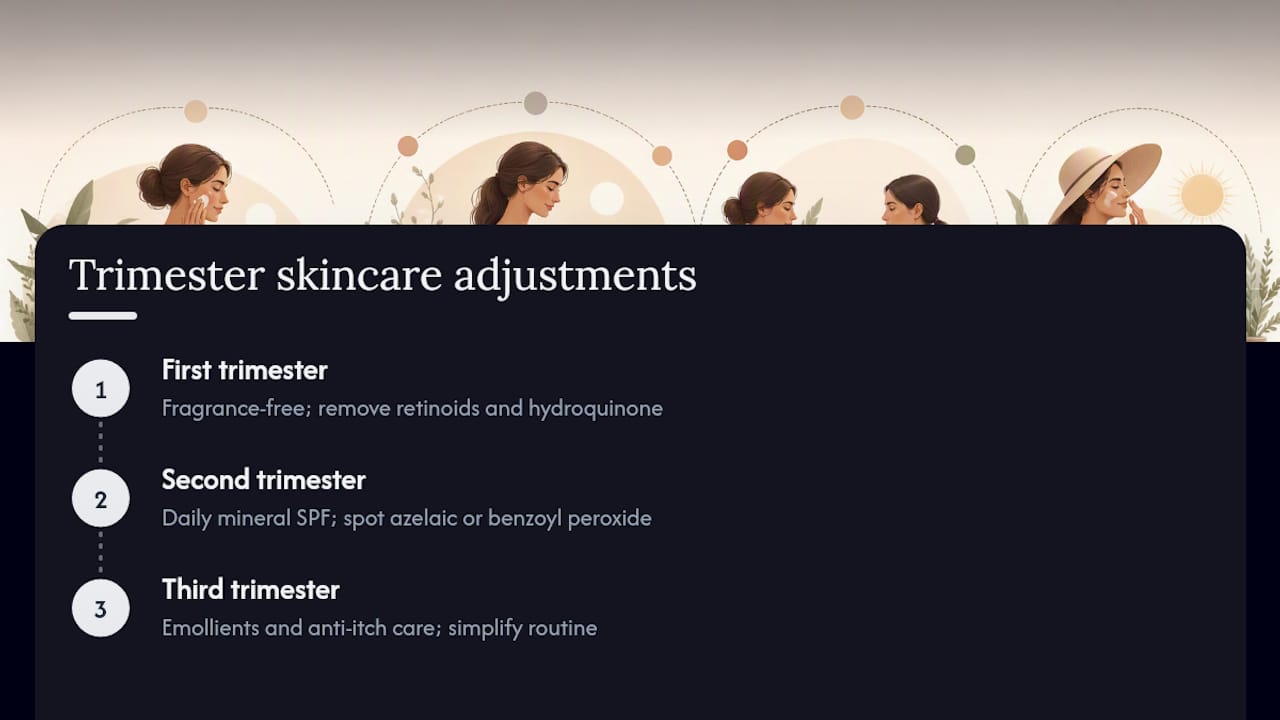
First trimester: This is when nausea and heightened smell sensitivity often make fragrance-heavy products unbearable, so switching to fragrance-free versions of your cleanser and moisturizer early makes sense. It’s also the ideal window to audit your bathroom shelf for retinoids and hydroquinone, since organogenesis, the period when your baby’s organs are forming, happens now and caution matters most here.
Second trimester: Melasma tends to appear or worsen during this stretch as hormone levels climb further, making daily mineral sunscreen non-negotiable if it wasn’t already a habit. Oil production often peaks here too, so this is when azelaic acid or benzoyl peroxide spot treatment tends to earn its place in your evening routine.
Third trimester: Skin stretching accelerates as your belly grows fastest, so emollients and anti-itch care become the priority alongside whatever acne or pigmentation routine you’ve already settled into. Swelling and increased skin sensitivity are common now, so this is a good time to simplify rather than add anything new. Save new product trials for earlier trimesters when possible, since patch testing takes time you may not want to spend this close to delivery.
Across all three stages, the products that were safe in month two are still safe in month eight. You’re not restarting your routine each trimester, just adjusting emphasis as symptoms change.
Managing Sensitive Skin or Allergies During Pregnancy
Skin that never used to react can suddenly flare during pregnancy, and skin with existing allergies can become harder to predict. The immune shifts that support pregnancy also change how your skin barrier responds to fragrance, preservatives, and certain plant extracts.
If you already know your triggers, this is not the time to test that boundary. Stick to fragrance-free, dye-free formulations, and resist the pull of “natural” or “clean” labeling as a safety guarantee. Several essential oils marketed as gentle botanicals are actually flagged for caution during pregnancy, a point worth remembering the next time a product’s ingredient list leans heavily on plant extracts you can’t easily identify, according to AAFP’s guidance on natural-product safety in pregnancy.
For newly sensitive skin with no prior history, simplify before you diagnose. Drop down to a bare-minimum routine, cleanser, moisturizer, sunscreen, for a week or two, then reintroduce one product at a time. That isolates the culprit far faster than trying to troubleshoot a five-step routine all at once.
If a reaction includes swelling, hives that spread, or difficulty breathing, that’s an emergency, not a skincare question. Persistent rashes that don’t respond to basic changes are worth a dermatology visit, since pregnancy can also trigger conditions unrelated to product use, like PUPPP (a common pregnancy rash), that need a different treatment path entirely.
Potential Effects of Pregnancy Safe Skincare Products on Breastfeeding
The ingredient list you built during pregnancy largely carries over into breastfeeding, with a few adjustments worth knowing. Topical retinoids and hydroquinone remain on the avoid list during lactation for the same absorption-related caution that applies during pregnancy. Benzoyl peroxide and azelaic acid, already established as reasonable choices for topical acne treatment during pregnancy, are generally considered compatible with breastfeeding too, since minimal systemic absorption is the same reasoning that supports their use in both phases.
One practical difference: if you’re applying anything to your chest or breast area, wash it off before nursing to avoid direct ingestion by your baby. This matters more for active ingredients like salicylic acid or vitamin C than for a basic moisturizer, but it’s a simple habit worth building regardless of what you’re using.
Oral medications carry more nuance than topicals here, since some drugs considered safe during pregnancy aren’t automatically safe during lactation, and vice versa. Any prescription you were on for acne, psoriasis, or another skin condition needs a separate safety check for breastfeeding rather than an assumption that pregnancy clearance carries over. Your OB, pediatrician, or dermatologist can cross-check specific medications against current lactation safety data faster than a general search will.
Guidance on Patch Testing New Skincare Products During Pregnancy
Pregnant skin reacts differently than it did a year ago, which makes patch testing more useful now than at almost any other point in your life. Apply a small amount of the new product to your inner forearm or behind your ear, then wait 48 hours before judging the result. Redness, itching, or small bumps within that window mean the product isn’t a fit right now, even if you used something similar without issue before pregnancy.
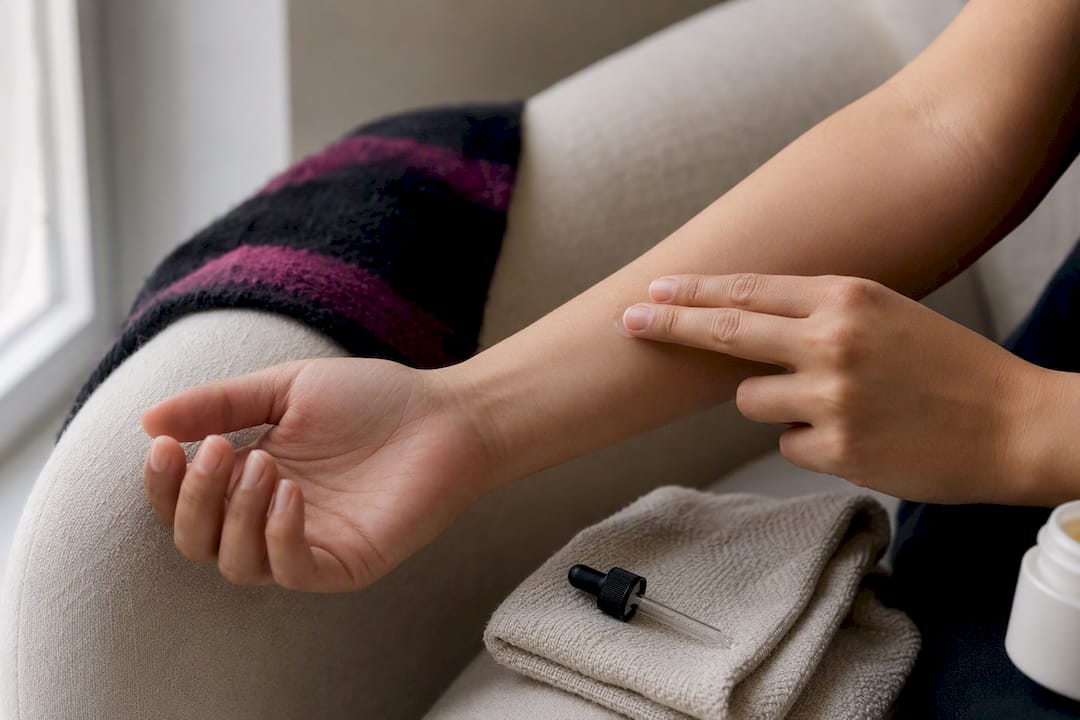
Test one new product at a time. If you introduce three items in the same week and react to something, you won’t know which one caused it, and you’ll end up cutting more from your routine than necessary. Space new introductions by at least a week when you can.
This applies even to products you’re switching to specifically because they’re marketed as pregnancy safe skincare options. “Pregnancy safe” describes the ingredient profile, not your individual skin’s reaction to it. A gentle, well-formulated moisturizer can still cause irritation on skin that’s more reactive than usual during this stage.
If a patch test comes back clean but you notice irritation once you start using the product on your face, stop and reassess rather than pushing through it hoping your skin will adjust. Pregnancy is not the moment to build tolerance to something that’s already bothering you.
The Real Priority Isn’t the Ingredient List
The conventional advice on pregnancy skincare spends most of its energy on what to avoid, and that’s useful, but it misses the bigger issue: most people either panic and strip their routine down to nothing, or ignore the guidance entirely and change nothing. Neither serves you well.
What the evidence actually supports is a targeted swap, not a teardown. Pull the handful of high-risk ingredients, keep everything else that was working, and lean harder on sunscreen than any other single product in your routine. Melasma prevention has more supporting evidence behind daily mineral SPF than behind any brightening serum on the market, and that’s the one habit worth treating as non-negotiable.
Where people get into trouble is self-diagnosing prescription decisions. Swapping your retinoid for azelaic acid is a reasonable move to make on your own. Deciding to stop a prescription antibiotic or antihypertensive without talking to your provider is not the same category of decision, even though both involve a product label. Know the difference, and call your clinician when a choice crosses from cosmetic into medical.
— Rao Dermatology
How Rao Dermatology Can Help With Pregnancy Skincare Concerns
If you’re staring at a bathroom shelf full of products and can’t tell what’s safe to keep, that’s exactly the kind of question worth bringing to a dermatologist instead of sorting out alone. Medical dermatology consultations for pregnancy-related skin concerns, from melasma and acne flares to persistent rashes, with coordination available with your OB when a prescription needs adjusting.

Both telehealth and in-person visits are available across multiple dermatology locations in various states, so you can get a professional read on your routine without an unnecessary trip to the office. Treatment plans are personalized around your specific skin, your trimester, and your existing prescriptions rather than a generic checklist. Explore the full range of medical dermatology services available, or if your concern leans cosmetic and can wait until after delivery, review the cosmetic services page to plan ahead. For a professional opinion on your current routine, consider booking a consultation and bring your product labels with you.
Authoritative Resources to Learn More
- FDA consumer guidance on cosmetics and pregnancy
- ACOG FAQ on skin conditions during pregnancy
- NCBI review of OTC topical acne treatments in pregnancy
This article is general information, not a substitute for advice from a qualified doctor. Consult a qualified healthcare professional about your own circumstances before acting on anything here.
Sources
- Skin conditions during pregnancy | ACOG
- Does FDA approve cosmetics before they go on the market? | FDA
- Exposure to Over-the-Counter Topical Acne Treatments in Pregnancy and While Breastfeeding | NCBI Bookshelf
- Narrative Review of Skin and Pregnancy: Dermatologic Manifestations and Medication Management During Pregnancy | Dermatology and Therapy
- Skin conditions during pregnancy | AAFP
FAQ
What Skincare Should I Avoid During Pregnancy?
Avoid topical retinoids like tretinoin and adapalene, hydroquinone, and any oral isotretinoin. Prescription drugs like spironolactone, oral tetracyclines, and finasteride also need a check with your provider before you continue them, per ACOG guidance.
How Do I Know if My Skincare Is Safe for Pregnancy?
Check the ingredient list on the back of the bottle against known problem ingredients, since the FDA doesn’t require pre-market approval of cosmetics and the safety burden sits with manufacturers, not regulators. Bring anything you’re unsure about to your OB or a dermatologist for a direct review.
Is Vitamin C Serum Safe to Use During Pregnancy?
Yes, vitamin C is generally considered one of the safer antioxidant actives to use during pregnancy and pairs well with a morning routine that ends in sunscreen. It’s a reasonable substitute for retinoids if you’re looking for a brightening or antioxidant effect without the pregnancy caution.
Is Any Skincare Product Automatically Safe During Pregnancy?
No product is universally safe just because it’s marketed as pregnancy safe skincare. Ingredient profile matters more than branding, and patch testing still applies since pregnant skin can react differently than it did before, even to gentle formulas.
When Should I See a Dermatologist About My Skincare During Pregnancy?
See a dermatologist if you’re dealing with severe or scarring acne, melasma that keeps spreading despite consistent sunscreen use, or a new rash that isn’t improving with basic fragrance-free care. Rao Dermatology offers consultations that coordinate directly with your OB when a prescription change is on the table.
Recommended
Filed under: