
Pair the ABCDE checklist with monthly photo checks and 4–12 week rechecks to catch changing moles early. See a dermatologist promptly for evolving spots.

Use the ABCDE rule as a monthly checklist for asymmetry, border irregularity, color variation, diameter over 6 millimeters, and evolving change, and see a dermatologist right away for any spot that fits. The stakes are real: melanoma caught at the localized stage has a 5-year relative survival rate near 100%, compared with far worse odds once it spreads.
TL;DR:
- Spots smaller than 6 millimeters can still be melanoma, especially if they are rapidly changing or new, so size alone should not determine concern.
- The evolving nature of a mole or spot is the most significant clinical signal, often warranting immediate professional evaluation regardless of other features.
- Melanomas like amelanotic, acral, and mucosal types often do not fit classic ABCDE rules, making the ugly duckling sign and specialist assessment crucial.
- Regular monthly self-exams with photographic records help detect subtle changes over time, providing better context than single-visit checks.
- Immediate dermatologist consultation is necessary if a spot bleeds spontaneously, refuses to heal, or shows rapid size, shape, or color changes.
Table of Contents
- What Each Letter Of ABCDE Melanoma Screening Actually Means
- How To Do A Full Monthly Skin Self-Exam
- Spots That Don’t Fit The Pattern: Ugly Ducklings And Hidden Melanomas
- When To See A Dermatologist And What Happens Next
- Behind This Guidance: Rao Dermatology’s Approach To Early Detection
- What The Research Actually Tells Us About Self-Exams
- Ready For A Professional Skin Check? Here’s How Rao Dermatology Helps
- Sources
- FAQ
What Each Letter Of ABCDE Melanoma Screening Actually Means
The ABCDE rule works because melanoma tends to break the rules that normal moles follow. A healthy mole is round, one shade of brown, and stays put for years. A melanoma usually violates at least one of those expectations, and often several at once.
Here’s what to actually look for on your own skin:
- Asymmetry: draw an imaginary line through the middle of the spot. If one half doesn’t match the other in shape or size, that’s a flag. Most benign moles are close to symmetrical.
- Border: look for ragged, notched, or blurred edges, as if pigment is bleeding into the surrounding skin. Clean, smooth borders are far more reassuring than jagged ones.
- Color: watch for more than one shade in a single spot, tan, dark brown, black, red, or even white or blue mixed together. Some aggressive melanomas lose pigment entirely and show up pink or flesh-colored, which is why “no brown color” doesn’t mean “safe.”
- Diameter: the common benchmark is 6 millimeters, roughly the size of a pencil eraser. That said, a meaningful share of melanomas are diagnosed smaller than that, so diameter alone should never rule a spot out.
- Evolving: any change in size, shape, color, or elevation over weeks or months, plus new symptoms like bleeding, crusting, or itching.
Pro Tip: Don’t treat the “D” as a hard cutoff. If a small spot is changing fast, the change matters more than the ruler.
Among the five letters, evolving carries the most clinical weight. The CDC lists changing size, shape, or color as one of the clearest signals that a spot needs a professional look, regardless of how it scores on the other four.
How To Do A Full Monthly Skin Self-Exam
A self-exam only works if you actually repeat it the same way every time, so consistency matters more than intensity. The American Cancer Society recommends monthly checks using a well-lit room, a full-length mirror, and a hand mirror for spots you can’t see directly.
Here’s a routine that covers the whole body without missing the areas people forget:
- Pick a fixed day each month (the first Sunday, or the day you pay bills) so it becomes automatic.
- Start at your face and scalp, parting hair in sections or using a blow-dryer on cool to check the skin underneath.
- Move to neck, chest, and torso, lifting breasts if needed to check the skin beneath.
- Check arms, both sides, then hands, palms, and the spaces between fingers.
- Turn to a full-length mirror for your back and buttocks, using a hand mirror or a partner for spots you can’t twist to see.
- Sit down to inspect legs, then soles of the feet, the spaces between toes, and toenails.
- Finish with a quick check of the groin and, for a thorough exam, mucosal areas like the inside of the mouth.
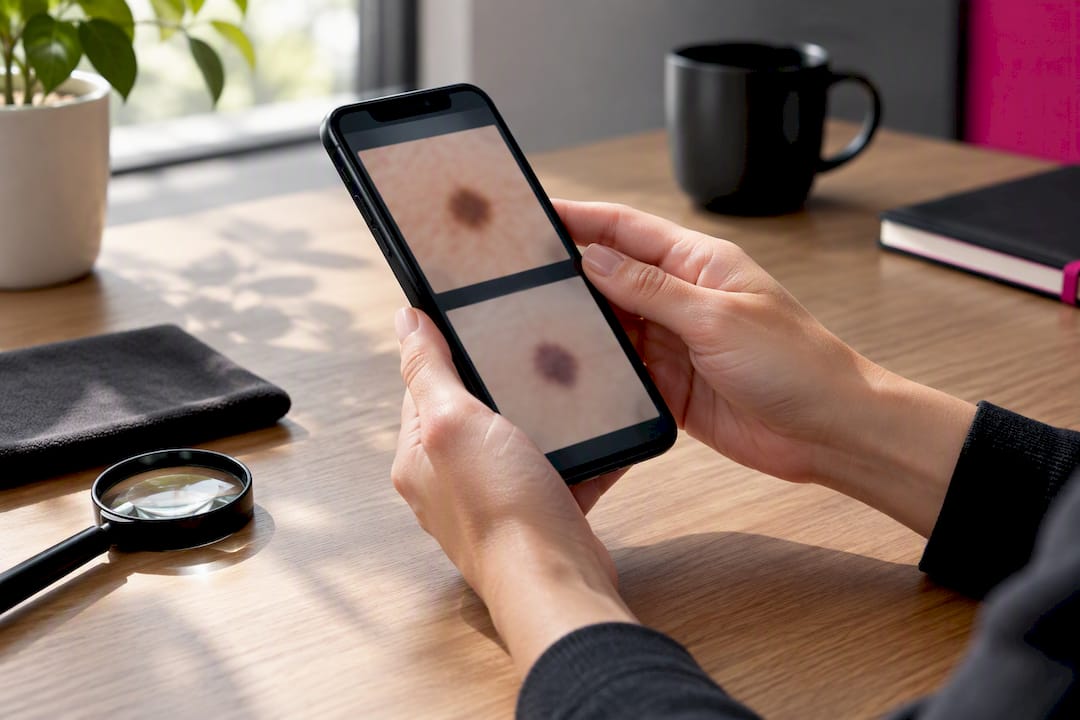
Photograph anything questionable with a ruler or coin next to it for scale, date the image, and recheck in 4 to 12 weeks if a spot seems borderline rather than obviously urgent. A step-by-step self-check guide can help you build a consistent record over time.
Contact a clinician immediately, without waiting for the next monthly check, if a spot starts bleeding on its own, won’t heal after several weeks, or changes noticeably in a matter of days rather than months.
Spots That Don’t Fit The Pattern: Ugly Ducklings And Hidden Melanomas
Not every melanoma checks every ABCDE box, and relying on the rule too rigidly is one of the most common self-exam mistakes. Clinicians often use a simpler heuristic instead: the ugly duckling sign, meaning a mole that just looks different from every other mole on your body, even if it can’t tell you exactly why.
A few atypical presentations deserve extra attention precisely because they slip past a checklist built for the classic case:
- Amelanotic melanoma carries little or no pigment and can look pink, red, or skin-colored, which makes the “color variation” rule almost useless for spotting it.
- Acral melanoma shows up on palms, soles, or under nails, sites people rarely inspect closely and doctors sometimes miss on a quick skin check.
- Mucosal melanoma develops inside the mouth, nose, or genital area and is often nonpigmented, so any new or changing lesion there warrants a specialist opinion, not a wait-and-see approach.
For a visual reference beyond written descriptions, the NCI’s Moles to Melanoma image tool walks through real comparison photos organized by ABCDE feature, which is far more useful than trying to picture “irregular border” from a text description alone.
When To See A Dermatologist And What Happens Next
Some findings need same-week evaluation, not a wait-and-see approach: rapid growth over days rather than months, spontaneous bleeding, a sore that won’t heal, or a new dark streak under a nail. Anything less urgent but still ABCDE-positive still deserves a scheduled appointment rather than months of watching.
At the visit, expect a full-body skin exam, often paired with dermoscopy, a handheld magnified light exam that lets a clinician see pigment patterns invisible to the naked eye. If a spot looks suspicious, a biopsy is the only way to confirm melanoma; clinical review also finds that clinician-detected melanomas tend to be diagnosed thinner than those a patient notices alone, largely because trained eyes catch subtler changes.
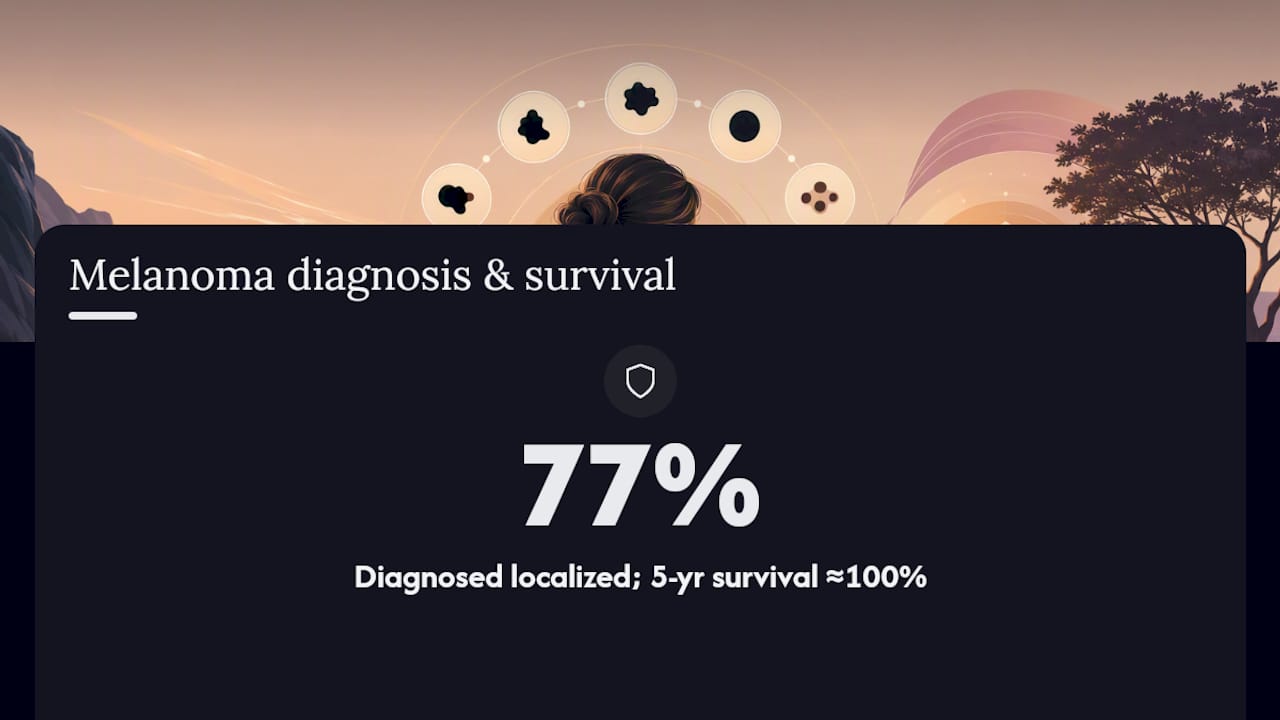
That thinness matters enormously for prognosis. SEER data show roughly 77% of melanomas are caught at the localized stage, where 5-year survival is close to 100%, versus a steep drop once the disease reaches distant sites.
Bring dated photos of anything you’ve been tracking, note when you first noticed the spot, and mention any personal or family history of skin cancer. A dermatologist can also explain what typically happens after a suspicious finding, including follow-up photo tracking for borderline spots.
Behind This Guidance: Rao Dermatology’s Approach To Early Detection
The practice brings extensive dermatology experience with providers who screen for melanoma using tools like confocal microscopy alongside standard skin exams. The practice’s skin cancer prevention, detection, and treatment services cover everything from routine screening to Mohs surgery for confirmed cases. Patients tracking a changing mole are often advised to schedule photo-documented rechecks in the 4 to 12 week range rather than guessing at whether a spot has actually changed.
What The Research Actually Tells Us About Self-Exams
The honest takeaway from the evidence is that ABCDE works best as a filter, not a diagnosis. It’s excellent at flagging which spots deserve a second look and terrible at ruling melanoma out, especially for amelanotic, acral, or mucosal cases that never fit the classic pattern.
The conventional advice oversells the diameter rule. People treat 6 millimeters as a threshold, when the data actually shows plenty of melanomas get caught smaller than that. The letter that deserves more attention than it gets is evolving: change over time is a stronger signal than any single snapshot, which is exactly why dated photos matter more than most self-exam guides admit.
If you take one thing from this article, prioritize consistency over thoroughness. A monthly five-minute check with a phone photo beats an occasional deep inspection you do twice a year and then forget about. Pair that habit with a professional exam when something looks off, and you’re covering both blind spots at once.
— Rao Dermatology
Ready For A Professional Skin Check? Here’s How Rao Dermatology Helps
Rao Dermatology gives you what a self-exam can’t: a trained eye, dermoscopy, and access to biopsy and treatment in one place if a spot turns out to be more than a false alarm.

If you’ve found a spot that’s changed, grown, or just looks different from everything else on your skin, bring dated photos and a rough timeline of when you first noticed it. That information helps a clinician judge whether a spot needs biopsy or just a scheduled recheck. Rao Dermatology’s skin cancer prevention, detection, and treatment services cover full-body screening, confocal microscopy, and Mohs surgery for confirmed cases across its California, New Jersey, and New York locations. Don’t sit on an evolving mole waiting for your next annual physical. Schedule a skin check now and get a definitive answer instead of a guess.
Sources
- Melanoma Treatment (PDQ®) - NCI
- Melanoma of the Skin — SEER Stat Facts
- How to do skin self-exams — American Cancer Society
- Symptoms of Skin Cancer — CDC
This article is general information, not a substitute for advice from a qualified doctor. Consult a qualified healthcare professional about your own circumstances before acting on anything here.
FAQ
What does ABCDE stand for in melanoma screening?
ABCDE stands for Asymmetry, Border irregularity, Color variation, Diameter, and Evolving change. It’s a checklist for spotting moles that look different enough from normal skin lesions to warrant a professional look, with 6 millimeters as the common diameter benchmark.
Can a melanoma be smaller than 6 millimeters?
Yes. The 6 millimeter mark is a useful guideline, not a cutoff, and a meaningful number of melanomas are diagnosed smaller than that. Any spot that’s rapidly changing deserves evaluation regardless of size.
What is the “ugly duckling” sign?
It’s a mole that looks noticeably different from all your other moles, even if you can’t pin down exactly which ABCDE feature it violates. Clinicians use this heuristic to catch melanomas that don’t fit the classic checklist.
How often should I do a skin self-exam?
Once a month, using a well-lit room, a full-length mirror, and a hand mirror for hard-to-reach spots. The American Cancer Society’s guidance covers the full routine, including scalp, soles, and between the toes.
Does Rao Dermatology offer melanoma screening?
Yes. Rao Dermatology provides full-body skin cancer screening, confocal microscopy, and Mohs surgery through its medical dermatology services across California, New Jersey, and New York. Current pricing details are available directly through the practice.
Recommended
Filed under: