
A clinician-first guide to lasers for Fitzpatrick IV–VI skin: which wavelengths work, 48–72 hour patch testing, conservative settings, and pre/post care...
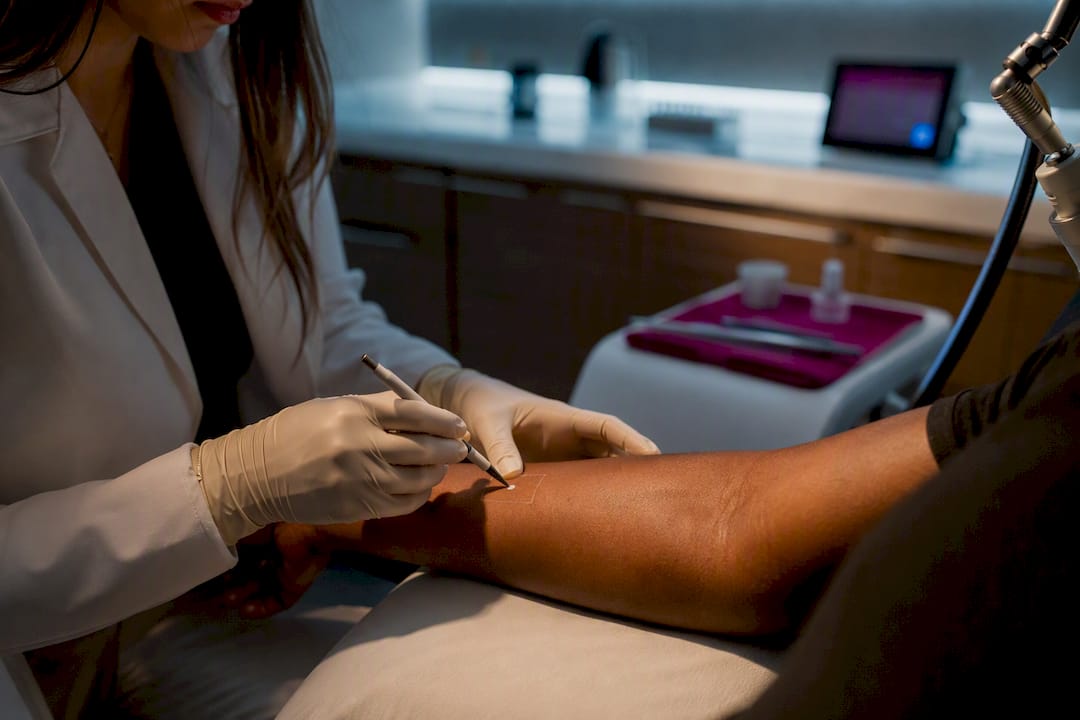
Yes, lasers can work safely on medium to dark skin, but the device matters as much as the diagnosis. Long-pulse 1064-nm Nd:YAG, picosecond lasers, and nonablative fractional devices are typically the safest choices for Fitzpatrick IV through VI skin, while traditional ablative CO2 resurfacing is usually avoided outside highly specialized centers. The deciding factor isn’t the machine itself. It’s a provider who patch-tests, uses conservative settings, and stages treatment over multiple sessions rather than chasing results in one pass.
TL;DR:
- Melanin absorbs shorter wavelengths, so long-pulse 1064-nm Nd:YAG, picosecond lasers, and nonablative fractional devices are safest for darker skin types.
- Proper operator judgment, conservative settings, patch testing, and staged treatments are key factors in ensuring safe laser procedures for Fitzpatrick IV through VI skin.
- Post-inflammatory hyperpigmentation is the most common complication in darker skin, but with proper prevention, it often resolves within weeks to months.
- Avoid aggressive ablative treatments like CO2 resurfacing unless performed at specialized centers with extensive experience in treating skin of color.
- Prioritize a provider’s familiarity with your skin tone and their testing protocol over the specific device brand when considering laser treatments.
Table of Contents
- Which Laser Types Work Best for Melanin-Rich Skin?
- Why Darker Skin Reacts Differently to Laser Energy
- How Providers Keep Laser Settings Safe for Darker Skin
- Building a Pre- and Post-Treatment Routine to Prevent PIH
- When to Avoid Lasers and What to Try Instead
- How Rao Dermatology Approaches Laser Safety for Darker Skin
- The Real Gap in This Conversation
- Ready for a Laser Consultation? Here’s What to Expect
- Sources
- FAQ
Which Laser Types Work Best for Melanin-Rich Skin?
Melanin absorbs light. That’s the whole problem in one sentence, and it’s why wavelength selection drives everything else in this article. Shorter wavelengths get soaked up by pigment in the epidermis before they ever reach their target, which means more heat, more collateral damage, and higher odds of a burn or a pigment change. Longer wavelengths bypass more of that surface melanin and penetrate deeper with less absorption by epidermal melanin, which is the physics behind nearly every safety recommendation for darker skin.
Three categories come up again and again in clinical guidance:
- Long-pulse 1064-nm Nd:YAG. The workhorse for hair removal and vascular lesions in deeper skin tones, largely because its wavelength slides past epidermal melanin instead of colliding with it.
- Picosecond lasers. These fire ultra-short pulses that shatter pigment and tattoo ink through a photoacoustic effect rather than a purely thermal one, which tends to spare surrounding tissue better than older pigment lasers.
- Nonablative fractional lasers, including 1550 nm and 1927 nm devices. These treat only a fraction of the skin’s surface per pass, leaving the epidermis largely intact, which is why nonablative fractional resurfacing carries a lower PIH risk than full-surface treatments.
None of these devices is automatically safe just because it’s the “right category.” Settings, pulse duration, and operator judgment still decide the outcome. A skilled provider using an older platform conservatively will often outperform an inexperienced one running the newest device at aggressive parameters.
Why Darker Skin Reacts Differently to Laser Energy
Postinflammatory hyperpigmentation, or PIH, is the complication you’ll hear about most, and it shows up more often in Fitzpatrick IV to VI skin because melanocytes in deeper skin tones respond to inflammation by overproducing pigment. Heat or trauma from a laser can trigger that response even when the treatment goes as planned.
The trials backing this aren’t small. A network meta-analysis of PIH interventions found that topical corticosteroids, intradermal tranexamic acid, oral TXA, and epidermal cooling all reduced PIH incidence compared with sunscreen alone.
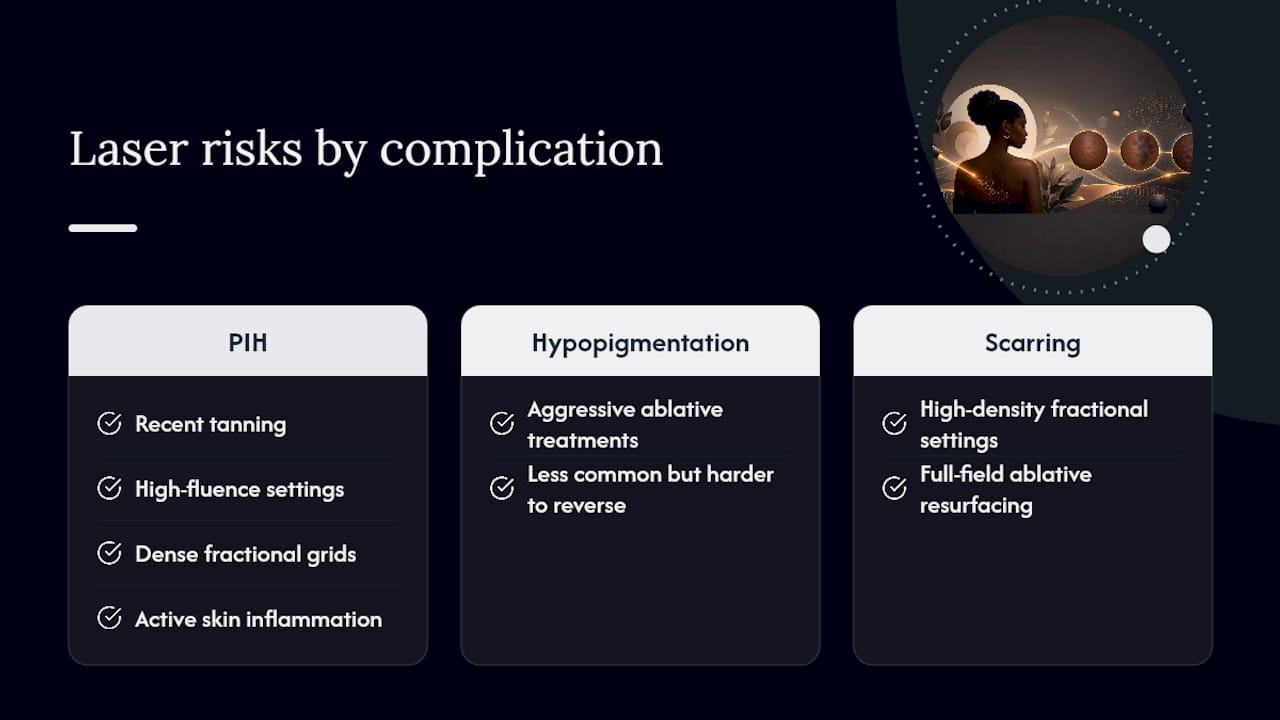
Risk climbs with recent tanning, high fluence settings, dense fractional treatment grids, active skin inflammation, and, frankly, an operator who hasn’t treated much skin of color. PIH is usually reversible over weeks to months with the right topical regimen. Hypopigmentation, a loss of pigment rather than an excess of it, is less common but harder to reverse, and is the complication most associated with aggressive ablative treatments. Scarring is rare with modern nonablative devices but remains a real risk with high-density fractional settings or full-field ablative resurfacing.
How Providers Keep Laser Settings Safe for Darker Skin
A provider who treats skin of color regularly follows a fairly consistent playbook before touching the laser to your skin.
- Assess your Fitzpatrick type and history. This includes past pigment problems, recent isotretinoin use, and any active dermatitis.
- Choose conservative parameters. Lower fluence, longer pulse duration, larger spot sizes, and lower treatment density for fractional devices all reduce epidermal heating.
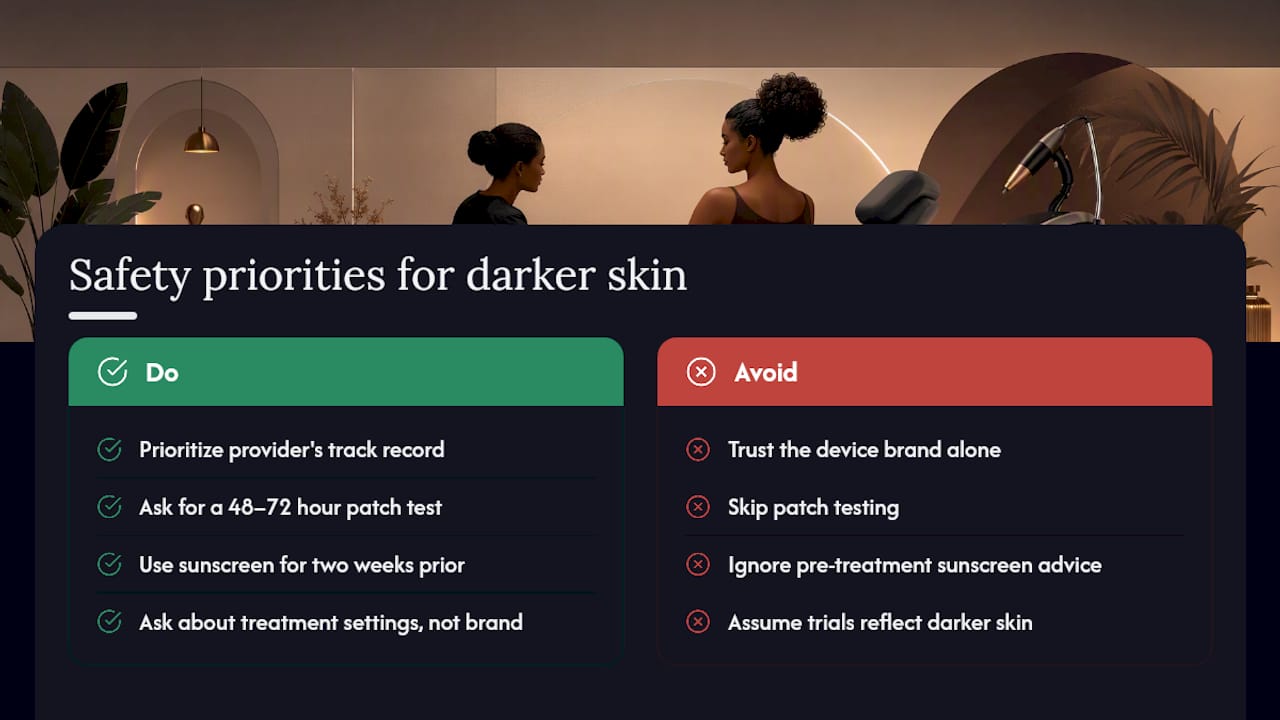
- Run a patch test first. A single test pulse goes on an inconspicuous area, and you wait 48 to 72 hours to check for delayed pigment changes or blistering before committing to full treatment.
- Use cooling and stage the sessions. Multiple lower-intensity treatments spaced weeks apart consistently outperform one aggressive session for both safety and results.
Pro Tip: Ask your provider directly how many patients with your skin tone they treat in an average month. A confident, specific answer tells you more than any marketing page.
Building a Pre- and Post-Treatment Routine to Prevent PIH
The single best strategy for avoiding PIH is preventing it before it starts, not treating it after the fact. That means the two weeks before your appointment matter almost as much as the appointment itself.
- Two or more weeks before treatment: strict SPF 50+ daily, no tanning, and, if your provider recommends it, a topical melanogenesis inhibitor. A common protocol uses 4% hydroquinone starting two weeks before treatment and continuing for three to four weeks afterward, always under dermatologist supervision.
- During the procedure: epidermal cooling and lower-density fractional passes reduce thermal injury to surrounding skin.
- After treatment: daily sunscreen, a gentle cleanser and moisturizer, and avoiding exfoliants or retinoids until your provider clears you. Some fractional protocols add a short course of topical corticosteroid.
Expect visible improvement to build over several weeks, not overnight, and know that starting prevention before the laser touches your skin beats trying to treat pigment change after it appears.
When to Avoid Lasers and What to Try Instead
Traditional ablative CO2 resurfacing strips the epidermis entirely, and in Fitzpatrick IV to VI skin, that comes with meaningfully higher rates of dyspigmentation and scarring unless it’s performed by a center with deep, specific experience in skin of color. For most patients, it’s not the first option, and often not an option at all.
Treatment should also wait if you’ve had recent significant sun exposure, an active skin infection or inflammatory flare, or isotretinoin use within your provider’s recommended window.
For pigment or texture concerns, non-laser routes are worth discussing before or alongside laser therapy:
- Low-strength chemical peels performed under professional supervision
- Microneedling, done by a dermatologist or trained esthetician
- Targeted topical regimens for hyperpigmentation
- Staged, conservative nonablative laser sessions rather than a single aggressive treatment
How Rao Dermatology Approaches Laser Safety for Darker Skin
A dermatology practice with experienced leadership treats a wide range of skin tones daily. That volume matters in this specialty, since device selection alone doesn’t guarantee a safe outcome; operator judgment does.
Patients evaluated for laser treatment can expect a Fitzpatrick skin assessment, a test spot before full treatment, parameters adjusted to their specific skin tone and history, and a pre- and post-treatment plan built around minimizing pigment risk. Readers who want more background before a consultation can review Rao Dermatology’s patient guide to lasers or the practice’s breakdown of fractional laser treatment.
The Real Gap in This Conversation
Most advice about laser treatment for darker skin focuses on which device to pick, as if the machine were the whole story. It isn’t. The research on skin of color is thinner than it should be, partly because darker-skinned patients remain underrepresented in device trials, which means a lot of what works in practice comes from experienced clinicians layering caution on top of imperfect data rather than from a stack of large randomized trials.
That’s not a reason to avoid lasers. It’s a reason to be skeptical of any provider who treats device choice as the whole safety plan. The conventional wisdom oversells the “right laser” and undersells the test spot, the 48 to 72 hour wait, and the unglamorous discipline of sunscreen for two weeks before an appointment. If you take one thing from this article, prioritize the provider’s track record with your skin tone over the brand name on the machine in the room. Ask about patch testing before you ask about the device. The settings someone chooses for you matter more than what’s printed on the equipment.
— Rao Dermatology
Ready for a Laser Consultation? Here’s What to Expect
If you’re weighing laser treatment for pigment, scarring, or hair removal and want a plan built around your specific skin tone, a consultation is the practical next step rather than researching devices on your own indefinitely. Rao Dermatology’s cosmetic dermatology team evaluates candidacy with a Fitzpatrick assessment and test spot before recommending settings, so you’re not guessing which device category applies to you.

The practice’s cosmetic dermatology services cover laser procedures alongside the pre- and post-treatment planning that actually determines whether you end up with clear results or a pigment problem to manage afterward. If a laser turns out not to be the right fit for your skin at this time, the esthetic services team can walk through peel or microneedling alternatives instead. Schedule a consultation with Rao Dermatology to get a personalized assessment before your next appointment.
This article is general information, not a substitute for advice from a qualified doctor. Consult a qualified healthcare professional about your own circumstances before acting on anything here.
Sources
- Recommendations from Cosmetic Surgeons About Lasers for People of Color
- Laser therapy in skin of colour — StatPearls / NCBI Bookshelf
- Review: Cosmetic procedures and nonablative resurfacing in skin of color (PMC article)
FAQ
What Type of Laser Is Best for Dark Skin?
Long-pulse 1064-nm Nd:YAG, picosecond devices, and nonablative fractional lasers such as 1550 nm and 1927 nm are typically the safest choices, since their wavelengths and delivery methods reduce absorption by epidermal melanin.
Can You Get Laser Treatment If You Have Dark Skin?
Yes. Laser treatment can be safe and effective for Fitzpatrick IV through VI skin when a provider uses conservative settings, patch tests first, and follows a proper pre- and post-treatment regimen.
Is CO2 Laser Good for African American Skin?
Traditional ablative CO2 laser resurfacing carries a higher risk of pigment changes and scarring in darker skin and is generally avoided unless performed by a center with specific, extensive experience treating skin of color.
Is a Nonablative Fractional Laser Safe for Dark Skin?
Nonablative fractional lasers are generally considered a safer option for darker skin because they spare much of the epidermis, though results still depend heavily on conservative density and fluence settings.
Recommended
Filed under: