
Discover the best esthetic devices for dermatologists in 2026. Learn how to enhance treatments with effective tools for diverse skin concerns.
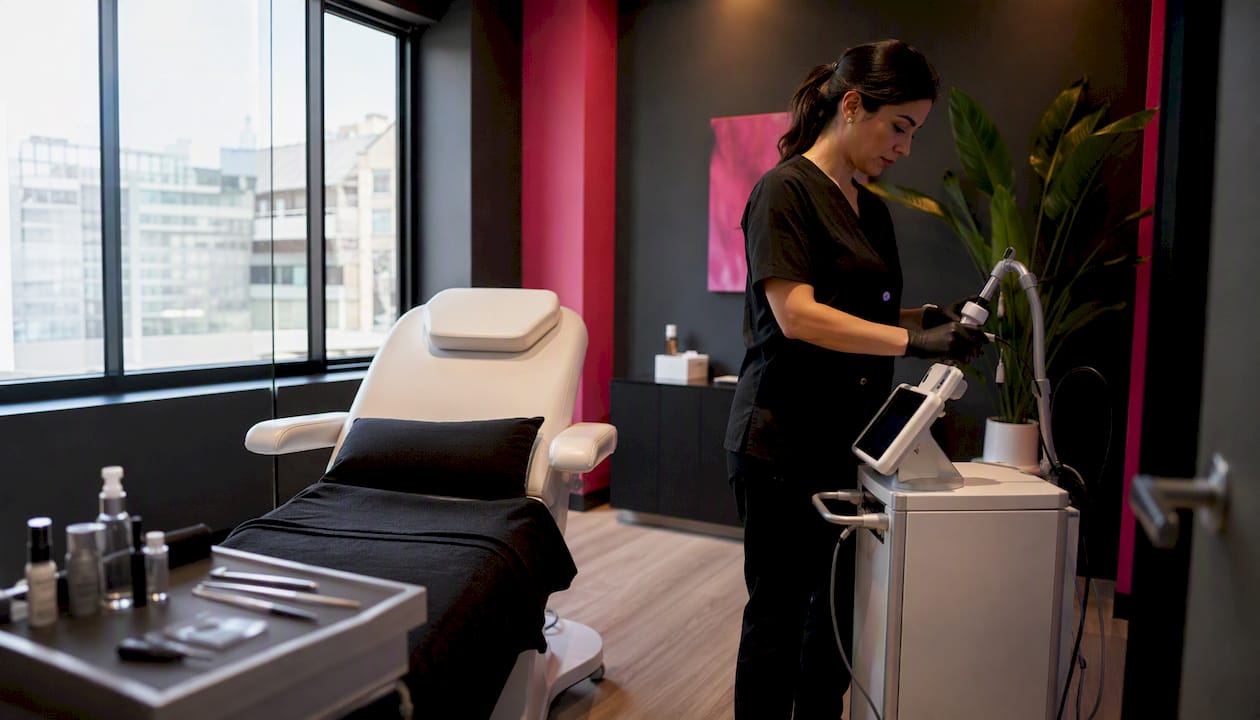
Dermatology practices rely on ten core device categories for in-office esthetic treatments: medical lasers, fractional lasers, picosecond lasers, IPL/BBL, RF microneedling, HIFU/MFU, medical LED/phototherapy, hair-removal lasers, microdermabrasion/dermabrasion, and cryotherapy. Each targets a distinct clinical problem, and top practices build a multimodal arsenal because no single device covers every patient need.
- Medical lasers (CO2, Er:YAG, Nd:YAG, PDL): Ablative resurfacing, vascular lesions, pigment correction
- Fractional lasers: Collagen remodeling with reduced downtime via microthermal treatment zones
- Picosecond lasers: Tattoo removal and pigmented lesion clearance with ultrashort pulses
- IPL/BBL: Broad-spectrum light for sun damage, rosacea, and hair reduction
- RF microneedling: Skin tightening and texture improvement; chromophore-independent, safe across all Fitzpatrick types
- HIFU/MFU: Focused ultrasound targeting SMAS at 1.5–4.5 mm depth for lifting
- Medical LED/phototherapy: Clinician-grade panels for acne, wound healing, and psoriasis management
- Hair-removal lasers (alexandrite, diode, Nd:YAG): Long-term follicle reduction across skin types
- Microdermabrasion/dermabrasion: Mechanical exfoliation for texture, mild scarring, and superficial pigment
- Cryotherapy: Targeted tissue destruction for warts, AKs, and benign lesions
| Category | Primary indications | Typical downtime | Practice fit |
|---|---|---|---|
| Ablative CO2/Er:YAG laser | Deep wrinkles, scars, resurfacing | 7–14 days | Low throughput, high revenue/session |
| Fractional non-ablative laser | Texture, fine lines, mild scars | 1–3 days | Moderate throughput |
| Picosecond laser | Tattoo removal, pigment | Minimal | High throughput |
| IPL/BBL | Sun damage, rosacea, hair | Minimal | High throughput |
| RF microneedling | Tightening, acne scars | 2–5 days | Moderate throughput |
| HIFU/MFU | Lifting, SMAS stimulation | None–1 day | Moderate throughput |
| Medical LED/phototherapy | Acne, inflammation, wound healing | None | High throughput |
| Hair-removal laser | Follicle reduction | Minimal | High throughput |
| Microdermabrasion | Texture, superficial pigment | None | High throughput |
| Cryotherapy | AKs, warts, benign lesions | 1–7 days | High throughput |
Table of Contents
- How much do esthetic devices cost, and what’s the ROI timeline?
- How do devices fit into multimodal treatment plans?
- What should you check before choosing a vendor?
- When do patients see results, and what are the contraindications?
- How does device data connect to your EMR and practice software?
- What training and certification do device operators need?
- How should you educate patients about device-based treatments?
- What are the legal and insurance considerations for device use?
- Key Takeaways
- The device arms race misses the point
- Raodermatology offers clinician-led esthetic care across three states
- Useful sources and further reading
- FAQ
How much do esthetic devices cost, and what’s the ROI timeline?
Device prices span a wide range. Entry-level IPL and microdermabrasion units start around $10,000–$30,000. Mid-tier RF microneedling and fractional laser systems typically run $50,000–$150,000. Premium ablative CO2 platforms and HIFU systems can exceed $150,000–$200,000.
Leasing spreads capital outlay over 36–60 months and preserves cash flow, which matters when a practice is adding a second device category. Buying outright costs less over time but ties up capital. Many vendors offer hybrid arrangements: a lower purchase price with a mandatory service contract.
Consumables are the hidden cost. RF microneedling tips, fractional laser handpiece replacements, and IPL filters add $20–$100 per treatment depending on the platform. Factor those in before comparing sticker prices.
ROI modeling should account for revenue per treatment, sessions per patient, consumable cost per session, and service contract amortization. Many clinics recoup device cost within a few years when throughput and marketing are optimized. A device that books four treatments per day at $400 each generates $1,600 daily — the math changes fast once the room is consistently scheduled.
How do devices fit into multimodal treatment plans?
No device works in isolation. The most effective protocols layer energy-based treatments with topicals, injectables, and chemical peels because each modality addresses a different skin layer or mechanism.
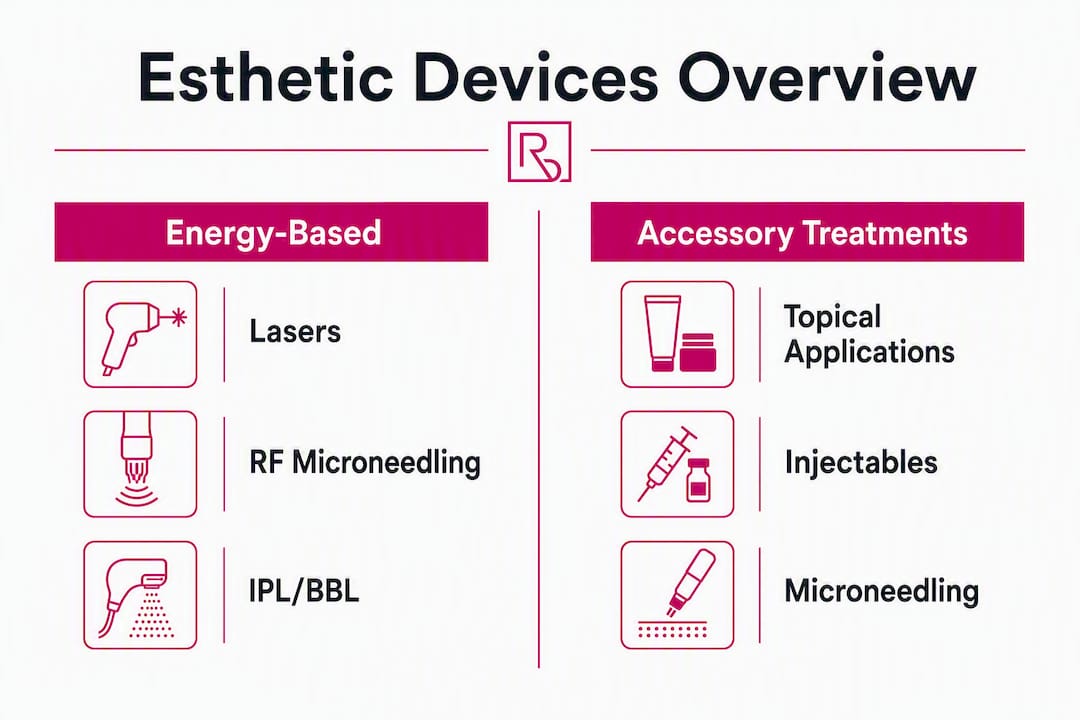
A common sequence: a fractional laser session to stimulate collagen, followed by a medical-grade retinoid or growth-factor serum to accelerate remodeling. Botulinum toxin addresses dynamic lines that no resurfacing device can fix. A personalized, multimodal approach consistently outperforms single-modality treatment for complex presentations like melasma or post-acne scarring.
RF microneedling pairs well with PRP or topical peptides applied immediately post-treatment, when the microchannels are open. IPL and PDL vascular treatments are often sequenced before injectable fillers — treating the skin surface first, then restoring volume. The sequencing matters: ablative resurfacing and injectables should be spaced by at least two weeks to avoid compromised healing.
Pro Tip: Map each patient’s Fitzpatrick type and primary concern before selecting a device sequence. Darker skin types often respond better to RF microneedling or Nd:YAG than to ablative or short-wavelength lasers.
What should you check before choosing a vendor?
The demo is where vendors are separated from partners. Before committing to any platform, run through this checklist:
- FDA clearance: Confirm the device holds a 510(k) clearance or PMA for the specific indications you plan to treat — not just a general clearance.
- Peer-reviewed evidence: Ask for published clinical studies, not just manufacturer white papers. Systematic reviews carry more weight than single-center case series.
- Peer references: Request contact information for two or three practices of similar size and patient mix that have used the device for at least 12 months.
- Training program: Confirm the vendor provides hands-on, in-office proctoring — not just a one-day course. Ask who delivers it and how many sessions are included.
- Service contract terms: Clarify response time for repairs, loaner device availability, and what consumables are covered.
- Before/after photo libraries: Documented outcomes from real patients treated on that specific platform, not stock photography.
Major manufacturers each bring a distinct profile. Candela’s Vbeam PDL family leads for vascular lesion treatment, with cryogen-based epidermal cooling and a long clinical track record. Cutera’s excel V+ offers dual-wavelength versatility across vascular and pigmented indications, with large spot sizes that support throughput. Lumenis covers a broad multi-indication portfolio spanning lasers and light-based systems. Cynosure brings a diverse range including hair removal, resurfacing, and vascular platforms. Lutronic focuses on fractional and picosecond options for rejuvenation and pigment/tattoo removal. Solta Medical’s Fraxel is the established name in non-ablative fractional resurfacing with documented evidence for texture and scar improvement. Alma Lasers offers modular platforms combining light and RF technologies. Sciton’s platform family supports premium ablative and hybrid resurfacing configurations.
When do patients see results, and what are the contraindications?
Timeline varies sharply by modality. IPL sun-damage clearance often shows in 2–4 weeks after a single session. Fractional laser collagen remodeling takes 3–6 months to peak, with most patients needing 3–5 sessions. RF microneedling tightening follows a similar arc. HIFU/MFU lifting effects typically appear over 2–3 months as collagen contracts and rebuilds. Ablative CO2 resurfacing delivers the most dramatic results but requires 7–14 days of social downtime and full results at 3–6 months.
Common contraindications across device categories include active infection at the treatment site, isotretinoin use within 6 months (for ablative and fractional procedures), pregnancy, photosensitizing medications, and uncontrolled autoimmune conditions. Darker Fitzpatrick skin types (IV–VI) require careful parameter selection — longer wavelengths, lower fluences, and test spots — to reduce the risk of post-inflammatory hyperpigmentation or hypopigmentation.
This article provides general clinical information, not medical advice. Patients should consult a board-certified dermatologist, and clinics should verify current FDA clearance and state medical-board requirements before purchasing or operating any device.
How does device data connect to your EMR and practice software?
Most modern esthetic devices do not natively integrate with EMR platforms like Epic, Athenahealth, or Modernizing Medicine’s EMA. The practical solution is a documented workflow: treatment parameters, session notes, and before/after photos are entered manually or via a connected tablet into the patient’s chart immediately after each session.

Some practice management platforms designed for aesthetic medicine — Nextech, PatientNow, and Aesthetic Record among them — offer photo documentation modules and treatment history tracking that sit alongside scheduling and billing. These are worth evaluating alongside any device purchase, because a device that generates no structured outcome data is a missed opportunity for both clinical quality review and marketing.
HIPAA compliance applies to any before/after photos stored digitally. Obtain written authorization before capturing images, store them in an encrypted system, and confirm your vendor’s software meets HIPAA requirements before connecting any device-linked tablet to your network.
What training and certification do device operators need?
FDA clearance defines what a device is cleared to do — it does not specify who can operate it. That is governed by state medical-board rules, which vary significantly. In most states, licensed physicians, nurse practitioners, and physician assistants may operate Class III and Class IV laser devices. Some states require a designated Laser Safety Officer (LSO) on staff. A handful require the supervising physician to be on-site during treatments.
Manufacturer training programs are the baseline. Most major vendors — Candela, Cutera, Cynosure, Sciton, and others — offer structured clinical training that includes device physics, parameter selection, patient assessment, and adverse-event management. In-office proctoring, where a clinical trainer observes the first several live treatments, is the standard that separates adequate training from genuinely safe onboarding.
Beyond manufacturer programs, the American Society for Laser Medicine and Surgery (ASLMS) offers courses and a Laser Safety Officer certification pathway. The American Board of Laser Surgery provides additional credentialing options. Staying current with dermatology best practices — including device-specific updates — is an ongoing obligation, not a one-time box to check.
How should you educate patients about device-based treatments?
Patients who understand what a device does — and what it does not do — are more satisfied and more compliant with post-treatment protocols. The consultation is where that education happens.
Cover four things in every device consultation: what the treatment targets and how it works in plain language, realistic outcome expectations with a specific timeline, downtime and aftercare requirements, and the number of sessions typically needed. Show before/after photos from your own patient population, not manufacturer stock images. That specificity builds trust.
Written consent forms should describe the device, the cleared indication, the risks specific to the patient’s skin type, and the alternatives considered. For patients with Fitzpatrick IV–VI skin, document the parameter rationale and the test-spot plan. The AAD notes that clinician-grade LED and phototherapy used alongside tailored medical plans produces results that at-home devices cannot match — that distinction is worth making explicit to patients who arrive having tried consumer devices.
What are the legal and insurance considerations for device use?
Malpractice coverage for esthetic device procedures is not automatic. Many general medical malpractice policies exclude cosmetic procedures or require a rider for laser and energy-based treatments. Confirm your policy covers the specific devices and indications you offer before the first treatment.
Product liability sits with the manufacturer for FDA-cleared devices used within cleared indications. Operating a device off-label — treating an indication not listed in the clearance — shifts liability exposure to the practice. Document the clinical rationale for any off-label use in the patient chart.
State regulations add another layer. Some states classify laser operation as the practice of medicine; others permit delegation to licensed aestheticians or nurses under physician supervision. The supervising physician’s liability does not disappear under delegation — it expands. Consult your state medical board and a healthcare attorney before building a delegation protocol.
Key Takeaways
Medical-grade esthetic devices require FDA clearance, peer-reviewed evidence, hands-on training, and a clear ROI model before any practice should commit to a purchase.
| Point | Details |
|---|---|
| Device categories matter | Ten core categories cover the full range of esthetic indications; no single device replaces a curated multimodal set. |
| ROI timeline is predictable | Clinics typically recoup device costs within 18–36 months when throughput and marketing are optimized. |
| Skin-type safety is non-negotiable | Fitzpatrick IV–VI patients need longer wavelengths, lower fluences, and documented test-spot protocols to avoid pigmentary complications. |
| Training goes beyond the manual | Manufacturer in-office proctoring and state laser-safety officer requirements are the minimum standard for safe device operation. |
| Raodermatology’s approach | Raodermatology integrates clinician-led, multimodal esthetic protocols across California, New Jersey, and New York — matching device choice to patient mix and skin type. |
The device arms race misses the point
The conversation around esthetic devices in dermatology has drifted toward a technology competition — which platform has the newest wavelength, the largest spot size, the most impressive before/after gallery. That framing serves manufacturers more than patients.
What actually determines outcomes is the clinical judgment applied before the device is ever switched on: the right patient selection, the right Fitzpatrick assessment, the right sequencing with topicals and injectables, and the honest conversation about what a device can and cannot do. A Fraxel in the hands of a clinician who skips the skin-type workup is more dangerous than a basic IPL used by someone who knows their patients.
The practices that consistently produce strong results — and strong patient retention — are the ones that treat device selection as a clinical decision, not a capital expenditure. They ask which device fills a gap in their current treatment menu, not which one has the best financing terms or the flashiest booth at a conference.
Raodermatology’s 25-plus years of clinical experience across multiple sites reflects exactly that discipline: technology in service of the patient, not the other way around.
Raodermatology offers clinician-led esthetic care across three states
Patients in California, New Jersey, and New York have direct access to Raodermatology’s full range of cosmetic and medical dermatology services — from laser treatments and RF-based procedures to medical-grade esthetic services performed by licensed estheticians under physician oversight.
For patients, the starting point is a consultation where a clinician matches the right device category to your skin type, concern, and downtime tolerance — not a menu of treatments sold on commission. For clinic decision-makers, Raodermatology’s multi-site operational experience across diverse patient populations offers a real-world reference point for device integration, staff training, and protocol development.
Book a consultation or reach out about esthetic services at Raodermatology to get a clinician’s assessment of which treatments fit your specific needs.
Useful sources and further reading
The sources below back the clinical claims in this article and serve as starting points for vendor due diligence and regulatory verification.
| Manufacturer | Device categories covered | FDA status note |
|---|---|---|
| Candela (Vbeam PDL) | Vascular lesions, pigmented lesions | 510(k) cleared; PDL with cryogen cooling |
| Cutera (excel V+) | Vascular, pigmented, multi-wavelength | 510(k) cleared; dual-wavelength platform |
| Lumenis | Lasers, IPL, light-based multi-indication | Multiple 510(k) clearances across portfolio |
| Cynosure | Hair removal, resurfacing, vascular, RF | Multiple 510(k) clearances; broad portfolio |
| Lutronic | Fractional, picosecond, resurfacing | 510(k) cleared platforms |
| Solta Medical (Fraxel) | Non-ablative fractional resurfacing | 510(k) cleared; established clinical evidence |
| Alma Lasers | Lasers, IPL, RF, modular platforms | Multiple clearances; modular configurations |
| Sciton | Ablative/non-ablative, fractional, BBL | 510(k) cleared; premium resurfacing platforms |
Curated references:
- Dermatologic Lasers: Comprehensive Review of Cosmetic and Therapeutic Uses — peer-reviewed overview of laser types, wavelengths, and clinical indications including CO2, Er:YAG, and Fraxel
- Advancements in laser technologies for skin rejuvenation (Haykal, 2024) — systematic review of fractional laser efficacy and safety
- Journal of Cosmetic Dermatology — Energy-Based Skin Rejuvenation (RF, HIFU/MFU) — mechanism and parameter data for RF and MFU platforms
- DermNet NZ — Lasers in Dermatology — chromophore targeting, skin-of-color guidance, and contraindications
- AAD — Red Light Therapy Guidance — clinician-grade LED vs. at-home device comparison
- PMC — Review on Clinic Implementation of Energy-Based Devices — infrastructure, training, consumables, and ROI planning
- Candela Vbeam PDL product page — clinical specifications and cleared indications
- Cutera excel V+ product page — dual-wavelength system specifications
- Cynosure product portfolio — full device range including PicoSure Pro, Clarity II, and XERF
- Raodermatology — What Is Fractional Laser? — patient-facing guide to fractional laser technology and downtime
- Raodermatology — Advanced Dermatology Technology Today — practice-level overview of professional-grade devices
Practical next steps for clinic buyers:
- Request the device’s 510(k) number and search the FDA 510(k) database to verify cleared indications
- Ask vendors for peer-reviewed publications, not just manufacturer data, and for references from practices with a similar patient mix
- Confirm service contract terms in writing: response time, loaner availability, and consumable coverage
- Verify your state medical board’s rules on laser operator licensing and supervision requirements before finalizing a staffing model
FAQ
What devices do dermatologists most commonly use for esthetic treatments?
The most common categories are medical lasers (CO2, PDL, Nd:YAG), fractional lasers, IPL/BBL, RF microneedling, and HIFU/MFU systems. Hair-removal lasers and medical LED/phototherapy round out most full-service practices.
How do I know if an esthetic device is FDA cleared?
Search the device’s 510(k) number in the FDA’s publicly accessible 510(k) database. Ask the vendor for the specific clearance number and the cleared indications — general clearance does not automatically cover every treatment you plan to offer.
How many sessions does a typical laser treatment require?
It depends on the modality and indication. IPL for sun damage often takes 3–5 sessions; fractional laser resurfacing typically requires 3–5 sessions spaced 4–6 weeks apart; hair removal usually needs multiple sessions. Results from collagen-stimulating treatments peak at 3–6 months post-treatment.
Is RF microneedling safe for darker skin types?
RF microneedling is broadly safe across Fitzpatrick skin types because RF energy is chromophore-independent and does not target melanin the way many lasers do. Proper parameter selection and test spots are still recommended for Fitzpatrick IV–VI patients.
Where can patients in California, New Jersey, or New York access these treatments?
Raodermatology offers clinician-led laser treatments and cosmetic dermatology services across its California, New Jersey, and New York locations. A consultation with a board-certified dermatologist is the first step to matching the right device category to your skin type and goals.
Recommended
Filed under: