
Unlock your skin's potential with our comprehensive cosmetic dermatology consultation guide. Prepare effectively and achieve real results!

Many people spend hundreds of dollars each year on serums, masks, and trending skincare products, only to look in the mirror and wonder why nothing seems to stick. The frustrating truth is that without expert guidance, even the most disciplined routine can miss the mark entirely. A cosmetic dermatology consultation is often the missing link between guessing and genuinely transforming your skin. This guide walks you through every stage of the process, from what to bring on appointment day to how to track your results over time, so you walk in prepared and walk out with a real plan.
Table of Contents
- What you need before your consultation
- Step-by-step consultation walkthrough
- Common mistakes and how to avoid them
- Verifying results and next steps
- What most guides miss about cosmetic dermatology consultations
- Explore expert cosmetic dermatology services
- Frequently asked questions
Key Takeaways
| Point | Details |
|---|---|
| Preparation matters most | Bringing the right materials and avoiding makeup sets the stage for a successful cosmetic dermatology consultation. |
| Expert guidance beats trends | Board-certified dermatologists provide reliable advice that far surpasses social media recommendations. |
| Communication shapes results | Sharing your goals and medical history openly leads to a personalized, evolving skincare plan. |
| Avoid common mistakes | Disregarding professional credentials or failing to bring accurate information can limit consultation effectiveness. |
What you need before your consultation
Having set the stage for why expert help matters, let’s move into exactly what to gather before your appointment.
Most people underestimate how much the preparation phase shapes the quality of their consultation. Think of it this way: your dermatologist has a limited window to understand your entire skin history, your goals, and your health background. The more organized you are, the more productive that window becomes. Solid preparing for your dermatology appointment habits can mean the difference between a generic recommendation and a truly personalized treatment plan.
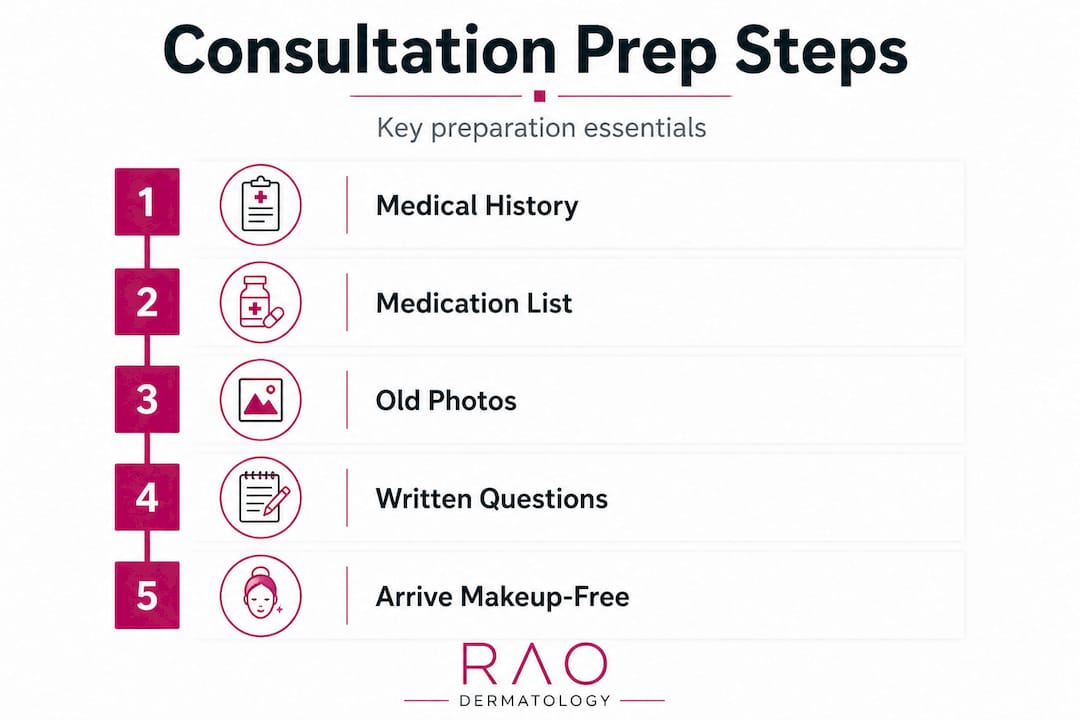
Here is what to bring and do before you arrive:
- Government-issued ID and insurance cards (even for cosmetic visits, some practices need these on file)
- Complete medical history, including any chronic conditions, past surgeries, and previous skin treatments
- A written list of all current medications, including supplements and over-the-counter products
- Known allergies, especially to topical ingredients, adhesives, or anesthetics
- Old photos of your skin, which serve as an anatomy reference and help your provider understand how your skin has changed
- Written questions you want answered, organized by priority so nothing gets forgotten in the moment
- No makeup on your face, because your provider needs to inspect your natural skin tone, texture, and any areas of concern
One detail many patients overlook is medical dermatology essentials that cross over into cosmetic care. Conditions like rosacea, seborrheic dermatitis, or hormonal acne can directly influence which cosmetic treatments are safe and effective for you. Disclosing these upfront saves time and prevents complications.
Regarding medications, preparation includes avoiding blood thinners and aspirin before your appointment to reduce bruising risk, especially if any injectable or procedural treatments are being considered. Stop these at least a week in advance if your doctor approves.
| Item to bring | Why it matters |
|---|---|
| Medical history | Identifies contraindications and guides safe treatment selection |
| Medication list | Prevents dangerous interactions with cosmetic procedures |
| Old photos | Provides anatomy reference and tracks skin changes over time |
| Written questions | Keeps the consultation focused and ensures nothing is missed |
| Allergy list | Avoids reactions to topical agents, fillers, or numbing creams |
| No makeup | Allows accurate assessment of your baseline skin condition |
Pro Tip: Write your questions the night before and rank them by importance. Consultations move quickly, and your top concerns should be addressed first, not last.
Understanding what new patients should know about visiting a dermatology practice for the first time also helps set realistic expectations. Cosmetic consultations are collaborative conversations, not one-sided prescriptions.
Step-by-step consultation walkthrough
With your prep done, here’s precisely how a typical consultation unfolds, from opening questions to actionable recommendations.
Knowing what to expect at each stage removes the anxiety and lets you focus on communicating clearly. Here is how a well-structured cosmetic dermatology consultation typically flows:
-
Arrival and intake forms. You will complete or verify intake paperwork covering your health history, medications, and cosmetic goals. This information primes the dermatologist before they even enter the room.
-
Initial skin evaluation. The provider examines your skin under specialized lighting and sometimes magnification. They assess texture, pigmentation, pore size, fine lines, volume loss, and any areas of concern you have flagged.
-
Medical history review with photo reference. Your old photos become a valuable tool here. They allow the dermatologist to compare your current anatomy to a previous baseline, which is especially useful for filler placement or tracking pigmentation changes.
-
Goal discussion using your written questions. This is your moment. Present your written questions and describe your goals in plain language. Be specific: “I want to soften the lines between my brows” is more useful than “I want to look younger.”
-
Provider assessment and recommendation. Based on your skin evaluation and goals, the dermatologist outlines which treatments are appropriate, which are not, and why. They will explain expected outcomes, timelines, and any risks.
-
Building your personalized plan. A good cosmetic plan is not a single appointment. It is an evolving strategy that adapts as your skin changes with age, lifestyle, and seasonal shifts.
“Board-certified dermatologists with FAAD designation bring specialized training that goes beyond general medical education. Their recommendations evolve with aging, meaning your plan should be revisited and refined over time, not treated as a one-time fix.”
Knowing the right questions to ask your dermatologist before you go makes this stage significantly more productive. Ask about realistic timelines, maintenance requirements, and what happens if you stop a particular treatment.
One of the most important decisions you will make is choosing the right provider. Here is a quick comparison:
| Provider type | Training level | Best suited for |
|---|---|---|
| Board-certified dermatologist (FAAD) | Medical school plus residency plus board exams | Complex skin concerns, medical and cosmetic overlap |
| Licensed esthetician | State-licensed cosmetology or esthetics school | Facials, peels, and non-medical aesthetic services |
| General practitioner | Medical school, no dermatology specialization | Basic referrals only |
| Nurse injector | Nursing degree plus injection training | Botox and filler under physician supervision |
Finding a dermatologist who is board-certified and experienced in cosmetic procedures is not just a preference. It is a safety standard. The FAAD credential signals that the provider has passed rigorous examinations and is committed to ongoing education in dermatology.

Common mistakes and how to avoid them
Now that you know the consultation flow, let’s make sure you sidestep the most common errors that can sabotage your skin outcomes.
Even well-intentioned patients make avoidable mistakes that dilute the value of their consultation. Here are the most common ones and how to prevent them.
Skipping board certification verification. Not all cosmetic providers are created equal. A provider without FAAD credentials may lack the depth of training needed to identify when a cosmetic concern has a medical root cause. Always verify credentials before booking. The board-certified dermatologist benefits are substantial, particularly when your skin health is on the line.
Trusting social media trends over professional advice. This is one of the most widespread problems in cosmetic skincare today. A trending ingredient or procedure on social media may be completely wrong for your skin type, tone, or medical history. Social media trends are unreliable as a guide for cosmetic treatment decisions. What works for an influencer with oily skin in a warm climate may cause serious irritation for someone with sensitive, dry skin in a cold environment.
Arriving without key information. Forgetting your medication list or failing to mention a recent cosmetic treatment at another practice can lead to dangerous combinations or ineffective recommendations. Full disclosure is not optional.
Not preparing questions in advance. Many patients leave consultations realizing they forgot to ask something important. A written list prevents this entirely. Prioritize your questions so the most critical ones are addressed even if time runs short.
Treating your plan as permanent. Your skin at 35 is not your skin at 50. Hormonal changes, sun exposure, weight fluctuations, and lifestyle shifts all alter your skin’s needs. Iterative plans evolve with aging, and failing to revisit your strategy means you may be following outdated recommendations.
Pro Tip: Before your appointment, do a quick search on your provider’s name plus “FAAD” or check the American Board of Dermatology’s online verification tool. It takes two minutes and gives you significant peace of mind.
Here are the most common mistakes at a glance:
- Choosing a provider based on price alone rather than credentials
- Relying on a friend’s recommendation for a treatment that worked for them but may not suit your skin
- Not mentioning supplements like fish oil or vitamin E, which can also thin blood
- Failing to photograph your skin before starting any treatment (no baseline means no way to measure progress)
- Stopping a recommended treatment early because results are not immediate
Choosing the best dermatologist involves more than proximity and availability. Look at their specialty focus, their experience with your specific concern, and whether they take time to explain options rather than push a single solution.
Verifying results and next steps
After avoiding the key mistakes, it’s important to track your outcomes and stay engaged in the plan your dermatologist creates.
A consultation is only as valuable as the follow-through. Here is how to stay on top of your results and keep your skin journey moving forward.
-
Review the written summary. Ask for a written or digital summary of the recommendations discussed. This prevents miscommunication and gives you a reference point when you get home and start researching your options.
-
Document your skin with photos. Take clear, consistent photos of your skin in the same lighting and angles before starting any treatment. This is your personal baseline. Repeat at four weeks, eight weeks, and beyond.
-
Schedule your follow-up appointment. Do not wait until you notice a problem. Book your next appointment before you leave the office. Most cosmetic treatments require follow-up assessments to evaluate efficacy and adjust dosing or technique.
-
Monitor for adverse effects. Know what is normal (mild redness, slight swelling) versus what requires a call to your provider (persistent pain, unusual discoloration, signs of infection). Your provider should give you a clear list of what to watch for.
-
Revisit your plan annually at minimum. Your skin’s needs change, and so should your treatment strategy.
The range of cosmetic dermatology services available today is broader than most patients realize. From injectables and laser resurfacing to chemical peels and medical-grade facials, your options expand significantly when you work with an experienced team.
| Follow-up milestone | What to assess |
|---|---|
| 2 weeks post-treatment | Initial response, any side effects, comfort level |
| 4 to 6 weeks | Visible changes in texture, tone, or targeted concern |
| 3 months | Sustained results, need for maintenance or adjustment |
| Annually | Full plan review based on skin aging and lifestyle changes |
For specific procedures, preparation matters just as much after the fact. If chemical peels are part of your plan, understanding chemical peel preparation and aftercare keeps your results intact and reduces recovery time. The full range of dermatology services available through a multi-location practice gives you access to consistent care whether you are in California, New Jersey, or New York.
What most guides miss about cosmetic dermatology consultations
To wrap up, here’s what our experience shows that most checklists and online guides overlook.
Most consultation guides give you a list and call it a day. What they rarely address is the mindset shift that separates patients who get lasting results from those who cycle through treatments without progress.
The biggest gap we see is the assumption that cosmetic dermatology is a destination rather than a relationship. Patients often arrive hoping for a single solution, a product, a procedure, a fix. But skin is a living organ that responds to sleep, stress, diet, hormones, and environment. A truly effective cosmetic plan accounts for all of these variables and adjusts accordingly.
We have also noticed that patients who treat their appointment preparation guide as a one-time checklist tend to plateau. The patients who see the most consistent improvement are those who return, share updates, bring new photos, and ask follow-up questions. They treat their dermatologist like a long-term partner, not a vending machine.
Another overlooked reality: board-certified dermatologists often catch subtle factors that no trend or algorithm can detect. A slight asymmetry, a change in mole texture, a pattern of redness that suggests rosacea rather than sensitivity. These nuances require trained eyes and clinical experience, not a filter or a quiz. The cosmetic and medical sides of dermatology are more connected than most people realize, and a provider who understands both gives you a significant advantage.
Finally, give yourself permission to evolve. The treatment that was right for you at 32 may not be the right choice at 45. Skin changes are not failures. They are signals. A good cosmetic dermatology plan honors where your skin is right now and builds toward where you want it to be, one informed step at a time.
Explore expert cosmetic dermatology services
Ready to achieve your skin goals with experienced guidance? Here’s where your next step begins.
At Rao Dermatology, board-certified dermatologists and licensed estheticians work together across locations in California, New Jersey, and New York to deliver personalized cosmetic care that goes beyond surface-level solutions. With 25+ years of experience and a commitment to evidence-based treatment, the practice offers a full range of cosmetic dermatology services tailored to your unique skin profile, goals, and life stage.

Whether you are exploring injectables for the first time, managing pigmentation concerns, or building a long-term anti-aging strategy, the team at Rao Dermatology is equipped to guide you with precision and care. Browse all all dermatology services to find the right starting point for your consultation. Your skin deserves a plan built around you, not a trend.
Frequently asked questions
What should I bring to my cosmetic dermatology consultation?
Bring your medical history, a list of current medications and allergies, old photos, and written questions, and arrive without makeup so your provider can accurately assess your baseline skin condition.
Why is board certification important in cosmetic dermatology?
Board-certified dermatologists (FAAD) have completed specialized medical training and rigorous board exams, making them best qualified to deliver safe, effective cosmetic care and identify underlying medical skin concerns.
Should I avoid any medications before my appointment?
Yes. Avoid aspirin and blood thinners before your consultation, as these increase bruising risk, particularly if injectable or procedural treatments are being considered. Always confirm with your prescribing physician first.
How often should I update my cosmetic dermatology plan?
Review your plan at least once a year, since plans evolve with aging and your skin’s needs shift with hormonal changes, lifestyle factors, and the natural aging process.
Recommended
- How to prepare for your dermatology appointment: a step-by-step guide | Rao Dermatology
- How to navigate cosmetic dermatology referrals for better skin | Rao Dermatology
- Medical Dermatology Essentials: Prevention, Treatment & Aesthetics | Rao Dermatology
- Cosmetic Dermatology | Rao Dermatology
- Post-surgery skin care: heal naturally and minimize scars
Filed under: