
Ensure your safety with our step-by-step guide for an effective at-home skin cancer check. Catch changes early and stay healthy!

Skin cancer is the most diagnosed cancer in the United States, yet many people skip the one habit that makes the biggest difference: a regular at-home skin cancer check. Formally called a skin cancer self-examination, this monthly practice lets you catch suspicious changes early, when treatment is most effective. The good news is that you do not need medical training to do it well. You need the right tools, a clear process, and the knowledge to recognize what warrants a dermatologist’s attention. This guide gives you all three.
Key takeaways
| Point | Details |
|---|---|
| Self-exams monitor, not diagnose | At-home checks identify suspicious changes early, but a biopsy confirms any skin cancer diagnosis. |
| ABCDE rule is your framework | Asymmetry, Border, Color, Diameter, and Evolving changes are the five warning signs to assess every mole. |
| Thoroughness requires the right tools | A full-length mirror, handheld mirror, and good lighting are non-negotiable for an effective exam. |
| Hidden spots get missed most often | Scalp, soles, nail beds, and genitals are frequently overlooked and require deliberate attention. |
| Self-exams and professional care work together | High-risk individuals should self-examine every three to four months and see a dermatologist annually. |
What you need for an at-home skin cancer check
Before you start examining your skin, spend two minutes pulling together the right supplies. A rushed self-exam in poor lighting is not much better than no exam at all.
Tools to gather:
- A full-length mirror mounted on a wall or door
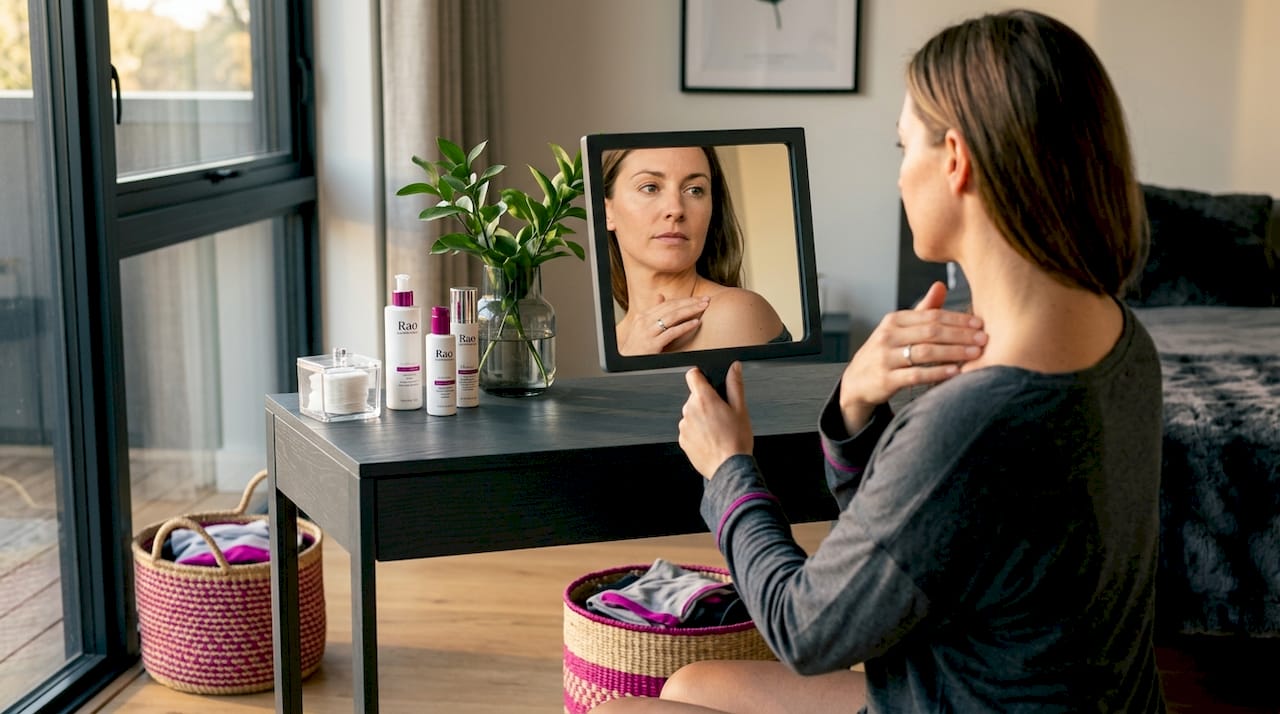
- A handheld mirror for your back, scalp, and hard-to-reach areas
- Bright, natural or white artificial light (avoid yellow-toned bulbs)
- A smartphone with a camera for photographing suspicious spots
- A ruler or measuring tape for recording the size of any lesion
- A comb or blow dryer to part your hair during the scalp check
Partner assistance and good lighting significantly improve how thoroughly you cover your body during a self-exam. If you have a trusted partner willing to help, ask them to check your upper back, scalp, and the back of your ears. These are the areas most commonly missed when examining solo.
How often should you do this? High-risk individuals benefit from checking every three to four months, while most adults should perform a full-body check once a month. Pick the same date each month so it becomes a fixed habit, similar to a routine bill payment.
Pro Tip: Set a recurring calendar reminder for your monthly skin check. Doing it right after a shower, when your skin is clean and dry, makes the process faster and more consistent.
| Tool | Why it matters |
|---|---|
| Full-length mirror | Lets you view your front, sides, and lower body without straining |
| Handheld mirror | Reflects the back of your scalp, neck, and upper back |
| Smartphone camera | Captures reference photos so you can track changes over time |
| Ruler | Measures lesion diameter, a key part of the ABCDE assessment |
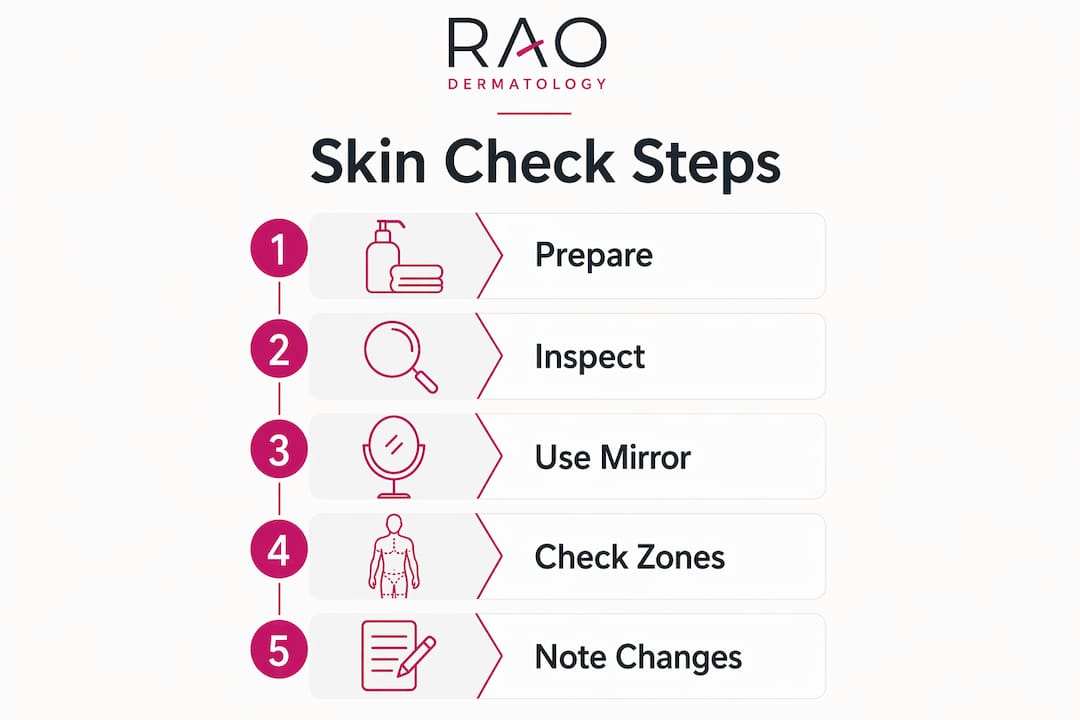
Step-by-step instructions for a head-to-toe skin exam
A methodical approach is what separates a useful self-exam from a vague once-over. Work from the top of your body down, checking every section before moving to the next.
Understanding the ABCDE warning signs
Before you begin, commit the ABCDE framework to memory. The ABCDE rule covers Asymmetry, Border irregularity, Color variation, Diameter greater than 6 millimeters, and Evolving changes. Each letter targets a specific visual property that distinguishes a normal mole from a potentially dangerous one.
- Asymmetry: If you drew a line through the mole, both halves should match. They do not match on a suspicious lesion.
- Border: Healthy moles have smooth, well-defined edges. Irregular, ragged, or blurred borders are a red flag.
- Color: One consistent shade of tan or brown is normal. Multiple colors, including red, white, blue, or black, within a single mole are concerning.
- Diameter: Most benign moles stay smaller than a pencil eraser, which is about 6 millimeters. Larger spots deserve attention.
- Evolving: Any mole that changes in size, shape, or color over weeks or months needs professional evaluation.
The six-zone body check
Work through your body in six zones. Do not skip zones because you feel rushed.
- Face and scalp. Stand under good lighting and examine your forehead, nose, lips, ears, and neck. Use your comb or blow dryer to part your hair in sections and inspect your scalp with a handheld mirror, or ask a partner to check this area for you.
- Chest and abdomen. Face the full-length mirror with good light behind you. Check your neck, collarbone, chest, and stomach. Women should lift the breasts to examine the skin underneath.
- Arms and hands. Extend each arm fully, checking the front, back, and inner surface. Examine the webbing between your fingers, your fingernail beds, and your palms.
- Back and buttocks. Turn your back to the full-length mirror and use your handheld mirror to view your upper and lower back, shoulders, and buttocks. This zone is where melanoma is commonly found in men.
- Legs and feet. Sit down and examine each leg from thigh to ankle, including the back of your knee. Then check the tops of your feet, soles, and the spaces between your toes. Melanoma develops in unexpected places like the soles and between toes, making thoroughness here non-negotiable.
- Genital area. This zone is easy to skip, but skin cancer can occur here. A quick visual check with a handheld mirror takes under a minute.
Pro Tip: Photograph suspicious spots with a ruler next to the lesion for scale. Date each photo and keep a simple folder on your phone. This timeline becomes extremely useful when you visit a dermatologist.
One useful comparison table to keep in mind while checking:
| Characteristic | Normal mole | Suspicious lesion |
|---|---|---|
| Shape | Symmetrical, round or oval | Asymmetrical halves |
| Edges | Smooth, clearly defined | Irregular, notched, or blurred |
| Color | Even tan or brown | Multiple shades within one spot |
| Size | Under 6mm | Over 6mm or growing |
| Behavior | Stable for years | Changing, itching, or bleeding |
Common mistakes that undermine your skin exam
Even people who perform regular self-exams make errors that reduce their effectiveness. Knowing these pitfalls in advance keeps you from repeating them.
Areas most commonly skipped:
- The scalp, particularly under thick hair
- Between the toes and the soles of the feet
- Fingernail and toenail beds (melanoma here often appears as a dark streak under the nail)
- The lower back and backs of the knees
- The genital region
Poor lighting is one of the most frequent problems. Checking your skin in a dim bathroom mirror means you will miss subtle color changes and thin borders. Use a bright daylight bulb or examine your skin near a sunny window when possible.
Another common error is skipping documentation. If you notice a mole but do not photograph or measure it, you have no baseline to compare against next month. Self-exams are most valuable as early warning monitoring when they are documented consistently over time.
“Avoiding panic over benign moles while maintaining vigilance is the balance every person doing self-exams needs to find.” — Cleveland Clinic
Not every new spot is cancer. Most adults develop new benign moles through their forties. The key is tracking change, not panicking at every freckle. If a spot looks the same as it did three months ago, that consistency is reassuring. If it has shifted in any way, that is your cue to call a dermatologist.
Pro Tip: Keep a simple note in your phone titled “Skin Watch List” with photos, dates, and locations of any spots you want to monitor. This takes three minutes and makes your next dermatology appointment significantly more productive.
What to do when you find something suspicious
Finding a suspicious spot does not mean you have cancer. It means you have found something worth evaluating by a professional. That is exactly what a home skin cancer assessment is designed to do.
The following signs should prompt a dermatologist visit without delay:
- Any mole that meets one or more ABCDE criteria
- A spot that bleeds without injury or itches persistently
- A new growth that appears after age 40 and changes quickly
- A dark streak or band under a fingernail or toenail
- Any sore that does not heal within four weeks
Moles with changes in size, shape, or color, or symptoms like itching and bleeding, require professional evaluation rather than continued observation at home. This is the single most important boundary to understand about self-exams: they are a screening tool, not a diagnostic one.
When you see a dermatologist, they will perform a thorough exam using tools unavailable at home. Professional screenings typically last 10 to 15 minutes and include dermoscopy, which uses magnification and polarized light to examine deeper skin layers. If a lesion looks concerning, a biopsy is the next step. A biopsy, not a visual exam, is the method that confirms a skin cancer diagnosis.
The timeline matters. Early-stage melanoma detected before it spreads has a five-year survival rate above 98 percent. Waiting months to act on a suspicious spot dramatically changes that picture. Schedule the appointment within two weeks of noticing a red-flag change, not two months.
My honest take on self-exams
I have worked with patients who noticed something worrying on their skin but waited six, eight, even twelve months before coming in. Nearly every time, the reason was not ignorance. It was anxiety. They were afraid of what a dermatologist might find, so they kept watching and hoping the spot would just go away.
What I have seen repeatedly is that the people who do regular self-exams actually become less anxious over time, not more. They know what their skin normally looks like. They can tell when something is genuinely new versus when a familiar mole just looks different under bathroom lighting. That baseline knowledge is powerful.
My honest view is that self-exams are an empowering practice, not a replacement for professional screening. Think of them as the monitoring layer between your annual dermatology visit. They do not replace a clinician’s eye or a biopsy. But they dramatically shorten the window between a change appearing and a person getting it checked.
If you are nervous about what you might find, start anyway. Knowing is always better than not knowing. And pair those self-checks with a yearly professional skin exam so nothing slips through.
— Krunal
Raodermatology’s skin cancer services

At Raodermatology, Dr. Babar K. Rao and his team have spent more than 25 years helping patients in New Jersey, New York, and California catch and treat skin cancer before it progresses. If your self-exam has turned up something worth a closer look, or if you are simply overdue for a full-body professional check, this is the right next step.
Raodermatology offers expert skin cancer screening using advanced diagnostic tools including dermoscopy and in-house dermatopathology, meaning your biopsy results are read by a specialist who knows your case. The practice also provides detailed guidance on performing monthly self-checks so you stay informed and proactive between visits. Whether you have a specific concern or want an annual preventive exam, the team delivers thorough, personalized evaluations backed by decades of clinical experience.
FAQ
What is an at-home skin cancer check?
An at-home skin cancer check, also called a skin cancer self-examination, is a monthly visual inspection of your entire body to identify moles or growths that may have changed in appearance. It is a monitoring tool, not a diagnostic method.
How do I use the ABCDE rule during a self-exam?
Evaluate each mole for Asymmetry, Border irregularity, Color variation, Diameter over 6mm, and any Evolving changes. Any spot that meets one or more of these criteria should be evaluated by a dermatologist.
Can a self-exam replace a professional skin cancer screening?
No. Self-exams help identify suspicious lesions early, but only a biopsy can confirm a skin cancer diagnosis. Annual professional exams remain the standard of care, especially for high-risk individuals.
Which body areas are most commonly missed during self-exams?
The scalp, soles of the feet, spaces between the toes, fingernail and toenail beds, and the genital area are the most frequently overlooked zones. Melanoma can develop in any of these locations, so deliberate attention to each is worthwhile.
When should I see a dermatologist after a self-exam?
Schedule an appointment within two weeks if you notice a mole that has changed in size, shape, or color, bleeds or itches without cause, or any new growth that does not resolve on its own within four weeks.
Recommended
- Complete Guide to At-Home Skin Cancer Checks: What You Need to Know | Rao Dermatology
- How to Do an At-Home Skin Cancer Check: Complete Monthly Self-Exam Guide | Rao Dermatology
- Annual Skin Cancer Screening: Your Complete Guide to Dermatology Checkups | Rao Dermatology
- Skin cancer screening: early detection and prevention | Rao Dermatology
Filed under: