
Discover why use proactive skin care to prevent damage and aging. Learn key benefits and tips for maintaining healthy skin today!

Proactive skin care is the deliberate practice of preventing skin damage and aging through consistent, scientifically backed daily habits. The term “preventive dermatology” is the recognized clinical standard for this approach, and it differs fundamentally from reactive care, which addresses damage only after it appears. Why use proactive skin care? Because the science is clear: early, consistent habits preserve collagen, reduce skin cancer risk, and delay the visible signs of aging by years. Raodermatology, with over 25 years of clinical experience across California, New Jersey, and New York, treats preventive care as the foundation of every patient’s long-term skin health plan.
What are the main benefits of proactive skin care?
Preventive skin care delivers measurable, documented benefits that reactive treatments cannot replicate after the fact.
The most direct benefit is reduced cancer risk. Daily use of broad-spectrum sunscreen with SPF 15 or higher cuts melanoma risk by 50%. That single habit, applied consistently, is one of the most powerful health decisions a person can make.

UV radiation also drives the majority of visible aging. UV radiation causes up to 80% of wrinkles, pigmentation changes, and skin texture thickening. That means most of what people associate with “getting older” is actually sun damage, and it is largely preventable.
Collagen loss is another critical factor. Collagen decline begins in the mid-20s, making the late teens and early 20s the ideal window to start protective habits. Starting early can delay the need for invasive corrective treatments well into your 40s.
The benefits of proactive skin care also include:
- Maintained skin barrier function: A healthy barrier keeps moisture in and irritants out, reducing sensitivity and chronic inflammation.
- Lower long-term costs: Preventing damage costs far less than correcting it with procedures like laser resurfacing or chemical peels.
- Reduced inflammation: Consistent, gentle routines prevent the low-grade inflammation that accelerates cellular aging.
- Better product performance: Healthy, intact skin absorbs active ingredients more effectively than compromised skin.
Pro Tip: Apply a broad-spectrum SPF 30+ sunscreen every morning, even on cloudy days. UV rays penetrate cloud cover and glass, so indoor exposure still accumulates over time.
How does proactive skin care differ from reactive approaches?
Preventive skin care focuses on preserving skin function before damage occurs. Reactive, or corrective, care targets existing issues using stronger treatments like retinoids at high concentrations, chemical peels, or laser procedures. Both have a place in dermatology, but they serve different purposes at different stages.
The practical difference shows up in the ingredients and intensity of each approach. Preventive routines rely on SPF 30+, gentle cleansers, moisturizers, and low-dose antioxidants like vitamin C. Corrective routines often involve prescription-strength retinoids, glycolic acid peels, or procedures that require recovery time. Preventive care is a daily conditioning process. Corrective care is an intervention.
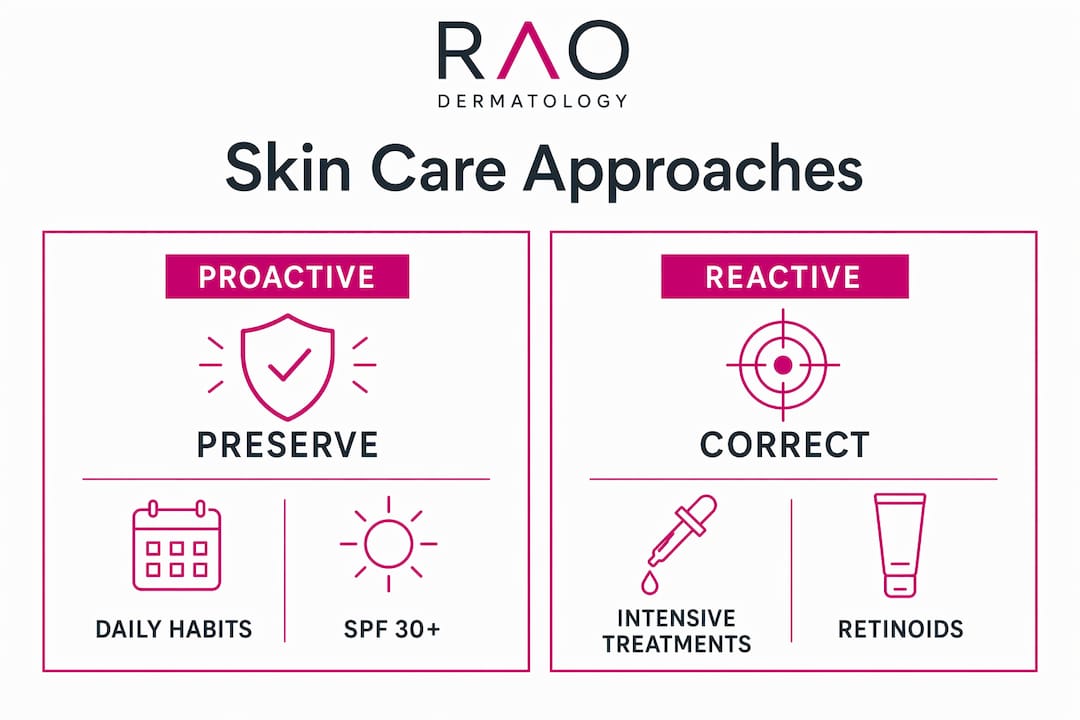
A key risk of skipping prevention is that reactive treatments carry real downsides. Overuse of exfoliants and aggressive products in young adults disrupts the skin barrier, causes persistent redness, and can actually accelerate collagen breakdown. Treating skin aggressively before damage exists often creates the very problems it was meant to prevent.
| Approach | Goal | Typical methods | Timing |
|---|---|---|---|
| Preventive (proactive) | Preserve skin function | SPF, antioxidants, gentle cleansing | Daily, starting in teens |
| Corrective (reactive) | Repair existing damage | Peels, retinoids, laser | After damage appears |
Think of preventive care as a marathon and corrective care as a sprint. Sprinting works in a crisis, but you cannot sprint forever. Consistent, low-intensity daily habits build the structural resilience that keeps skin healthy for decades.
Pro Tip: If you are currently using a corrective product like a high-strength retinoid, pair it with a barrier-supporting moisturizer to offset the risk of inflammation and sensitivity.
What does a proactive skin care routine look like?
A proactive skincare routine benefits from simplicity. Minimalist, consistent routines of daily SPF 30+, gentle cleansing, and moisturizing outperform complex, aggressive regimens for long-term skin health. Complexity is not the goal. Consistency is.
A solid daily routine follows this structure:
- Gentle cleansing (morning and evening): Use a mild, pH-balanced cleanser. Avoid foaming cleansers with sulfates that strip the skin’s natural oils and compromise barrier integrity.
- Antioxidant serum (morning): Vitamin C serum applied under sunscreen neutralizes free radicals from UV and pollution exposure. It also supports collagen synthesis.
- Broad-spectrum SPF 30+ (morning): This is the single most important step. UVA rays penetrate glass, meaning indoor workers and commuters accumulate photoaging damage without realizing it.
- Moisturizer (morning and evening): A moisturizer reinforces the skin barrier and reduces transepidermal water loss. Look for ingredients like ceramides, hyaluronic acid, or niacinamide.
- Low-strength retinoid (evening, 2 to 3 times per week): Retinoids support cell turnover and collagen production. Start at a low concentration to avoid barrier disruption.
Lifestyle factors matter just as much as topical products. Stress, sleep, and diet profoundly impact skin health and the success of any topical routine. Poor sleep raises cortisol, which breaks down collagen. A diet high in processed sugar triggers glycation, which stiffens collagen fibers. Managing these factors is not optional. It is part of the routine.
Pro Tip: Avoid layering more than three active ingredients at once. Overloading your routine increases the risk of irritation and makes it harder to identify what is working.
For dermatologist-recommended routine guidance tailored to your skin type, a professional consultation removes the guesswork entirely.
How to choose proactive skin care products and when to start
The ideal time to start preventive skin care is in your teens to mid-20s. Collagen preservation started early can delay invasive corrective treatments by decades. Starting in your 30s or 40s still delivers real benefits, but the structural foundation is harder to maintain once significant decline has occurred.
Choosing the right products requires reading labels carefully and avoiding marketing claims that are not backed by ingredients. Here is what to look for:
- SPF label: Broad-spectrum SPF 30 or higher. “Broad-spectrum” means protection against both UVA and UVB rays.
- Vitamin C concentration: Look for L-ascorbic acid at 10%–20% for antioxidant benefit. Lower concentrations are gentler for sensitive skin.
- Retinoid strength: Start with retinol at 0.025%–0.1% before moving to stronger prescription options.
- Fragrance-free formulas: Fragrance is the most common cause of contact dermatitis and barrier disruption in skin care products.
- Ceramide content: Ceramides are lipids that reinforce the skin barrier. Their presence in a moisturizer signals a barrier-focused formula.
Avoid cycling through trendy products every few weeks. Skin needs at least 8–12 weeks to show a measurable response to a new ingredient. Frequent switching prevents you from knowing what is actually working.
Professional guidance is the most reliable shortcut. A skin care check with a dermatologist identifies your skin type, flags early concerns, and removes the trial-and-error process from product selection. The importance of proactive skin care grows when it is personalized to your biology rather than applied generically.
After a procedure or treatment, post-treatment skin care plays a critical role in sustaining results. Consistent gentle care between professional visits preserves the gains from any in-office treatment.
Pro Tip: When starting a new active ingredient, introduce it on alternating nights for the first two weeks. This lets your skin adapt without triggering a barrier reaction.
Key Takeaways
Proactive skin care works because consistent daily prevention preserves collagen, cuts melanoma risk by 50%, and delays visible aging far more effectively than corrective treatments applied after damage occurs.
| Point | Details |
|---|---|
| Start early for maximum benefit | Collagen decline begins in the mid-20s, making teens to mid-20s the best window to start. |
| Sunscreen is non-negotiable | Broad-spectrum SPF 30+ daily reduces melanoma risk by 50% and prevents up to 80% of visible aging. |
| Simplicity outperforms complexity | Gentle cleansing, SPF, and a moisturizer consistently applied beat aggressive multi-step regimens. |
| Lifestyle factors are part of the routine | Sleep quality, stress management, and diet directly affect how skin responds to topical care. |
| Professional guidance personalizes results | A dermatologist identifies your skin type and flags early concerns before they require correction. |
Why I think most people start skin care at the wrong time
The most common mistake I see is people treating skin care as a response to a problem. They notice fine lines, sun spots, or persistent dryness, and then they start researching products. By that point, the structural damage is already underway. The correction phase is more expensive, more time-consuming, and less effective than prevention would have been.
The concept of “skin fitness,” as dermatology researchers now frame it, reframes the entire approach. Skin health reflects systemic biological resilience, not just surface appearance. That shift in thinking changes everything. You are not just managing how you look. You are maintaining a biological system that protects you from infection, regulates temperature, and signals internal health.
What I have found is that people who commit to a simple, consistent routine in their 20s rarely need aggressive interventions in their 40s. The ones who skip prevention and chase correction spend more money, deal with more side effects, and often end up with results that look less natural. Skin care as a long-term conditioning process rewards patience in a way that no single procedure can replicate.
The other misconception worth addressing is that proactive care requires an expensive, multi-step routine. It does not. SPF, a gentle cleanser, and a basic moisturizer are enough to build a strong foundation. Add vitamin C and a low-strength retinoid when you are ready. That is the whole framework. The goal is not complexity. It is consistency applied over years.
— Krunal
Raodermatology’s approach to preventive skin health
Preventive dermatology is not a passive approach. It requires the right professional partnership to catch what daily routines cannot address alone.

Raodermatology offers preventive dermatology services across its California, New Jersey, and New York locations, including full-body skin cancer screenings, personalized care plans, and cosmetic consultations. Dr. Babar K. Rao and the clinical team bring over 25 years of experience to both skin cancer prevention and the kind of early-intervention care that keeps patients out of the corrective treatment cycle. Scheduling a skin health assessment is the most direct way to understand your current skin condition and build a prevention plan that fits your biology.
FAQ
What is proactive skin care?
Proactive skin care, also called preventive dermatology, is the practice of using consistent daily habits to prevent skin damage before it occurs. It focuses on sunscreen, gentle cleansing, moisturizing, and antioxidants rather than correcting existing problems.
When should you start a proactive skin care routine?
The ideal time to start is in your teens to mid-20s, when collagen production is still strong and the most structural preservation is possible. Starting later still delivers real benefits, but earlier intervention produces better long-term outcomes.
Does sunscreen really make a difference for skin aging?
UV radiation causes up to 80% of visible skin aging, including wrinkles and pigmentation. Daily broad-spectrum SPF 30+ use is the single most evidence-backed step for preventing both photoaging and melanoma.
How is proactive skin care different from reactive skin care?
Proactive care preserves skin function through gentle, daily habits. Reactive care corrects existing damage using stronger treatments like chemical peels or prescription retinoids. Prevention is less expensive and carries fewer side effects than correction.
How do lifestyle factors affect skin care results?
Sleep quality, stress levels, and diet directly influence how skin responds to topical products. Poor sleep raises cortisol, which breaks down collagen, while a high-sugar diet accelerates glycation and stiffens skin structure.
Recommended
- Skin Health Improvement Tips That Actually Work | Rao Dermatology
- Skin Care Tips for Patients: What Actually Works | Rao Dermatology
- Why Regular Dermatologist Visits Are Essential for Healthy Skin | Rao Dermatology
- Spring Clean Your Skincare Routine: Expert Tips from Dermatologists | Rao Dermatology
Filed under: