
Discover why seeking personalized dermatology can significantly improve your skin treatment outcomes and help achieve your unique skin goals.

Most people assume a dermatologist visit works the same way for everyone: you describe a problem, get a prescription, and move on. But skin is not generic. What clears one person’s acne can trigger severe irritation in another, and a standard treatment for a suspicious mole may miss early skin cancer in someone with darker skin. Personalized dermatology tailors care to your unique skin type, genetics, medical history, and goals, improving outcomes across both medical and cosmetic concerns. Understanding when and why this approach matters could be the difference between effective treatment and years of frustrating, ineffective care.
Table of Contents
- What is personalized dermatology and why does it matter?
- Who benefits most? Special considerations for diverse skin types
- The science behind personalization: Evidence, technology, and outcomes
- When is personalized dermatology essential—and when can standards suffice?
- A dermatologist’s perspective: The truth about personalization
- Ready for truly personalized dermatology care?
- Frequently asked questions
Key Takeaways
| Point | Details |
|---|---|
| Tailored treatments work better | Personalized dermatology considers your unique skin, health, and goals for better outcomes. |
| Diverse needs require custom care | Skin of color and unusual issues benefit most from specialty approaches. |
| Technology boosts results | AI and genomics-backed personalization shows measurable improvement in treatment success. |
| Know when to personalize | Complex or persistent skin concerns usually need a tailored plan, while simpler issues may not. |
What is personalized dermatology and why does it matter?
Personalized dermatology is exactly what it sounds like: a care model built around you rather than around a textbook protocol. Instead of applying the same first-line treatment to every patient with eczema or rosacea, a personalized approach factors in your skin type, genetic background, lifestyle, environmental exposures, and specific goals before recommending anything. The result is a plan that fits your biology rather than a plan designed for the average patient.
“Personalized dermatology tailors treatments to individual skin type, genetics, medical history, and goals, improving efficacy for both medical issues like skin cancer and cosmetic concerns.” This shift from population-based to patient-based care is transforming how dermatologists approach everything from prescriptions to procedures.
Why does this matter in practical terms? Consider a few common scenarios:
- Skin cancer screening: A standard visual exam may miss subtle lesions in patients with deeply pigmented skin if the clinician relies only on patterns observed in lighter-skinned populations. A personalized approach accounts for these differences in how lesions present, leading to earlier and more accurate detection.
- Acne treatment: Retinoids work well for many patients, but those with sensitive or reactive skin may experience severe peeling and inflammation before any benefit appears. Adjusting the concentration, frequency, and vehicle (the base formula) based on individual skin tolerance dramatically changes the outcome.
- Cosmetic care: Choosing the right filler, laser, or chemical peel depends heavily on your skin’s thickness, elasticity, and pigmentation tendencies. Reviewing the full range of cosmetic dermatology options with a specialist ensures treatments are matched to your specific anatomy and desired result.
It is also worth remembering that many people put off skin evaluations because they assume nothing serious is happening. Understanding the importance of dermatologist visits for ongoing monitoring is itself part of a personalized strategy, since early intervention is far more effective than reactive care.
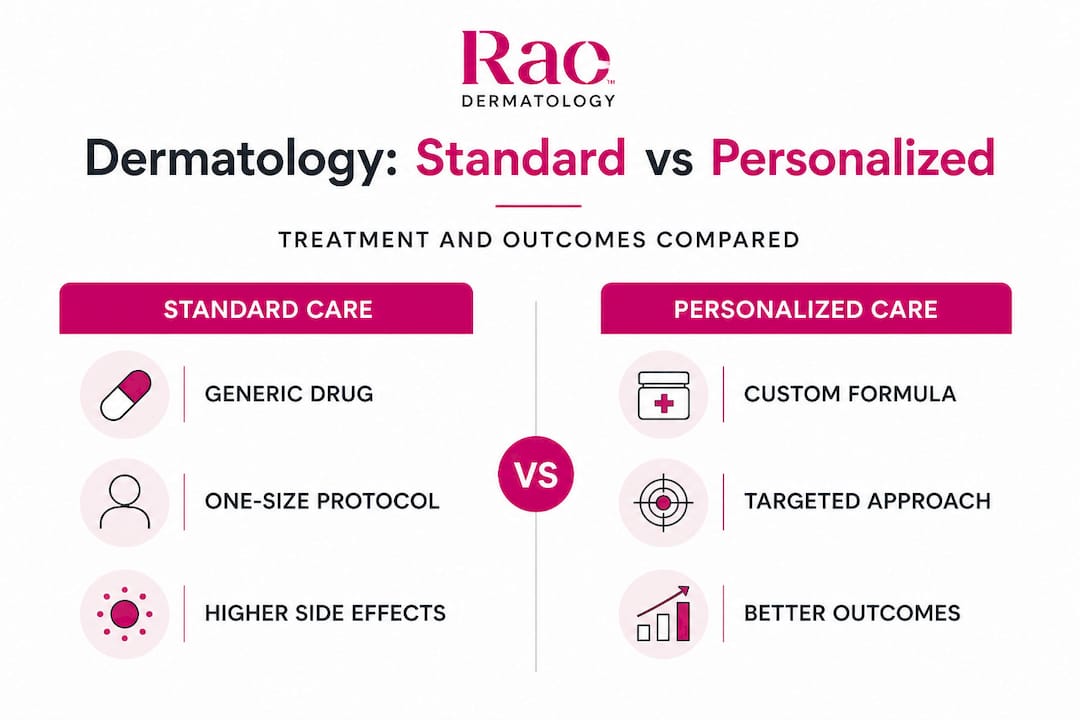
The core advantages of personalized dermatology over conventional, protocol-driven care come down to three measurable differences:
- Greater treatment efficacy: When therapy is matched to the patient rather than the condition alone, clinical improvement tends to happen faster and more completely.
- Fewer side effects: Removing incompatible ingredients or overly aggressive treatments reduces the chance of adverse reactions, irritation, or post-inflammatory hyperpigmentation.
- More meaningful, lasting results: Cosmetic and medical outcomes both sustain longer when they are built on an accurate understanding of your skin’s unique characteristics.
Who benefits most? Special considerations for diverse skin types
Now that we have defined personalized dermatology, who stands to gain the most from this approach? The honest answer is anyone with persistent, complex, or poorly responsive skin conditions. But one group carries a particularly significant and often overlooked risk when treated with generic protocols: patients with skin of color.

Research published in peer-reviewed literature confirms that skin of color requires specially tailored approaches because conditions present very differently across pigmentation levels. Skin cancer diagnoses tend to come later in patients with darker skin, partly because clinicians may not immediately recognize the atypical visual patterns. Post-inflammatory hyperpigmentation (PIH), a darkening of the skin after injury or inflammation, is also far more common and severe in darker skin tones, meaning any treatment that causes even minor irritation carries a higher functional cost for these patients.
The situation is compounded by a growing reliance on artificial intelligence tools in dermatology. AI models show lower accuracy in darker skin tones because the datasets used to train them have historically skewed toward lighter-skinned populations. This means an AI-assisted diagnosis tool may confidently flag a benign lesion on fair skin while missing a genuine concern in a darker-toned patient. Personalized care, driven by a clinician who understands these disparities, closes that gap.
Here is a side-by-side comparison of generic versus personalized care for patients with skin of color:
| Factor | Generic/standard care | Personalized care |
|---|---|---|
| Skin cancer detection | May use visual patterns less reliable for darker skin | Uses history, biopsy, and targeted tools |
| PIH risk management | Standardized irritants may worsen pigmentation | Formulations adjusted to minimize inflammatory risk |
| AI-assisted diagnosis | Potentially lower accuracy due to dataset bias | Clinician oversight corrects algorithmic gaps |
| Acne treatment | One-size retinoid strength or antibiotic | Concentration and vehicle matched to skin sensitivity |
| Cosmetic procedures | Standard laser settings regardless of skin tone | Wavelengths and energy levels adjusted for pigment depth |
Pro Tip: If you have skin of color and feel your concerns have been minimized or misdiagnosed, ask your dermatologist specifically how they adjust their approach for your skin type. A good clinician will have a clear, confident answer.
For patients who want to work proactively toward better skin health, exploring healthier skin strategies tailored to your particular needs is a great starting point. Understanding that your skin has specific needs is not a minor detail. It is the foundation of effective care.
Here are the most common situations where diverse skin type considerations directly affect outcomes:
- Late-stage skin cancer diagnosis in patients with deeply pigmented skin who received less vigilant monitoring.
- Worsened hyperpigmentation after well-intentioned treatments like chemical peels that were too aggressive.
- Undertreatment of keloids because the provider did not account for the higher keloid tendency in certain ethnic backgrounds.
- Cosmetic disappointment after laser treatments calibrated for lighter skin left permanent marks on darker skin.
The science behind personalization: Evidence, technology, and outcomes
Understanding who benefits leads naturally to the next question: what does the science actually say about personalized care, and how do new technologies make it more effective?
The evidence base is now substantial. A major review analyzing 74 studies, including 22 randomized controlled trials (RCTs), found strong support for AI and genomics-driven personalization in dermatology. The RCTs showed statistically significant improvements in skin hydration, elasticity, and pigmentation when care was customized rather than standardized. Notably, digital twin modeling, where a virtual simulation of a patient’s skin is used to predict how it will respond to different treatments before any product is applied, showed the potential to dramatically reduce the trial-and-error phase of care.
Here is a summary of what the technology-driven research shows:
| Technology | What it does | Proven outcome |
|---|---|---|
| Genomic profiling | Identifies genetic predispositions for conditions like psoriasis or melanoma | Earlier intervention, reduced progression risk |
| AI pattern recognition | Analyzes lesion features at scale | Faster preliminary assessment, needs diverse training data |
| Digital twin modeling | Simulates treatment response before application | Fewer adverse reactions, faster path to results |
| Custom compounding | Formulates products to exact patient specifications | Reduced irritation, better tolerance |
| Microbiome analysis | Maps the skin’s bacterial ecosystem | Targeted therapy for chronic eczema and acne |
Critically, personalization also improves treatment adherence. Patients who understand that their regimen was designed specifically for them tend to follow through more consistently, which is a real-world factor that determines whether any treatment actually works. A technically perfect protocol that the patient abandons after two weeks produces no benefit. Custom care generates buy-in.
Understanding the full spectrum of what prevention and treatment essentials look like in a modern dermatology practice helps patients set realistic expectations and participate actively in their own care. The more informed you are, the better the results tend to be.
- AI helps identify patterns in lesions, but human expertise remains essential for interpreting results in context.
- Genomic data can predict which topical agents will work faster and which ones are likely to cause reactions.
- Custom compounding means your moisturizer, retinoid, or anti-inflammatory can be built to your exact specifications.
- Patient adherence improves measurably when people understand why each element of their plan was chosen for them.
When is personalized dermatology essential—and when can standards suffice?
Now that we have seen what the science supports, how can you decide when to seek personalized dermatology versus a conventional approach?
The honest answer is that personalization is not always necessary. If you have a straightforward fungal infection with no complicating history, a standard antifungal regimen will almost certainly work. Simple wart removal, routine sunburn aftercare, or a basic mild eczema flare may respond perfectly well to evidence-based protocols without any customization at all. The Frontiers in Artificial Intelligence research that supports personalization also acknowledges this clearly: for uncomplicated cases, standard guidelines often suffice and offer the advantage of extensive validation across large populations.
Personalization becomes essential in these scenarios:
- Your condition has not responded to standard treatment after two or more trials. This is the clearest signal that a one-size approach is not working for you.
- You have a complex or overlapping diagnosis. Rosacea on top of acne on top of sensitive skin requires a carefully sequenced, customized plan rather than a generic protocol for any one condition.
- You are at elevated risk for skin cancer due to family history, sun exposure patterns, or previous abnormal findings. Customized surveillance timelines and biopsy decisions matter here.
- Your skin type creates unique risks for standard treatments, including darker skin tones prone to PIH or very thin skin prone to over-reaction.
- You are pursuing cosmetic outcomes that require precise matching of technique to your anatomy, such as volumizing a specific facial area without creating an unnatural appearance.
Pro Tip: Before your next dermatology appointment, write down every treatment you have tried, how long you used it, and what happened. This history gives a personalized care provider the raw material they need to build a smarter plan for you.
When complex conditions require tissue-level analysis, dermatopathology services add another layer of precision by examining skin samples at the cellular level. This kind of diagnostic depth is rarely needed for simple cases but becomes invaluable when standard exams cannot explain what is happening in your skin.
A dermatologist’s perspective: The truth about personalization
Personalized dermatology is real. It is not a marketing phrase invented to justify a premium appointment fee. The evidence supporting tailored care is strong, and the patients who benefit most are often those who have been failed by generic approaches for years, whether that means repeated acne treatments that never fully resolved their condition, cosmetic procedures that left hyperpigmentation instead of improvement, or a skin cancer that was caught later than it should have been.
That said, personalization is a tool, not a guarantee. We see patients sometimes arrive expecting that a customized approach will be instantly transformative in ways that no approach could be. The truth is that even a perfectly tailored regimen takes time, consistency, and honest communication between patient and provider to deliver results. Personalization improves the starting conditions and the trajectory, but it does not override biology or skip the work.
What genuinely differentiates a high-quality personalized approach from standard care is the integration of guidelines with individual context. The best dermatologists do not throw out evidence-based protocols. They use those protocols as scaffolding and then build the specific plan around the patient in front of them. That combination, proven science plus individual precision, is where the real clinical value lives.
The patients who get the most from tailored skin of color insights and personalized care in general are the ones who advocate for themselves. If a treatment is not working, say so clearly. If your skin has responded poorly to certain ingredients before, bring that history to your appointment. Your information is part of the personalization process. The more your dermatologist knows about your skin’s actual behavior, the better your care will be.
Ready for truly personalized dermatology care?
If anything in this article resonated with your own experience, you are not alone. Many patients in California, New Jersey, and New York have spent years working through treatments that were never really designed for them.
At Rao Dermatology, Dr. Babar K. Rao and his team have built a practice around exactly this kind of precision care, with more than 25 years of experience in both medical dermatology and advanced aesthetic services. Whether you are concerned about skin cancer risk, dealing with a stubborn chronic condition, or exploring options for skin rejuvenation, every plan starts with your skin’s specific needs. Explore the full range of dermatology services across multiple locations and find out what care designed for you actually looks like.
Frequently asked questions
How does personalized dermatology reduce the risk of side effects?
By customizing formulations to your skin type and medical history, unnecessary ingredients are avoided, which directly lowers the chance of adverse reactions or irritation. This targeted approach means your skin is exposed only to what it can tolerate and what it actually needs.
Is personalized dermatology more expensive than standard care?
The upfront cost can be higher, but personalized care often saves money over time by reaching effective results faster and reducing the expense of repeated failed treatments. Think of it as precision over repetition.
Are there risks to using AI in dermatology for people with darker skin?
Yes. AI models show bias and lower accuracy in patients with darker skin tones because training datasets have historically lacked sufficient diversity. Human clinical judgment remains essential to correct these gaps.
Does personalized dermatology use genetic testing?
Some advanced practices use genomic profiling to inform treatment decisions, and 74 studies including 22 RCTs support this approach, showing measurable improvements in skin hydration, elasticity, and pigmentation outcomes. Not every case requires genetic testing, but it is a valuable tool for complex or resistant conditions.
Recommended
- January Special Offers at Our Dermatology Practice in California | Rao Dermatology
- What dermatology really means for your skin health | Rao Dermatology
- Dermatology’s Role in Healthier, Younger-Looking Skin | Rao Dermatology
- Dermatopathology explained: How it guides better skin health | Rao Dermatology
- Why Genetic Diagnosis Is Critical for Personalized Care
- Why Some PRP Treatments Work Better Than Others - Nortex Tissue Regeneration
Filed under: