
Discover how to refer dermatology patients efficiently with our step-by-step guide. Improve patient care and streamline your referrals today!

Incomplete referral packets. Vague urgency flags. A specialist receiving a two-line note about a suspicious lesion with no photo, no prior treatment history, and no differential. These breakdowns are more common than most clinicians want to admit, and they cost patients time they may not have. When a referring provider in California, New Jersey, or New York sends a dermatology referral without the right documentation, the receiving specialist either delays care to gather missing details or, worse, schedules a consultation that ends up being a data-collection visit rather than a diagnostic one. This guide gives you a step-by-step framework to refer smarter, reduce back-and-forth, and get your patients seen faster.
Table of Contents
- Understanding referral criteria and urgency
- Gathering essential clinical information
- Leveraging clinical photography in referrals
- Avoiding common referral mistakes
- Comparing referral approaches: Traditional versus eConsult
- The real impact of streamlined referrals: Lessons learned
- Connecting patients with advanced dermatology services
- Frequently asked questions
Key Takeaways
| Point | Details |
|---|---|
| Referral driven by urgency | Always base dermatology referrals on clinical severity and need for specialty care, not mere symptoms. |
| Complete referral packet | Include complaint details, prior therapy, test results, and clinical photos to support diagnosis. |
| Clinical photography boosts efficiency | Consented, high-quality photos can improve referral outcomes, particularly for teledermatology. |
| Avoid common errors | Check that packets have all required information, clear urgency, and proper consent for photos. |
| Choose referral method wisely | Pick traditional or eConsult workflows depending on case urgency, procedure type, and practice setup. |
Understanding referral criteria and urgency
Most skin concerns do not need a specialist. That fact is worth sitting with. A structured primary care approach handles the majority of dermatologic complaints effectively, and defaulting to a specialist for every rash or lesion wastes resources and delays care for patients who genuinely need the expert touch.
So when does a referral become necessary? Urgency and specialty-level need are the two core drivers. As outlined in evidence-based dermatology protocols, referral triage should be driven by severity and urgency and the need for specialty care or a higher level of care, not by symptoms alone. That distinction matters enormously. A patient presenting with widespread, treatment-resistant psoriasis affecting quality of life has a clinical severity argument for referral. A patient with a new-onset mild eczema does not, at least not immediately.
Key indications for dermatology referral include:
- Lesions suspicious for melanoma, squamous cell carcinoma, or basal cell carcinoma that require dermoscopy, biopsy, or Mohs surgery evaluation
- Inflammatory skin diseases such as psoriasis, hidradenitis suppurativa, or pemphigus vulgaris that are failing first-line therapy
- Diagnostic uncertainty after a reasonable primary care workup, particularly when the differential includes autoimmune or systemic conditions with skin manifestations
- Pediatric dermatology concerns where presentations are atypical or parental anxiety is compounding without clear diagnosis
- Cosmetic concerns that require laser therapy, injectables, or other aesthetic procedures beyond the scope of general practice
Urgency assessment matters. Prioritize referrals for lesions with rapid growth, irregular borders, ulceration, or bleeding. Inflammatory conditions with systemic involvement also warrant expedited review rather than routine scheduling.
When evaluating urgency, think in tiers: emergent (same-week), semi-urgent (two to four weeks), and routine (standard scheduling). Assigning the correct tier upfront prevents bottlenecks and aligns your patient’s actual clinical need with the specialist’s schedule. When you’re helping a patient find the right specialist, guiding them toward choosing the best dermatologist for their specific condition matters just as much as the referral itself. Understanding medical dermatology essentials can also help primary care clinicians recognize where their management ends and specialty care begins.
Gathering essential clinical information
A referral is only as useful as the information it contains. This is where most referrals fall apart. A specialist receiving vague notes cannot make a prompt, accurate assessment, which means the patient waits while the office calls your practice to request records that should have been included from the start.

The standard for a clinically complete referral packet is well-established. Use a standardized referral packet that documents the dermatologic complaint, your differential or clinical impression, prior therapies and their responses, relevant test results, and supporting visual documentation when appropriate.
Here is a practical breakdown of what every referral packet should contain:
| Component | What to include | Why it matters |
|---|---|---|
| Chief complaint | Duration, onset, location, and progression | Establishes timeline for diagnosis |
| Clinical impression | Your working differential or most likely diagnosis | Helps specialist prioritize workup |
| Prior treatments | Medications tried, doses, duration, and outcomes | Avoids redundant therapy |
| Lab and imaging results | Relevant bloodwork, patch test results, biopsy reports | Prevents unnecessary repeat testing |
| Medications list | Full current medication list with dosages | Flags potential drug-related dermatoses |
| Allergy history | Documented allergies and reactions | Critical for procedural and prescription planning |
| Clinical photos | Consented, high-quality images of the lesion or rash | Dramatically improves diagnostic accuracy |
Additional items worth including when applicable:
- Family history of skin cancer, psoriasis, or autoimmune conditions
- Occupational exposure history for suspected contact dermatitis
- Travel history for unusual or atypical infectious presentations
- Previous dermatology records if the patient has been seen elsewhere
Pro Tip: Even a brief, well-organized narrative summary of the case outperforms a stack of unorganized records. Write two to three sentences framing the clinical picture before attaching supporting documents. It signals to the specialist what to look for and sets the tone for a productive consultation. You can share the appointment preparation checklist with patients directly so they arrive ready to support their own care.
Leveraging clinical photography in referrals
If there is one single upgrade you can make to your referral workflow today, it is this: take a photo. Clinical photography is not glamorous, but it consistently improves the quality of specialist consultations, particularly in teledermatology and eConsult settings where the dermatologist is reviewing the case remotely before or instead of an in-person visit.
Research confirms that clinical photography materially improves dermatology referral efficiency by supporting diagnosis and aiding eConsult and teledermatology workflows. A well-composed, properly lit photograph of a suspicious lesion can help the specialist triage the case, determine whether biopsy is warranted, and in some cases provide a working diagnosis before the patient walks through the door.
Here is a practical step-by-step workflow for clinical photography in referrals:
- Obtain written consent from the patient before any photos are taken. Document consent in the medical record and specify how the images will be used and shared.
- Use a consistent background such as a neutral gray or white surface to ensure the lesion is the focal point of the image.
- Capture three views: a wide-angle establishing shot showing anatomical location, a mid-range shot showing lesion morphology in context, and a close-up showing surface detail, borders, and coloration.
- Use natural or ring-light lighting rather than harsh flash, which can wash out surface features and distort color.
- Include a scale reference such as a ruler or coin in at least one shot to help the specialist estimate size accurately.
- Ensure the image is in focus before capturing. Motion blur or poor focus makes clinical photography nearly useless for diagnostic purposes.
- Transfer images securely using a HIPAA-compliant platform. Never send patient images via standard text message or personal email.
Pro Tip: Standardize your file naming convention from day one. Use a format like PatientInitials_Date_Location (for example, JD_2026-04-15_LeftArm) so the specialist can easily match images to records without confusion. Attach photos directly to the referral packet, not as a separate email sent days later. For practices navigating the cosmetic referral workflow, before-and-after style photos following the same standardized protocol also support continuity of care in aesthetic consultations.
Avoiding common referral mistakes
Even experienced clinicians fall into referral patterns that slow the process down without realizing it. Awareness of the most frequent errors is the first step toward fixing them systematically.
The most common referral breakdowns include:
- Incomplete clinical information: Missing prior treatment history or relevant labs forces the specialist to gather data before they can assess the patient meaningfully.
- Unclear urgency designation: Marking everything as routine regardless of clinical severity causes high-priority cases to be scheduled weeks out. Marking everything urgent erodes credibility.
- Missing consent documentation for photos: Sending clinical images without documented patient consent creates both ethical and legal exposure for your practice.
- No clinical impression included: Sending records without a differential or working impression leaves the specialist guessing what you actually wanted them to evaluate.
- Failure to update the packet after new information emerges: If lab results come back after the initial referral is sent, update the packet before the patient is seen.
Here is an important benchmark to keep in mind: most dermatologic concerns can be managed in primary care, with referral needed in approximately 10% of cases in published studies. That statistic should recalibrate how you triage. If your referral rate is significantly higher, it may signal a gap in primary care dermatology confidence rather than a genuine increase in complex cases.
Before submitting any referral packet, run through a quick verification checklist:
- Is the chief complaint clearly described with onset, duration, and location?
- Is my clinical impression or differential documented?
- Have I listed all prior treatments and their outcomes?
- Are lab results, biopsy reports, or imaging attached if relevant?
- Have I obtained and documented consent for any clinical photos included?
- Is the urgency tier accurately assigned and clearly communicated?
Sharing new patient essentials with your patients alongside the referral helps them arrive prepared and reduces the likelihood of the consultation being used to collect history rather than advance diagnosis.
Comparing referral approaches: Traditional versus eConsult
Not every referral requires an in-person visit. Understanding the available channels helps you match each patient’s need to the most efficient pathway.
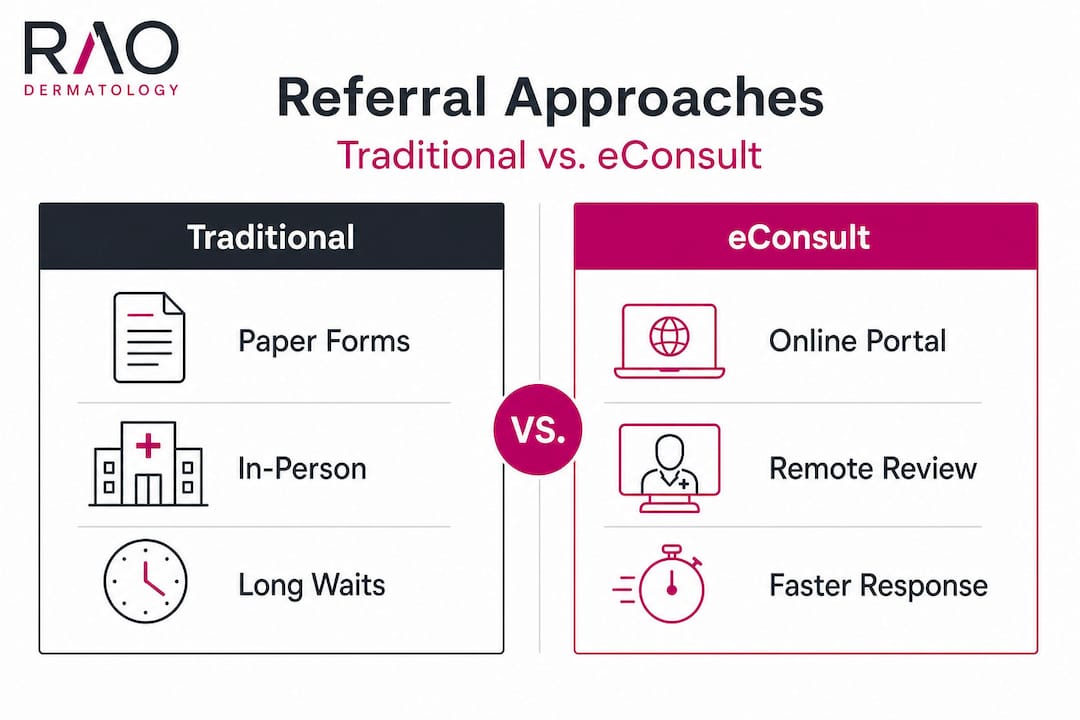
| Referral type | Best use case | Turnaround | Limitations |
|---|---|---|---|
| Traditional in-person referral | Complex cases, biopsies, procedures, cosmetic consultations | Two to six weeks typical | Scheduling delays, patient travel required |
| eConsult (asynchronous) | Diagnostic uncertainty, low-to-moderate urgency, teledermatology-eligible cases | One to five business days | Requires quality photos and complete documentation |
| Urgent/expedited referral | Suspected skin cancer, rapidly evolving lesions, systemic involvement | Same day to one week | Requires clear urgency justification |
| Cosmetic referral | Aesthetic procedures, injectables, laser therapy | Flexible scheduling | Insurance typically not involved |
Teledermatology and eConsult pathways are expanding rapidly, particularly in California, New Jersey, and New York where specialist access can be limited by geography or wait times. Evidence supports a structured approach: clinical photography to aid diagnosis and teledermatology and eConsult workflows, combined with a systematic method for distinguishing normal from abnormal findings in primary care, improves both speed and accuracy of specialist consultation.
Teledermatology works best when the referral packet is complete. An eConsult submitted with poor-quality photos or missing history is slower than no eConsult at all, because it generates a request for more information before any clinical input is provided.
For clinicians looking to understand the range of specialist services available when making referral decisions, finding expert dermatology care is a useful resource to share with patients navigating their options.
The real impact of streamlined referrals: Lessons learned
Here is the uncomfortable truth about dermatology referrals: most problems are not caused by slow specialists. They are caused by incomplete packets. Speed is not what separates a good referral from a bad one. A referral sent in five minutes with missing data will sit in a queue while the specialist’s office tracks down labs or calls the patient for a history the referring provider already had. A referral that takes an extra fifteen minutes to assemble properly moves through the system without friction.
The clinicians who build the most effective referral systems are not the ones who refer the fastest. They are the ones who create repeatable processes. Templates matter enormously here. A structured referral template embedded directly in your EHR reduces the cognitive load of building each packet from scratch. It also functions as a quality control mechanism because if the template has a field for prior therapy outcomes, you will notice immediately when that field is empty.
Photos reduce repeat consultations more than almost any other single intervention. When a specialist reviews a high-quality image before the patient arrives, the consultation starts at a higher level. The discussion is about management, not about establishing what the lesion looks like. That compression of the diagnostic timeline benefits the patient, the specialist, and your practice’s relationship with the receiving dermatology team.
Pro Tip: Create a one-page referral template specific to dermatology and make it available to every provider in your practice. Include fields for all the components in the packet table above, a consent checkbox for clinical photos, and an urgency tier selector. Review it quarterly and update it based on feedback from the dermatology practices you refer to most frequently.
For practices managing a mix of medical and cosmetic referrals, it is worth recognizing that the documentation standards differ. Reviewing cosmetic referral practicalities helps ensure aesthetic referrals are handled with the same completeness as medical ones, even when insurance is not involved.
Connecting patients with advanced dermatology services
When a referral is truly warranted, the quality of the specialist you connect your patient with is just as important as the quality of the packet you send. Patients in California, New Jersey, and New York deserve access to dermatology care backed by deep experience, advanced technology, and a practice model built around outcomes.

Rao Dermatology brings over 25 years of expertise to both medical and cosmetic dermatology, with multiple locations across the East and West coasts. Whether your patient needs skin cancer screening and care or access to cosmetic dermatology expertise including laser treatments, injectables, and advanced aesthetic procedures, our team is structured to receive and act on well-prepared referrals efficiently. Connecting your patients with a practice that values documentation quality and clinical precision means fewer delays, better first-visit outcomes, and a referral relationship built on mutual respect for the patient’s time.
Frequently asked questions
What details should be included in a dermatology referral packet?
Include the chief complaint, your working differential, prior treatments and outcomes, relevant lab or biopsy results, and clinical photos if consented and appropriate, as outlined in standardized referral protocols.
How do I determine if a referral is necessary versus managing in primary care?
Referral decisions should hinge on severity, urgency, and the need for specialty care, not symptoms alone. About 10% of dermatologic cases in published studies warrant referral, meaning most can and should be managed in primary care.
Is clinical photography required when referring dermatology patients?
Photos are not always required, but clinical photography materially improves diagnostic accuracy and is especially valuable for teledermatology and eConsult referrals where the specialist reviews the case remotely.
What are common mistakes in dermatology referrals?
Missing clinical history, unclear urgency designation, and absent consent documentation for photos are the most frequent errors. A structured primary care approach that distinguishes normal from abnormal findings before referral significantly reduces these breakdowns.
Recommended
Filed under: