
Discover the crucial role of hydration in skin health. Learn how proper hydration enhances elasticity, repairs skin, and combats aging.
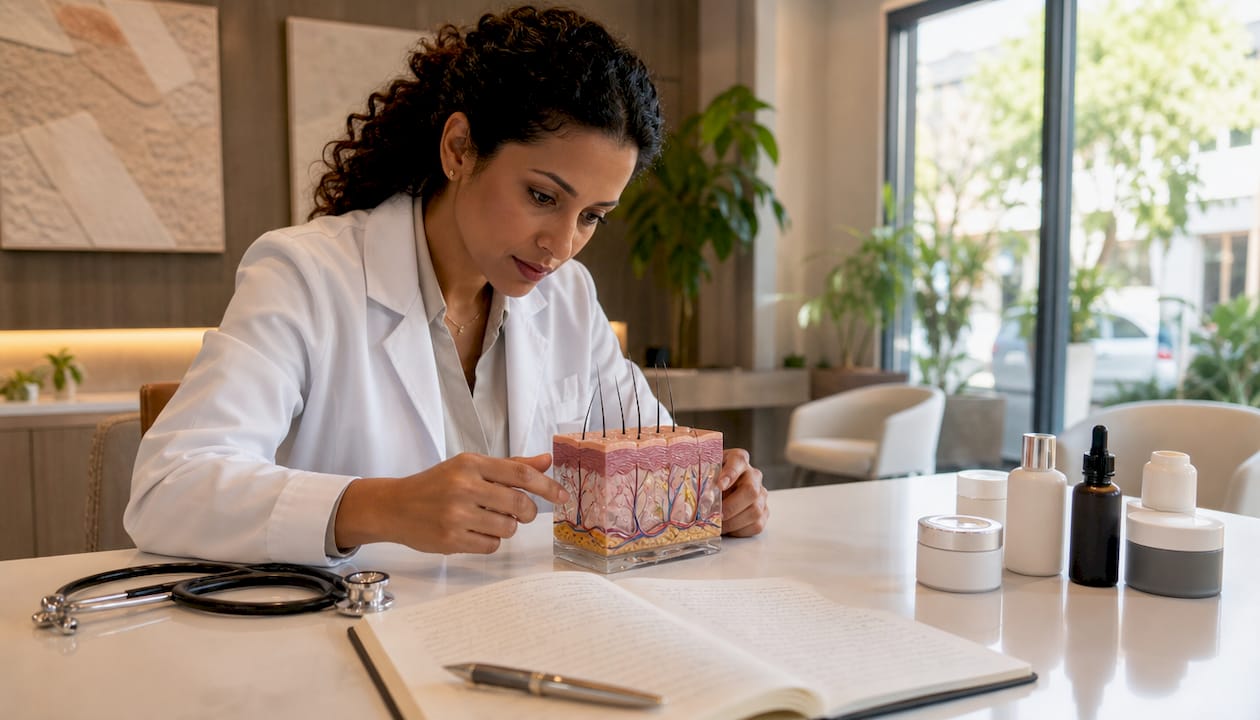
Skin hydration is defined as the process of maintaining adequate water content within skin cells and the extracellular spaces between them. This water balance directly controls skin elasticity, barrier function, and visible appearance. The role of hydration in skin health goes far beyond surface-level moisture. It governs how your skin repairs itself, resists environmental damage, and ages over time. Understanding the difference between hydration and moisturization is the first step toward building a skincare routine that actually works.
How does hydration affect skin’s physical properties?
Hydrated skin exhibits measurably better elasticity and firmness. Water supports the structural integrity of collagen and elastin fibers, the proteins responsible for keeping skin supple and resilient. When water levels drop, those fibers lose their flexibility, and the skin begins to look dull, feel rough, and form fine lines more readily.
Skin turgor, the technical term for the pressure that keeps skin plump, depends directly on cellular water content. You can test this yourself: pinch the back of your hand and release it. Hydrated skin snaps back immediately. Dehydrated skin takes longer to return to its flat position. Dermatologists use this simple test as a quick clinical indicator of hydration status.
The effects of dehydration on skin go beyond texture. Hyaluronic acid can bind up to 1,000 times its weight in water and is one of the skin’s primary hydration regulators. As hyaluronic acid levels decline with age, the skin loses volume and elasticity, making topical replenishment increasingly important.
Visible signs of poor skin hydration include:
- Dullness and uneven tone: Water reflects light. Dehydrated skin scatters it unevenly, producing a flat, lackluster complexion.
- Tightness after cleansing: A sensation of pulling or discomfort signals the skin barrier is struggling to retain moisture.
- Exaggerated fine lines: Dehydration makes surface lines appear deeper, even in younger skin.
- Flakiness without oiliness: Skin can shed dead cells visibly while still producing normal sebum levels.
- Increased sensitivity: A compromised moisture barrier lets irritants penetrate more easily, triggering redness or stinging.
These signs are reversible with the right approach. The key is understanding where the water deficit originates.
What is the link between drinking water and skin hydration?
Drinking water supports systemic health and skin cell function, but it does not directly hydrate the skin surface. Water consumed orally travels through the digestive system, enters circulation, and reaches the skin last among the body’s organs. The skin barrier, specifically the stratum corneum, then controls how much of that water stays in the skin versus evaporates into the air.
Water intake may improve skin thickness and density in people who are genuinely dehydrated, but it does not significantly change skin hydration in people who already drink adequate amounts. This distinction matters because many people assume drinking more water will solve dry or dull skin. For most adequately hydrated individuals, the barrier function is the real bottleneck, not water intake.
That said, chronic mild dehydration does affect skin indirectly. Poor circulation reduces nutrient delivery to skin cells. Reduced kidney function slows the removal of metabolic waste, which can contribute to a sallow complexion. Staying well hydrated supports these background processes, even if it does not visibly plump the skin the way a topical humectant does.
Pro Tip: Apply a hydrating serum immediately after drinking a glass of water in the morning. Your skin’s absorption capacity is highest when your body is well hydrated internally, making topical products more effective at that moment.
The importance of water for skin is real, but it works indirectly. Think of internal hydration as the foundation and topical skincare as the structure built on top of it.
How do topical products support skin hydration?
Topical skincare products are the most direct and effective way to improve visible skin hydration. They work through three distinct mechanisms, each targeting a different part of the moisture equation.
Humectants attract water from the environment and from deeper skin layers into the outer skin. Glycerin, hyaluronic acid, urea, and betaine are the most clinically studied examples. Emollients fill the microscopic gaps between skin cells, smoothing texture and reducing water loss through those channels. Occlusives form a physical seal on the skin surface, slowing transepidermal water loss (TEWL). Petrolatum, shea butter, and dimethicone are common occlusives.
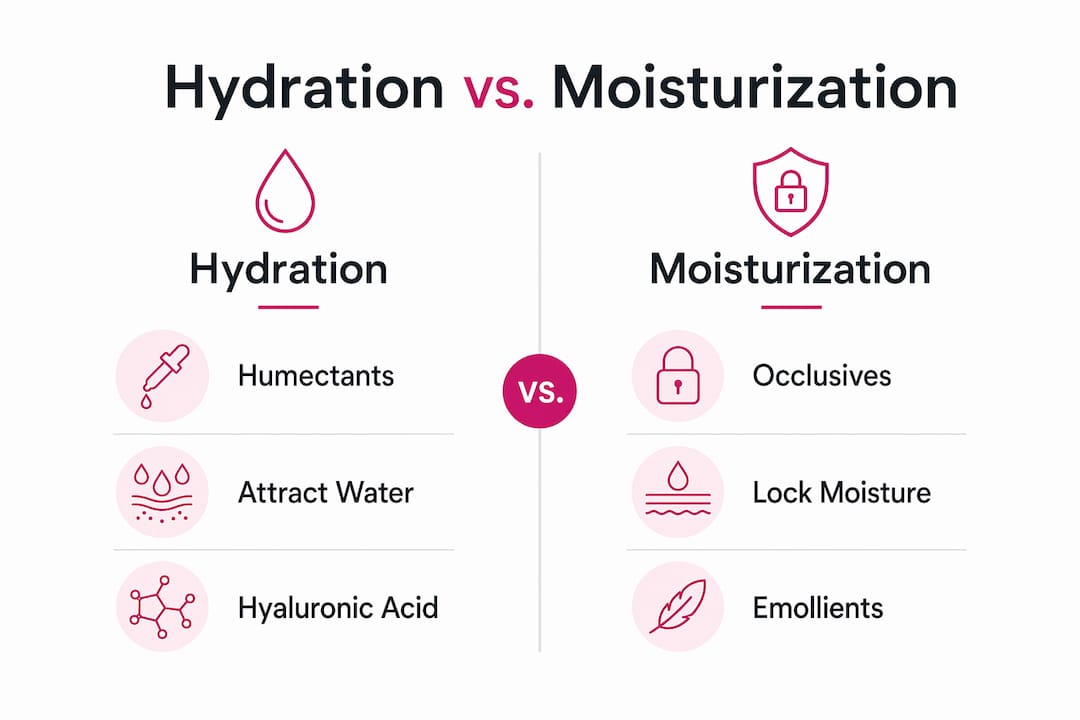
Humectants, occlusives, and emollients each serve a distinct function, and balanced moisturizers that combine all three restore hydration and barrier function more effectively than single-ingredient products. This is why layering a hyaluronic acid serum under a ceramide cream outperforms either product used alone.
The table below compares the primary ingredient categories and their roles:
| Ingredient type | Key examples | Primary function |
|---|---|---|
| Humectant | Hyaluronic acid, glycerin, urea | Draws water into the skin |
| Emollient | Squalane, shea butter, fatty acids | Smooths texture, fills cell gaps |
| Occlusive | Petrolatum, dimethicone, beeswax | Seals moisture in, reduces TEWL |
| Barrier lipid | Ceramides, cholesterol | Repairs skin barrier structure |
| Aquaporin booster | Betaine, osmolytes | Enhances cellular water transport |
Barrier repair is the most advanced area of current moisturizer science. Ceramides, cholesterol, and fatty acids in a 3:1:1 ratio mimic the natural lipid composition of the stratum corneum, making them the most effective combination for restoring barrier integrity and reducing TEWL. Products formulated with this ratio outperform standard creams for patients with persistent dryness or barrier dysfunction.
Aquaporins are water channel proteins embedded in skin cell membranes that regulate cellular water transport. Aquaporin-3 (AQP3) expression decreases with age, reducing the skin’s capacity to move water between layers. Newer moisturizer formulations containing osmolytes like betaine target this pathway, improving deep hydration beyond what conventional creams can achieve.
Pro Tip: Apply humectant serums to slightly damp skin, then immediately follow with an occlusive moisturizer. This sequence traps the water the humectant has drawn in, maximizing hydration retention throughout the day.
Long-term use of some traditional moisturizers can alter stratum corneum lipids and increase irritant susceptibility over time. Formulation quality matters as much as frequency of use. Choosing products with physiological lipids in clinically validated ratios protects the barrier rather than simply masking dryness.
How do you tell the difference between dry skin and dehydrated skin?
Dry skin and dehydrated skin are not the same condition, and treating one as the other leads to persistent problems. Dry skin is a skin type defined by insufficient oil production. Dehydrated skin is a temporary condition caused by a lack of water in the outer skin layer. The distinction determines which products will actually help.
Confusing dry and dehydrated skin leads to inappropriate product use. Dry skin needs oil-rich barrier repair with emollients and occlusives. Dehydrated skin needs water-binding agents like hyaluronic acid and glycerin, followed by a light moisturizer to seal them in. Applying a heavy oil-based cream to dehydrated skin may feel temporarily soothing but does not address the underlying water deficit.
One counterintuitive fact: oily skin can be dehydrated. When the skin loses water, it sometimes compensates by producing more sebum. People with oily, acne-prone skin often skip moisturizer, which worsens dehydration and triggers more oil production. A lightweight, water-based moisturizer breaks this cycle.
Key signs and care tips for each condition:
- Dry skin signs: Rough texture, visible flaking, redness, a feeling of tightness that persists all day, and a history of eczema or psoriasis.
- Dry skin care: Use cream-based or ointment moisturizers with ceramides and fatty acids. Avoid foaming cleansers that strip natural oils. Moisturize immediately after bathing while skin is still slightly damp.
- Dehydrated skin signs: Dullness, fine lines that appear worse in the afternoon, a tight feeling after cleansing that resolves with a serum, and skin that looks “crepey” under makeup.
- Dehydrated skin care: Layer a hyaluronic acid or glycerin serum under your moisturizer. Reduce alcohol-based toners. Increase water intake if you are genuinely under-hydrated.
Over-cleansing and harsh routines degrade the skin barrier, increasing water loss and accelerating dehydration. Environmental factors like low humidity, central heating, and wind compound this effect. When barrier disruption is severe or persistent, a board-certified dermatologist can measure TEWL and skin capacitance to guide targeted treatment. You can find practical guidance on managing dermatitis cases when barrier dysfunction overlaps with inflammatory skin conditions.
Key Takeaways
Skin hydration is the single most controllable factor in maintaining elasticity, barrier function, and a healthy complexion, and topical barrier repair outperforms increased water intake for visible results.
| Point | Details |
|---|---|
| Hydration vs. moisturization | Humectants add water; occlusives and emollients lock it in. Both steps are necessary. |
| Drinking water has limits | Water intake improves skin only in genuinely dehydrated individuals; barrier function is the real driver. |
| Barrier repair is the priority | Ceramides, cholesterol, and fatty acids in a 3:1:1 ratio restore the stratum corneum most effectively. |
| Dry vs. dehydrated skin | Dry skin needs oil-rich products; dehydrated skin needs water-binding agents. Oily skin can still be dehydrated. |
| Aquaporins matter | AQP3 expression declines with age; osmolyte-containing products support deeper cellular hydration. |
What I have learned from years of watching patients chase the wrong fix
The most common mistake I see is patients spending money on expensive serums while ignoring the basics of barrier care. They layer hyaluronic acid over a stripped, over-cleansed skin barrier and wonder why their skin still feels tight by noon. Hyaluronic acid is a powerful humectant, but it pulls water from wherever it can find it. On a damaged barrier in a dry environment, it can actually draw moisture out of the skin rather than into it. The occlusive step is not optional.
The second mistake is treating hydration as a product problem rather than a routine problem. Moisturizing once at night and skipping the morning application leaves skin exposed to hours of environmental water loss. The best practices for skin hydration are consistent and sequential: cleanse gently, apply humectant on damp skin, seal with an occlusive or barrier cream, and repeat morning and night.
What genuinely excites me about 2026 dermatology is the aquaporin research. The idea that we can target specific water channel proteins to improve deep cellular hydration, rather than just coating the surface, represents a real shift in how we think about skin health improvement. Betaine and other osmolytes are already appearing in clinical formulations, and the early results on barrier resilience are compelling.
My honest advice: if you have tried multiple moisturizers and still struggle with persistent dryness or dehydration, stop experimenting and get a professional assessment. TEWL measurement and skin capacitance testing take minutes and tell a dermatologist exactly where your barrier is failing. That data points directly to the right treatment, whether that is a ceramide-based repair cream, a prescription barrier therapy, or a lifestyle adjustment.
— Krunal
Raodermatology’s approach to skin hydration and barrier health
Persistent skin dryness and dehydration are not just cosmetic concerns. They signal barrier dysfunction that, left unaddressed, can worsen conditions like dermatitis, eczema, and chronic sensitivity. Raodermatology, founded by Dr. Babar K. Rao with over 25 years of clinical experience across California, New Jersey, and New York, offers professional assessments that go beyond surface-level skincare advice.

The practice’s esthetic services include treatments designed to restore skin hydration and support barrier function, complementing at-home routines with clinically guided care. For patients whose skin concerns run deeper, Raodermatology’s comprehensive dermatology services cover everything from barrier repair diagnostics to cosmetic treatments that improve skin texture and resilience. When your skin is not responding to over-the-counter products, expert evaluation is the most direct path to real results.
FAQ
What is the difference between hydration and moisturization?
Hydration adds water to the skin using humectants like hyaluronic acid and glycerin. Moisturization locks that water in using emollients and occlusives, preventing it from evaporating.
Does drinking more water improve skin hydration?
Increased water intake improves skin thickness and density in genuinely dehydrated individuals but has minimal visible effect on skin hydration in people who already drink adequate amounts.
Can oily skin be dehydrated?
Yes. Oily skin can lack water in the outer skin layer while still producing excess sebum. Skipping moisturizer often worsens dehydration and triggers more oil production.
What ingredients are best for repairing a dehydrated skin barrier?
Ceramides, cholesterol, and fatty acids in a 3:1:1 ratio most effectively restore the skin barrier. Hyaluronic acid and glycerin address water loss, while ceramide-based creams rebuild the structural lipid layer.
When should you see a dermatologist for skin hydration concerns?
See a dermatologist when persistent dryness or dehydration does not respond to consistent topical care. A clinician can measure TEWL and skin capacitance to identify barrier dysfunction and recommend targeted treatment.
Recommended
- Skin Health Improvement Tips That Actually Work | Rao Dermatology
- Essential Vitamins for Healthy, Glowing Skin: A Dermatologist’s Guide | Rao Dermatology
- National Healthy Skin Month: Essential Dermatologist-Approved Tips for Year-Round Skin Health | Rao Dermatology
- How Diet Affects Your Skin: Dermatologist-Approved Foods for Healthy, Glowing Skin | Rao Dermatology
Filed under: