
Learn how to prepare for your dermatology appointment with our step-by-step guide covering what to bring, how to prep your skin, and how to communicate clearly.

Showing up to a dermatology appointment without a plan is more common than you’d think. Many patients sit in the waiting room unsure of what to say, what to bring, or what will actually happen once they’re in the exam room. That uncertainty can make you forget important symptoms, leave questions unasked, and walk out feeling like you missed your chance. The good news is that a little preparation changes everything. This guide walks you through exactly what to gather, how to prep your skin, how to communicate clearly, and what to expect so your next visit is as productive as possible.
Table of Contents
- What to gather before your appointment
- How to prepare your skin and daily routine
- Communicating your concerns effectively
- What to expect during the appointment
- Common mistakes and how to avoid them
- An expert perspective: Why preparation makes all the difference
- Take the next step: Book with a trusted dermatologist
- Frequently asked questions
Key Takeaways
| Point | Details |
|---|---|
| Bring essential information | Arriving with a list of medications, allergies, and history saves time and supports accurate care. |
| Prep your skin carefully | Skip makeup, lotion, and nail polish so your dermatologist can examine your skin thoroughly. |
| Communicate clearly | Prepare notes on your symptoms and questions to make sure nothing is overlooked during your appointment. |
| Know what to expect | Understanding the visit process will help you feel more comfortable and confident during your exam. |
| Avoid common mistakes | Small oversights like forgetting details or using new skin products can affect your diagnosis and treatment. |
What to gather before your appointment
Now that you understand the benefits of being prepared, the first important step is gathering information and materials you’ll need. Think of this as building your patient file before you even walk through the door.
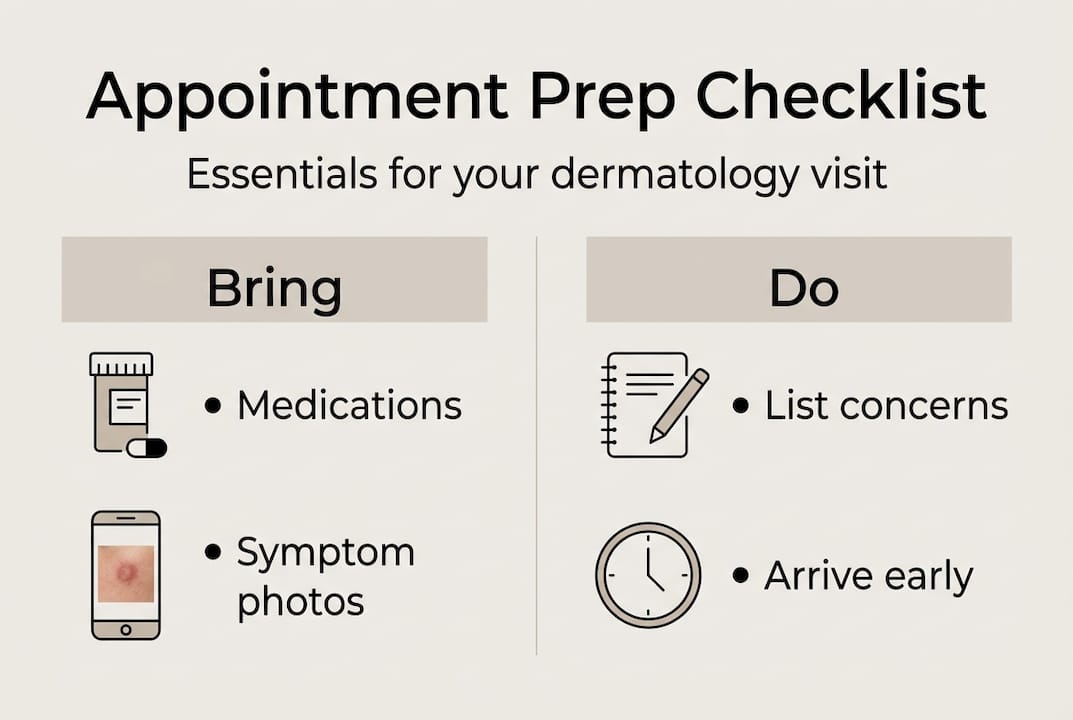
Start with your medications. Write down every prescription, over-the-counter drug, supplement, and vitamin you currently take. Include dosages if you know them. Your dermatologist needs this information to avoid prescribing something that could interact badly with what you’re already taking. A medication list and symptoms makes your visit more efficient and helps your doctor make faster, more accurate decisions.
Next, pull together your personal and family history related to skin. Has anyone in your family had melanoma, psoriasis, or eczema? Do you have a history of sunburns or tanning bed use? These details are not just background noise. They directly shape how your dermatologist approaches your care.
If you’ve noticed a changing mole, a recurring rash, or any skin concern that comes and goes, take photos before your appointment. Skin conditions can look different from day to day, and a photo taken during a flare-up is worth more than a verbal description.
Here’s a quick breakdown of what to bring versus what’s optional:
| Bring | Optional |
|---|---|
| Medication list with dosages | Insurance cards (check if already on file) |
| Known allergies | Previous dermatology records |
| Symptom timeline and photos | Referral letter from primary care |
| List of questions | Notes from past treatments |
| Family skin history | Skincare product labels |
You can also review the AAD preparation checklist to make sure nothing slips through the cracks. And if you’re still deciding on a provider, reading up on choosing a dermatologist can help you find the right fit before you book.
Pro Tip: Write your top three concerns on a notepad or your phone before the appointment. Rank them by priority so that if time runs short, your most important issue gets addressed first.
How to prepare your skin and daily routine
Once you’ve gathered important documents and information, it’s just as vital to properly prepare your skin for examination. What you put on your skin in the 24 hours before your visit can actually interfere with what your doctor sees.
Here’s a step-by-step approach for the day before and day of your appointment:
- Skip all makeup and foundation. Cosmetics mask skin tone changes, redness, and lesions.
- Remove nail polish. Dermatologists often check nails for signs of fungal infections or systemic conditions.
- Avoid applying lotions, serums, or sunscreen. These can alter the texture and appearance of your skin.
- Shower, but don’t scrub. Clean skin is ideal, but aggressive exfoliation can irritate or temporarily change the appearance of problem areas.
- Don’t shave over moles or skin lesions. This can cause bleeding or trauma that complicates the exam.
- Leave scabs alone. Peeling them off removes evidence your doctor may need to see.
- Skip self-tanner for at least a week prior. Artificial color changes can mask or mimic melanoma warning signs.
As noted in guidance for prepare your skin for procedures, you should avoid makeup and nail polish before your visit. The same principle applies to routine skin exams.

| Do | Don’t |
|---|---|
| Shower the morning of | Apply lotions or serums |
| Wear comfortable, easy-to-remove clothing | Wear heavy makeup or foundation |
| Leave skin bare and natural | Use self-tanner in the days before |
| Keep nails clean and polish-free | Shave directly over lesions or moles |
| Bring a list of current skincare products | Peel or pick at scabs |
For broader guidance on everyday skin health tips and how your routine affects your skin’s condition, it’s worth reviewing what habits support long-term skin health. You can also check skin check recommendations from the American Cancer Society for additional context.
Pro Tip: Keep your skin as natural as possible. Your dermatologist is trained to read what your skin is actually doing, not what it looks like under a layer of product.
Communicating your concerns effectively
With your skin ready, the next crucial step is making sure your concerns are clearly communicated to make the most of your appointment. Time in the exam room moves fast, and a clear, organized patient gets more out of every minute.
Start by preparing a timeline of your symptoms. When did you first notice the issue? Has it gotten worse, better, or stayed the same? Is it seasonal? Does it flare after certain foods, stress, or sun exposure? These patterns give your doctor real diagnostic clues.
Be specific about what makes things better or worse. “It itches more at night” or “it calms down after I use a cold compress” tells your dermatologist far more than “it’s just really uncomfortable.”
Also, be upfront about previous treatments. If you’ve tried an over-the-counter cream, a prescription from another doctor, or a home remedy, say so. Mention whether it helped and whether you experienced any side effects. Explaining symptoms, triggers, and treatments clearly improves outcomes and helps your doctor avoid repeating approaches that haven’t worked.
Here are the top ways to organize your concerns before your visit:
- List your top three to five symptoms in order of urgency
- Note when each symptom started and how it has changed
- Describe any known triggers or patterns
- Mention all treatments tried, including results
- Write down any important questions for your visit so you don’t forget them under pressure
“The most productive appointments happen when patients arrive with a clear picture of their symptoms, a record of what they’ve tried, and a short list of specific questions. It saves time and leads to better care.” — Rao Dermatology
For additional guidance, Harvard Health has compiled a useful list of questions for dermatologists that can help you think through what to ask.
What to expect during the appointment
Once prepared, knowing what to expect during your visit can ease nerves and help you focus on your health. Most appointments follow a predictable structure, and understanding it removes a lot of the mystery.
- Check-in. You’ll verify your insurance, complete or update intake forms, and confirm your reason for the visit. Bring your ID and insurance card.
- Medical history review. A nurse or medical assistant will ask about your health history, current medications, and the concern that brought you in.
- Visual skin exam. Your dermatologist will examine the area of concern and, depending on your visit type, may do a full-body skin check. You’ll likely be given a gown or drape for privacy and comfort.
- Diagnosis and discussion. Your doctor will explain what they observe, ask follow-up questions, and discuss possible diagnoses.
- Next steps. This may include a biopsy, a prescription, a referral, or simply a recommendation to monitor the area. Ask about follow-up timing before you leave.
Most skin exams include a thorough history, visual skin check, and time for questions. Research on patient satisfaction consistently shows that patients who feel heard and informed during their visit report higher satisfaction scores and are more likely to follow through with treatment plans.
If time feels rushed, it’s completely appropriate to say, “I have a couple more questions before we finish.” Advocating for yourself is not rude. It’s expected. You can also review the types of services offered at Rao Dermatology ahead of time so you know what’s available. For a broader overview of what happens during a skin exam, the Skin Cancer Foundation outlines visit expectations in a helpful format.
Common mistakes and how to avoid them
Even with the best intentions, mistakes happen. Here’s how you can avoid the most common ones and what to do if you slip up.
Wearing makeup or forgetting new symptoms can hinder accurate diagnosis, and these are among the most frequent errors patients make. Here’s the full list:
- Wearing makeup or heavy skincare products on the day of the visit
- Forgetting to mention a new symptom because it seems unrelated or minor
- Using a new skincare product in the days before the appointment, which can trigger a reaction that confuses the exam
- Leaving out medications or supplements from your list because you assume they’re not relevant
- Downplaying symptoms out of embarrassment or thinking they’re not worth mentioning
- Arriving without questions written down, then forgetting them once you’re in the room
If you realize on the morning of your appointment that you forgot to prep your skin or compile your medication list, don’t cancel. Just be upfront. Tell your doctor, “I’m wearing some moisturizer today, I wasn’t sure I needed to skip it.” Honesty fills the gap that preparation would have covered.
For more context on when symptoms deserve attention, reviewing reasons to see a dermatologist can help you recognize what’s worth flagging. The AAD also outlines the most common dermatology appointment mistakes and how to sidestep them.
Pro Tip: If you forgot your medication list, pull up your pharmacy app on your phone. Most apps show your complete prescription history and can serve as a quick substitute.
An expert perspective: Why preparation makes all the difference
Here’s something patients rarely hear: preparation doesn’t just help you. It genuinely changes what your doctor can do for you in the time you have together.
When a patient walks in with a clear symptom timeline, a photo of their rash from two weeks ago, and a short list of questions, the appointment shifts. Instead of spending the first ten minutes reconstructing a history, the doctor can move directly into assessment and problem-solving. That’s not a small thing. In a 20-minute appointment, those ten minutes are everything.
Many patients assume preparation matters only for complex conditions. That’s a misconception. A seemingly minor detail, like mentioning that a spot appeared after starting a new blood pressure medication, can completely change a diagnosis. Dermatology is full of conditions that mimic each other. Context is what separates a correct diagnosis from a missed one.
We’ve seen it repeatedly across our practice. Prepared patients leave with clearer answers, more targeted treatment plans, and less need for follow-up visits to fill in gaps. If you’re still working on finding the right dermatologist for your needs, start there. Then show up ready. That combination is hard to beat.
Take the next step: Book with a trusted dermatologist
Now that you know how to make the most of every dermatology appointment, it’s time to apply these tips to your next visit. Preparation puts you in control of your skin health and gives your doctor the full picture they need to help you effectively.

At Rao Dermatology, our board-certified team brings over 25 years of experience in both medical dermatology and cosmetic care across New Jersey, New York, and California. Whether you’re managing a chronic skin condition or noticing something new, we’re here to give you personalized, expert attention. Explore our full range of all dermatology services and take the first step toward clearer, healthier skin. Your skin deserves expert care, and you deserve to feel confident walking into every appointment.
Frequently asked questions
What should I not do before a dermatology appointment?
You should avoid products and cosmetics prior to your visit, including makeup, nail polish, lotions, self-tanners, and any new skincare products that could alter your skin’s natural appearance.
What information should I bring to my dermatology appointment?
Bring a list of your current medications, known allergies, relevant medical history, and photos of symptoms if possible. Your medication list and photos help your dermatologist make faster and more accurate assessments.
How do I make sure my dermatologist addresses all my concerns?
Write down all symptoms and questions beforehand and share them at the start of your appointment. Preparing your concerns ahead leads to better results and ensures nothing important gets overlooked.
Is it normal to feel nervous before seeing a dermatologist?
Yes, it’s completely normal. Being organized and prepared helps reduce that anxiety and ensures you walk out with the answers and next steps you actually need.
Recommended
- Essential Questions to Ask Your Dermatologist During Your Next Visit | Rao Dermatology
- How to Prepare for a Chemical Peel: Manhattan Dermatologist Guide | Rao Dermatology
- How to Choose the Best Dermatologist: A Complete Guide for Patients | Rao Dermatology
- Annual Skin Cancer Screening: Your Complete Guide to Dermatology Checkups | Rao Dermatology
Filed under: