
Discover the crucial role of SPF in skincare for 2026. Protect your skin from UV damage, slow aging, and lower cancer risk with our expert guide.

SPF is defined as the measure of how well a sunscreen protects skin from UVB radiation, the rays responsible for sunburn and DNA damage that leads to skin cancer. The role of SPF in skincare extends beyond preventing a burn. It is the single most evidenced intervention dermatologists recommend to slow premature aging, reduce hyperpigmentation, and lower skin cancer risk. Daily broad-spectrum SPF 15–30 or higher protects against both UVB-induced sunburn and UVA-associated aging, with UV rays peaking in intensity between 10 a.m. and 4 p.m. Choosing the right product and applying it correctly determines whether that protection actually works.
What does the SPF number mean and how does it protect skin?
SPF measures UVB protection only. The number tells you what fraction of UVB rays the sunscreen filters before they reach your skin. SPF 30 blocks about 97% of UVB rays, while SPF 50 blocks about 98%. That one percentage point difference sounds small, and clinically, it is.
The British Skin Foundation’s 2026 clinical consensus confirms that marginal gains above SPF 50 are minimal. Chasing SPF 100 does not double your protection. What matters far more is applying enough product and reapplying consistently throughout the day.
SPF says nothing about UVA protection. UVA rays penetrate deeper into the skin, driving collagen breakdown, wrinkles, and pigmentation changes. Broad-spectrum sunscreens protect against both UVA and UVB, making the “broad-spectrum” label a non-negotiable requirement when you shop. A product with a high SPF number but no broad-spectrum rating leaves your skin exposed to the most aging form of UV radiation.
SPF protection levels at a glance
| SPF Level | UVB Rays Blocked | Broad-Spectrum UVA Coverage |
|---|---|---|
| SPF 15 | ~93% | Only if labeled broad-spectrum |
| SPF 30 | ~97% | Only if labeled broad-spectrum |
| SPF 50 | ~98% | Only if labeled broad-spectrum |
| SPF 50+ | Marginally above 98% | Only if labeled broad-spectrum |
Key facts to remember when reading SPF labels:
- SPF measures UVB protection only, not UVA.
- “Broad-spectrum” is the label that confirms UVA coverage.
- SPF 30 and SPF 50 differ by just one percentage point of UVB blockage.
- No sunscreen blocks 100% of UV radiation.
- Water-resistant ratings (40 or 80 minutes) indicate how long protection holds during swimming or sweating.
How to use SPF effectively in your skincare routine
Correct application technique determines whether your SPF actually performs at its rated level. Most people significantly under-apply sunscreen, which means the protection they receive is far lower than the SPF number on the label. Getting the quantity right is as important as choosing the right product.
Follow these steps for effective daily SPF use:
- Complete your full morning routine first. Apply cleanser, toner, serum, and moisturizer. Let each layer absorb fully before moving to sunscreen.
- Apply SPF as the final step. SPF applied last in your routine creates an even, unbroken protective film over the skin. Layering products on top disrupts that film.
- Use the right amount. NHS 2026 guidelines recommend 6–8 teaspoons of sunscreen for full body coverage. For the face and neck alone, a nickel-sized amount is the standard minimum.
- Apply 30 minutes before sun exposure. Chemical sunscreens need time to bind to the skin before they become active. Mineral sunscreens work immediately, but the 30-minute window is a reliable habit for both types.
- Reapply every two hours. Reapply after swimming or sweating, regardless of the water-resistance rating on the label.
- Do not rely on SPF in makeup alone. Foundation or powder with SPF rarely gets applied in sufficient quantity to deliver the stated protection level.
Pro Tip: Apply sunscreen to your ears, the back of your neck, and the tops of your hands. These are the areas most consistently missed and most frequently show early signs of UV damage.
Why daily SPF matters for every skin tone and skin condition
SPF benefits every skin tone, not just fair skin. Melanin provides some natural photoprotection, but it does not prevent UVA or UVB skin damage. People with darker skin tones face a real risk of hyperpigmentation and photoaging without daily SPF use. The protection melanin offers is partial and inconsistent.
“Sunscreen is the most evidenced intervention to slow skin aging and prevent pigmentation and skin cancer. Consistent daily use outperforms any other topical product in long-term skin health outcomes.” — Dermatology clinical guidance
UV exposure does not stop when the sun disappears behind clouds. Up to 80% of UV light passes through clouds and glass windows, which means sitting near a window at work still exposes your skin to meaningful UV radiation. Daily SPF use is not a summer habit. It is a year-round practice.
Specific skin conditions and treatments make SPF even more critical:
- Retinoid users: Retinoids accelerate cell turnover and thin the outer skin layer, making it significantly more vulnerable to UV damage. Daily SPF is required when using tretinoin, retinol, or any prescription retinoid.
- Exfoliant users: Chemical exfoliants like AHAs and BHAs remove the protective outer layer of dead skin cells. Fresh skin underneath burns faster and pigments more easily.
- Post-procedure skin: Skin recovering from chemical peels, laser treatments, or microneedling is acutely sensitive to UV. SPF is non-negotiable during recovery.
- Hyperpigmentation conditions: Melasma and post-inflammatory hyperpigmentation worsen with UV exposure. Consistent SPF use is a core part of managing both conditions.
You can explore dermatologist-recommended skincare routines to see how SPF integrates with other active ingredients across different skin types.
How to choose the right SPF product for your skin type
SPF 30–50 covers the needs of most people for daily use. The difference between SPF 50 and SPF 100 is clinically negligible, so the choice of formula matters more than chasing a higher number. The two main formula categories are mineral and chemical, and each suits different skin types and lifestyles.
Mineral vs. chemical sunscreens
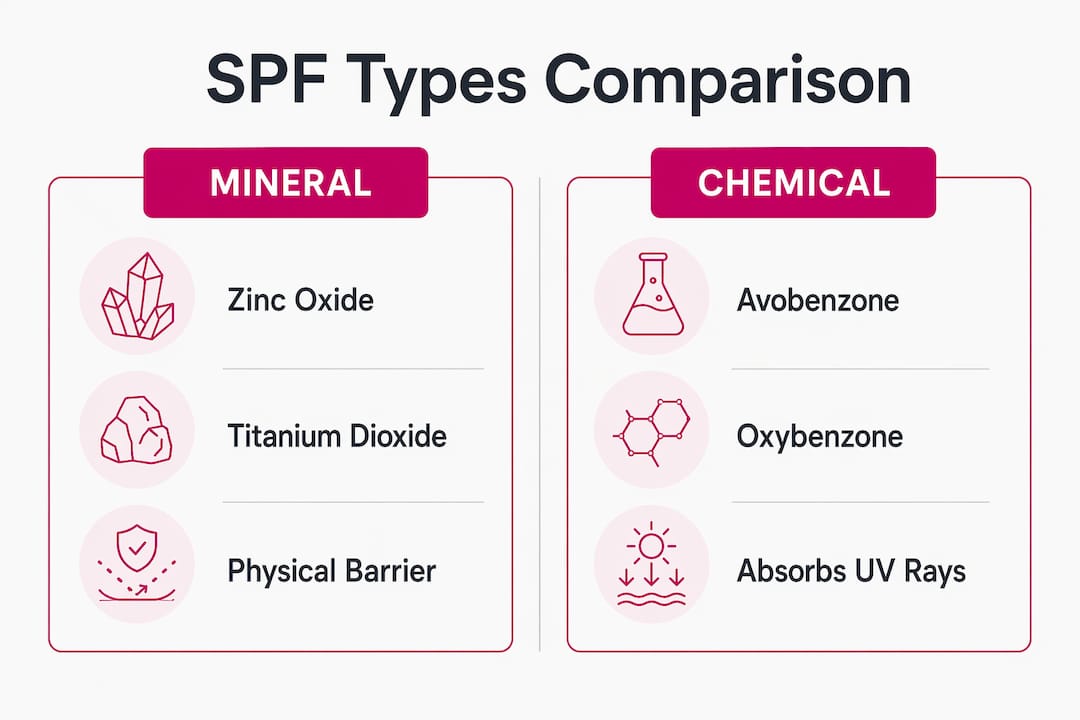
SPF products come in physical (mineral) and chemical formulas, each with distinct properties that affect how they feel on skin and who they suit best.
| Feature | Mineral (Physical) | Chemical |
|---|---|---|
| Active ingredients | Zinc oxide, titanium dioxide | Avobenzone, octinoxate, oxybenzone |
| How it works | Reflects UV rays off skin surface | Absorbs UV rays and converts to heat |
| Best for | Sensitive skin, rosacea, post-procedure | Everyday use, oily or acne-prone skin |
| Texture | Can leave white cast; newer formulas less so | Lightweight, invisible finish |
| Onset | Works immediately on application | Requires 20–30 minutes to activate |
| Water resistance | Available in both formulas | Available in both formulas |
Matching your SPF to your lifestyle improves the chance you will actually use it every day. A heavy, greasy formula worn under makeup will be skipped. A lightweight, non-comedogenic formula becomes a habit.
For outdoor sports or swimming, choose a water-resistant formula rated for 80 minutes and reapply on schedule. For office-based days with window exposure, a daily moisturizer with integrated broad-spectrum SPF 30 is a practical minimum. People with sensitive skin or conditions like rosacea typically tolerate mineral formulas better because they do not penetrate the skin barrier.
Pro Tip: If you find sunscreen breaks you out, switch to a mineral formula with zinc oxide as the sole active ingredient. Zinc oxide is anti-inflammatory and less likely to clog pores than most chemical filters.
For a deeper look at sunscreen types and protection, Raodermatology’s guide covers the full spectrum of product options and how to match them to your skin’s needs.
Key Takeaways
Daily broad-spectrum SPF 30 or higher, applied in sufficient quantity and reapplied every two hours, is the most effective single step you can take to protect skin from UV damage, premature aging, and skin cancer.
| Point | Details |
|---|---|
| SPF measures UVB only | Always choose broad-spectrum to protect against UVA-driven aging and pigmentation. |
| SPF 30 is sufficient for most | SPF 30 blocks 97% of UVB; gains above SPF 50 are clinically minimal. |
| Quantity determines effectiveness | Apply 6–8 teaspoons for the body and a nickel-sized amount for the face. |
| Daily use is non-negotiable | Up to 80% of UV light passes through clouds and glass, making year-round SPF necessary. |
| Formula choice drives compliance | Match mineral or chemical sunscreen to your skin type so you actually wear it every day. |
SPF is the one step I never let patients skip
After years of working alongside dermatologists and seeing the full range of what UV damage does to skin over decades, one pattern stands out clearly. Patients who wore SPF consistently, even imperfectly, aged better and developed fewer pigmentation problems than those who used every premium serum on the market but skipped sun protection.
The conversation I find myself having most often is about consistency versus perfection. People abandon SPF because they forget to reapply, or the formula feels heavy, or they think a cloudy day gives them a pass. None of those reasons hold up against the evidence. A daily SPF 30 applied every morning, even without perfect reapplication, delivers far more cumulative protection than an SPF 50 used only on beach days.
The other misconception worth addressing directly: darker skin tones do not get a free pass. I have seen patients with deep brown skin develop significant melasma and photoaging because they were told melanin was enough. It is not. SPF is for every skin tone, every season, and every skin condition.
The most practical advice I can give is to find a formula you genuinely like wearing. Texture, finish, and scent matter because they determine whether SPF becomes a daily habit or a bottle that sits unused. Pair it with a skin cancer prevention routine and you have the foundation of genuinely protective skincare.
— Krunal
Raodermatology’s approach to sun protection and skin health
Raodermatology brings over 25 years of clinical expertise to skin cancer prevention, detection, and treatment across California, New Jersey, and New York. If you are managing a skin condition that requires careful sun protection, using prescription-strength actives, or simply want a personalized sunscreen recommendation from a board-certified dermatologist, a consultation provides far more than any product label can.

Raodermatology’s skin cancer prevention services include comprehensive screening and tailored prevention strategies built around your skin type, tone, and lifestyle. The practice also offers esthetic and cosmetic services that incorporate sun protection education as a core part of every treatment plan. Protecting your skin starts with the right guidance from a specialist who knows your skin.
FAQ
What does SPF stand for and what does it measure?
SPF stands for Sun Protection Factor. It measures how well a sunscreen blocks UVB rays, the rays that cause sunburn and contribute to skin cancer risk.
Is SPF 30 or SPF 50 better for daily use?
SPF 30 is sufficient for most daily use, blocking about 97% of UVB rays. SPF 50 blocks about 98%, a marginal difference that matters less than applying enough product and reapplying every two hours.
Does sunscreen need to be reapplied indoors?
Reapplication indoors is not required if you stay away from windows. Up to 80% of UV light passes through glass, so people who sit near windows for extended periods should apply SPF in the morning and reapply if sun exposure is prolonged.
Can people with darker skin tones skip sunscreen?
No. Melanin provides partial natural protection but does not prevent UVA or UVB damage. People with darker skin tones still face real risks of hyperpigmentation, photoaging, and skin cancer without daily SPF use.
What is the difference between mineral and chemical sunscreen?
Mineral sunscreens use zinc oxide or titanium dioxide to reflect UV rays and work immediately on application. Chemical sunscreens absorb UV rays and convert them to heat, requiring 20–30 minutes to activate after application.
Recommended
- National Healthy Skin Month: Essential Dermatologist-Approved Tips for Year-Round Skin Health | Rao Dermatology
- Skin Cancer Prevention Tips: Your Sun Safety Guide | Rao Dermatology
- 2024 Skincare Resolutions: Expert Dermatologist Tips for Healthier Skin | Rao Dermatology
- Complete Guide to Sunscreen and Sunblock: Protection, Types, and Benefits | Rao Dermatology
Filed under: