
Aim for a skin cancer second opinion within 1–2 weeks. Request biopsy slides and the pathology report, and consult a dermatopathologist or Mohs surgeon to...

Most patients newly diagnosed with skin cancer benefit from a second opinion, especially when the pathology report reads as ambiguous, the recommended treatment is extensive, or the tumor sits in a cosmetically sensitive spot. The single most useful action right now: ask your treating clinician to release copies of your biopsy slides and pathology report, then schedule a review with a board-certified dermatologist or dermatopathologist. If the lesion is changing fast, bleeding, or your doctor has flagged it as likely melanoma, say so explicitly and ask whether any delay is safe before you wait for that second appointment.
TL;DR:
- Second opinions are especially crucial when pathology reports are ambiguous, the cancer is rare or aggressive, or it appears in cosmetically sensitive areas.
- Experts such as dermatopathologists, Mohs surgeons, and specialized cancer centers provide the most accurate assessments before treatment begins, ideally within one to two weeks.
- Patients should request full biopsy slides, dermoscopy images, clinical notes, and prior treatment records to ensure an effective review process.
- Insurance generally covers medically necessary second opinions, but prior authorization and direct slide transfer are important to avoid delays.
- Most second opinions confirm the initial diagnosis, but in some cases, they can lead to different treatment plans or additional pathology work, making timely review essential.
Table of Contents
- Who Should Get a Skin Cancer Second Opinion?
- How Fast Should You Get a Second Opinion?
- Who Should You Ask for a Second Opinion?
- How to Prepare for a Second-Opinion Appointment
- What Can a Second Opinion Actually Change?
- Does Insurance Cover a Second Opinion for Skin Cancer?
- Common Misconceptions About Second Opinions in Skin Cancer
- Our Perspective on Second Opinions
- Requesting a Second Opinion Through Rao Dermatology
- Sources
- FAQ
Who Should Get a Skin Cancer Second Opinion?
Not every mole biopsy needs a second set of eyes, but certain situations call for it almost every time. If your pathology report uses hedging language like “atypical” or “cannot rule out,” if you’ve been diagnosed with a rare or aggressive subtype, or if the cancer sits on your face, ears, hands, or genitals where reconstruction matters, a second opinion is worth pursuing.
Other clear triggers include:
- A recurrence after prior treatment
- A recommendation for extensive surgery or complex reconstruction
- A diagnosis that doesn’t match what the lesion looked like clinically
- Uncertainty about whether Mohs surgery or a simpler excision is the right call
There’s a real difference between wanting emotional reassurance and requesting a review that could change your management plan. Both are valid reasons to ask, but the second kind is more likely to change what happens next. Clinicians see these requests constantly, and most confirm the original diagnosis rather than upend it. Asking is standard practice, not an insult to your doctor.
How Fast Should You Get a Second Opinion?
Timing matters more in skin cancer than people assume, but “fast” doesn’t mean “instant.” A short, deliberate pause to gather records rarely causes harm. What does cause harm is sitting on a rapidly changing, bleeding, or ulcerated lesion for months while you shop for an appointment.
- Ask your current clinician directly whether waiting a week or two is safe for your specific diagnosis.
- If melanoma is suspected or confirmed, treat scheduling as urgent and mention that when booking.
- Aim for a second-opinion appointment within one to two weeks when your case isn’t urgent, since a prompt review in that window is typically safe for most non-emergency cases.
- Request that your original doctor send an expedited slide transfer along with a written referral question, which keeps the process from stalling in administrative limbo.
The best window for a second opinion is right after diagnosis, before treatment starts, since that’s when input can still shape the actual treatment plan.
Who Should You Ask for a Second Opinion?
The right specialist depends on the question you’re trying to answer. A board-certified dermatologist or a fellowship-trained Mohs surgeon is the right call when you’re weighing surgical options or trying to understand reconstruction. Specialists who focus on skin cancer tend to be more current on treatment approaches and clinical trial eligibility than a general practice provider.
- Dermatopathologists review the actual biopsy slides when wording in your report is vague or doesn’t match what the lesion looked like.
- Mohs surgeons weigh in on surgical margins, technique choice, and cosmetic outcome in sensitive areas.
- Multidisciplinary cancer centers, including NCI-designated centers, make sense for high-risk melanoma, unusual subtypes, or if you want access to clinical trials.
- Telemedicine and remote pathology review work well for a straightforward slide re-read, but an in-person visit is better when you need a physical exam or a treatment decision that depends on tumor location and depth.
How to Prepare for a Second-Opinion Appointment
A second opinion is only as good as the records behind it. Before your appointment, request your full biopsy report, the physical pathology slides (not just the typed summary), any dermoscopy images, clinical notes, prior treatment records, and a current medication list. If you’ve had photos taken of the lesion over time, bring those too.
Slides matter more than most patients realize. A dermatopathologist reviewing the actual glass slides can reassess tumor depth, margins, and subtype in ways a written report alone can’t capture, and that re-read sometimes changes the diagnosis meaningfully. Your original clinician’s office can usually arrange this transfer directly with the new provider.
Walk in with a short, prioritized list of questions:
- How certain is this diagnosis, and would slide review change it?
- What treatment alternatives exist, and how do they compare?
- What should I expect cosmetically, especially if surgery is involved?
- What’s the realistic timeline from here to treatment?
Pro Tip: Call your original clinician’s office and ask them to send slides directly to the second opinion provider with a one-line referral note. Skipping the “mail it yourself” step often saves a week or more.
What Can a Second Opinion Actually Change?
Four outcomes are possible: full confirmation of the original diagnosis, a different treatment recommendation, a request for additional pathology work or rebiopsy, or a referral to a specialist center or clinical trial. None of these outcomes are rare, and none should feel alarming if they happen.
Pathology slide review sits at the center of most meaningful changes. A second dermatopathologist reading the same slides can catch a different subtype, a deeper invasion than initially noted, or margin concerns that shift the staging and, with it, the treatment plan.
Look for these signals when choosing who reviews your case:
- Board certification in dermatology or dermatopathology
- In-house or closely coordinated access to slide review, not just a written report handoff
- Enough clinical volume in skin cancer specifically, not general dermatology alone
Most second opinions land where the first one did. But second opinions do sometimes alter the treatment plan in a meaningful share of cases, which is exactly why pathology review and full record transfer matter more than a quick phone consult.
Does Insurance Cover a Second Opinion for Skin Cancer?
Most insurers cover medically necessary second opinions for a cancer diagnosis, though prior authorization requirements and network restrictions vary by plan. Call your insurer before scheduling to confirm what paperwork, if any, they need from your treating physician.
Medicare generally covers second opinions for cancer care as well, but plan specifics still matter, so verify the details for your exact coverage.
A few steps speed things along:
- Ask your current doctor for a formal referral, which some insurers require for coverage.
- Have that office forward pathology slides directly rather than routing them through you.
- Tell the scheduler if your case is urgent. Many practices keep short-notice slots open for suspected melanoma.
- Ask whether a virtual pathology review is an option before committing to an in-person visit, which can shave days off the wait.
Common Misconceptions About Second Opinions in Skin Cancer
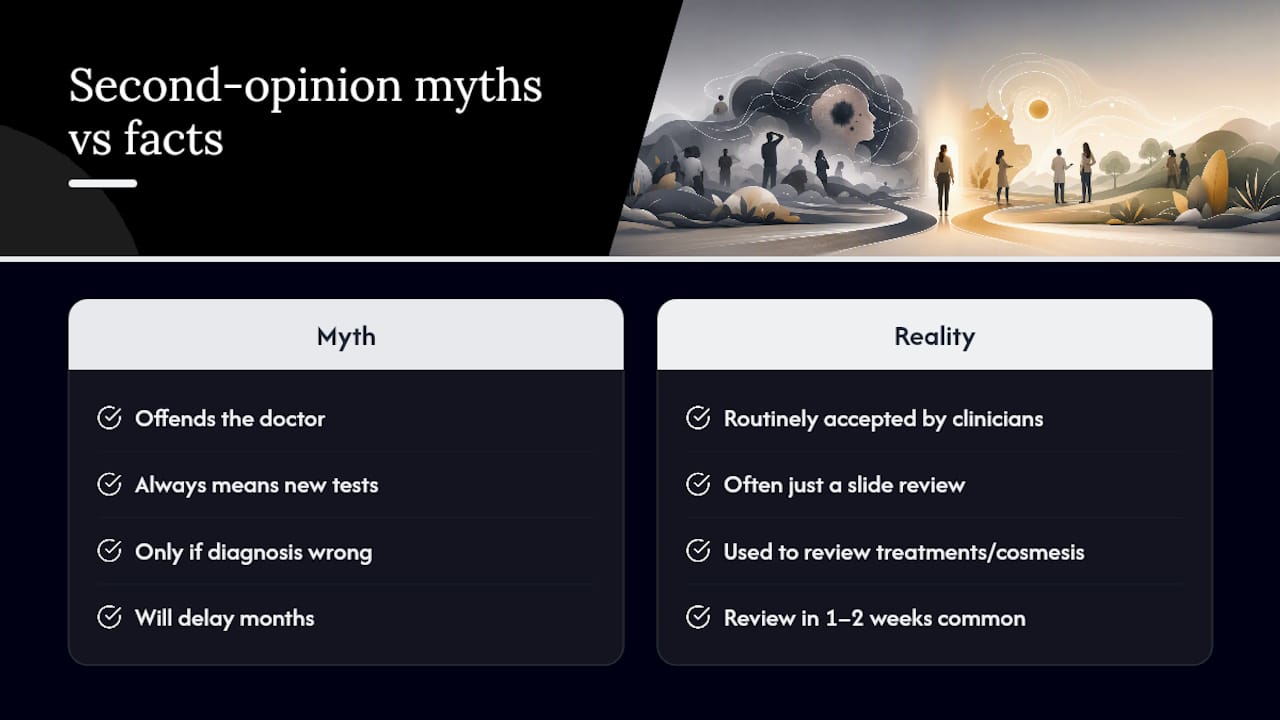
The biggest myth is that asking for a second opinion offends your doctor or signals distrust. In practice, oncologists and dermatologists field these requests routinely, and most treat it as a normal part of cancer care rather than a challenge to their judgment.
A second misconception: that a second opinion always means starting over with new tests. Often it just means a different set of trained eyes reading the same pathology slides, which is faster and less invasive than most patients expect.
Some patients also assume a second opinion is only for people who doubt their diagnosis is correct. In reality, plenty of patients seek one purely to understand treatment alternatives or get clarity on cosmetic outcomes before agreeing to surgery in a visible area.
There’s also a fear that getting a second opinion will delay treatment for months. In most non-urgent cases, a review within one to two weeks doesn’t meaningfully change your outcome, and it can prevent a bigger delay later if the original plan needed adjusting.
Finally, some patients think a second opinion has to come from a name-brand cancer center to count. A qualified board-certified dermatologist or dermatopathologist reviewing your actual slides can offer just as much clarity as a large institution, and often faster.
Our Perspective on Second Opinions
Patients rarely need a second opinion because their first doctor got it wrong. They need one because skin cancer decisions, especially around Mohs surgery, reconstruction, and cosmetically sensitive sites, benefit from more than one trained perspective before a scalpel is involved.
Coordinating pathology slide review quickly is the part patients underestimate. Getting slides from one office to another shouldn’t take weeks, and when it does, it’s almost always an administrative gap rather than a medical one. Diagnostic tools can add clarity in ambiguous cases without requiring an additional biopsy, and consulting a Mohs surgeon early, before reconstruction becomes an afterthought, tends to produce better cosmetic outcomes.
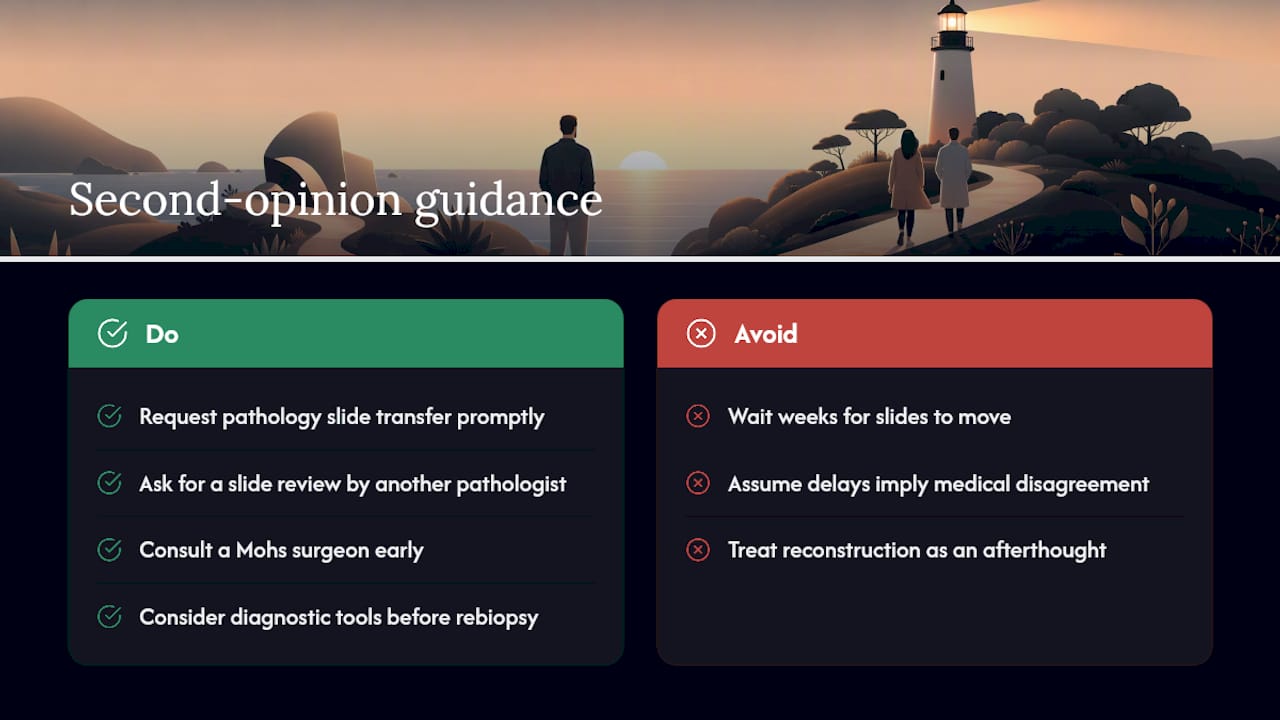
The goal isn’t to second-guess your first doctor. It’s to walk into treatment with enough clarity that you’re not wondering, months later, whether you asked the right questions.
— Rao Dermatology
Requesting a Second Opinion Through Rao Dermatology
Rao Dermatology gives you a direct path to specialist review instead of a maze of referral phone calls. The practice coordinates pathology slide review, offers Mohs surgery consultations, and uses confocal microscopy to clarify ambiguous cases without repeat biopsies, all under one roof across its California, New Jersey, and New York locations.
If you’re weighing a diagnosis you’re not fully settled on, or a treatment plan that involves surgery in a visible area, the fastest way forward is to request an appointment and have your current clinician forward your pathology slides and biopsy report ahead of time. That single step, done before you walk in, is usually what separates a productive first visit from one that ends in “let’s order more records.” Start by reviewing Rao Dermatology’s skin cancer prevention, detection, and treatment services and requesting a consultation with your slides ready to send.
This article is general information, not a substitute for advice from a qualified doctor. Consult a qualified healthcare professional about your own circumstances before acting on anything here.
Sources
- Is it time to seek a second opinion?
- Getting a Second Opinion for Melanoma
- Second Opinion Appointments
- Find NCI-Designated Cancer Centers
FAQ
How Long Can You Live With Untreated Skin Cancer?
It depends heavily on the type. Basal and squamous cell carcinomas grow slowly and are rarely life-threatening if caught within a reasonable window, but melanoma can spread within months if left untreated. Any changing, bleeding, or rapidly growing lesion needs prompt evaluation rather than a wait-and-see approach.
Will Medicare Pay for a Second Opinion on Cancer Treatment?
Medicare generally covers second opinions for a cancer diagnosis, and many private insurers do the same for medically necessary reviews. Confirm your specific plan’s referral or prior authorization requirements before scheduling, since rules vary by insurer.
What Is the Two-Week Rule for Skin Cancer?
It refers to fast-track referral pathways used when a lesion is strongly suspected to be skin cancer, aiming to get patients seen by a specialist within about two weeks of referral. For second opinions specifically, a review within one to two weeks is typically considered a safe window for non-urgent cases.
How Long Can You Have Skin Cancer Without Knowing?
Some skin cancers, particularly slow-growing basal cell carcinomas, can go unnoticed for months or even years before diagnosis. Melanoma tends to announce itself faster through visible changes in a mole’s color, shape, or size, which is why regular skin checks and prompt biopsy of suspicious spots matter.
Can Rao Dermatology Coordinate a Second Opinion With Pathology Slide Review?
Yes. Rao Dermatology coordinates dermatopathology review alongside Mohs surgery consultations and confocal microscopy, giving patients a single point of contact for both diagnosis confirmation and treatment planning across its locations.
Recommended
Filed under: