
Get psoriasis insurance coverage faster in the U.S. Learn CMS appeals timelines, clinic documentation tactics (PASI/BSA, photos), and short term financial...

Most U.S. health plans, whether commercial, Medicare, or Medicaid, cover psoriasis treatment when your dermatologist documents it as medically necessary. The catch is speed: prior authorization and step therapy rules routinely delay biologics and specialty drugs by weeks. If you’re starting a new treatment, call your insurer today to confirm whether the drug falls under your medical or pharmacy benefit, and ask your dermatologist’s office to begin the prior authorization paperwork the same day.
TL;DR:
- Most insurance plans require prior authorization and step therapy, which can delay biologic treatments by several weeks unless quickly addressed.
- Benefits often depend on benefit routing, with biologics administered in-office billed under medical benefits and pharmacy pick-up billed separately with different costs.
- Documentation such as PASI or BSA scores, clinical photos, and a dermatologist’s letter significantly increases chances of approval for biologic drugs.
- Denials typically stem from incomplete step therapy, formulary exclusions, or lack of medical necessity, but patients can appeal within set timeframes and seek external reviews.
- Financial aid options like manufacturer copay cards, assistance programs, and HSA or FSA funds can mitigate costs during approval delays.
Table of Contents
- Psoriasis Insurance Coverage by Plan Type: Commercial, Medicare, and Medicaid
- Why Do Insurers Require Prior Authorization for Psoriasis Drugs?
- What Happens After a Psoriasis Coverage Denial?
- Financial Assistance Options While You Wait for Approval
- How Your Dermatologist Strengthens a Psoriasis Coverage Request
- A Note From Rao Dermatology on Navigating Psoriasis Coverage
- Get Help With Psoriasis Care and Insurance Navigation
- Trusted Resources for Psoriasis Coverage and Appeals
- Sources
- FAQ
Psoriasis Insurance Coverage by Plan Type: Commercial, Medicare, and Medicaid
Coverage rules shift depending on where your plan comes from, and knowing the difference saves you a lot of confused phone calls. Employer-sponsored plans and ACA marketplace plans generally cover dermatology visits, topical prescriptions, phototherapy, and systemic or biologic drugs, but each carrier sets its own formulary and prior authorization rules. Medicare splits things awkwardly: Part B covers in-office treatments like injections, infusions, and phototherapy sessions, while Part D handles self-administered pills and injectables you’d pick up at a pharmacy. Medicaid coverage for psoriasis medication varies by state, since each Medicaid program builds its own preferred drug list and prior authorization criteria.
What tends to be covered across nearly all dermatology insurance plans:
- Dermatologist office visits and diagnostic exams
- Topical corticosteroids and other first-line topical treatments
- Phototherapy (UVB) administered in-office
- Systemic medications like methotrexate or oral retinoids
- Biologic injections or infusions, once approved through prior authorization
The detail that trips people up is benefit routing. A biologic given by injection in your dermatologist’s office often bills under the medical benefit, while the same drug picked up at a retail pharmacy bills under the pharmacy benefit, with a completely different copay structure. Before starting treatment, ask your insurer directly which benefit applies and pull up your plan’s own formulary rather than trusting what your pharmacy tells you at the counter, since confirming benefit routing early prevents surprise bills.
Why Do Insurers Require Prior Authorization for Psoriasis Drugs?
Insurers use prior authorization and step therapy to control spending on expensive specialty drugs, and biologics for psoriasis are some of the priciest medications on any formulary. Prior authorization means your insurer has to approve the drug before it pays for it. Step therapy means you often have to try and fail a cheaper option first, usually a topical, methotrexate, or phototherapy, before the plan will approve a biologic. Prior authorization requirements for biologics have grown more common in recent years, and documentation quality is often the deciding factor in whether a request gets approved on the first try.
What insurers typically want to see before approving a biologic:
- A diagnosis confirmed by a dermatologist, not a primary care referral alone
- PASI (Psoriasis Area and Severity Index) or BSA (Body Surface Area) scores showing disease severity
- Documentation of prior treatments tried and why they failed or were unsuitable
- Recent labs, when the drug requires baseline monitoring
- Dated clinical photos showing plaque extent and severity
Statistic Callout: Federal appeals guidance from CMS confirms that patients have a formal right to challenge a denial through internal appeal and, if that fails, an independent external review process, a right many patients never use.
Formulary tier placement also affects your wallet directly. A biologic on a specialty tier can carry a coinsurance percentage instead of a flat copay, which is why checking payer formulary positioning before your dermatologist prescribes a specific brand can save weeks of back-and-forth if a competing drug is preferred on your plan.
What Happens After a Psoriasis Coverage Denial?
Denials usually come down to three reasons: you haven’t completed step therapy, the drug isn’t on your plan’s formulary, or the insurer decided the treatment isn’t “medically necessary” based on the paperwork submitted. None of these are final answers.
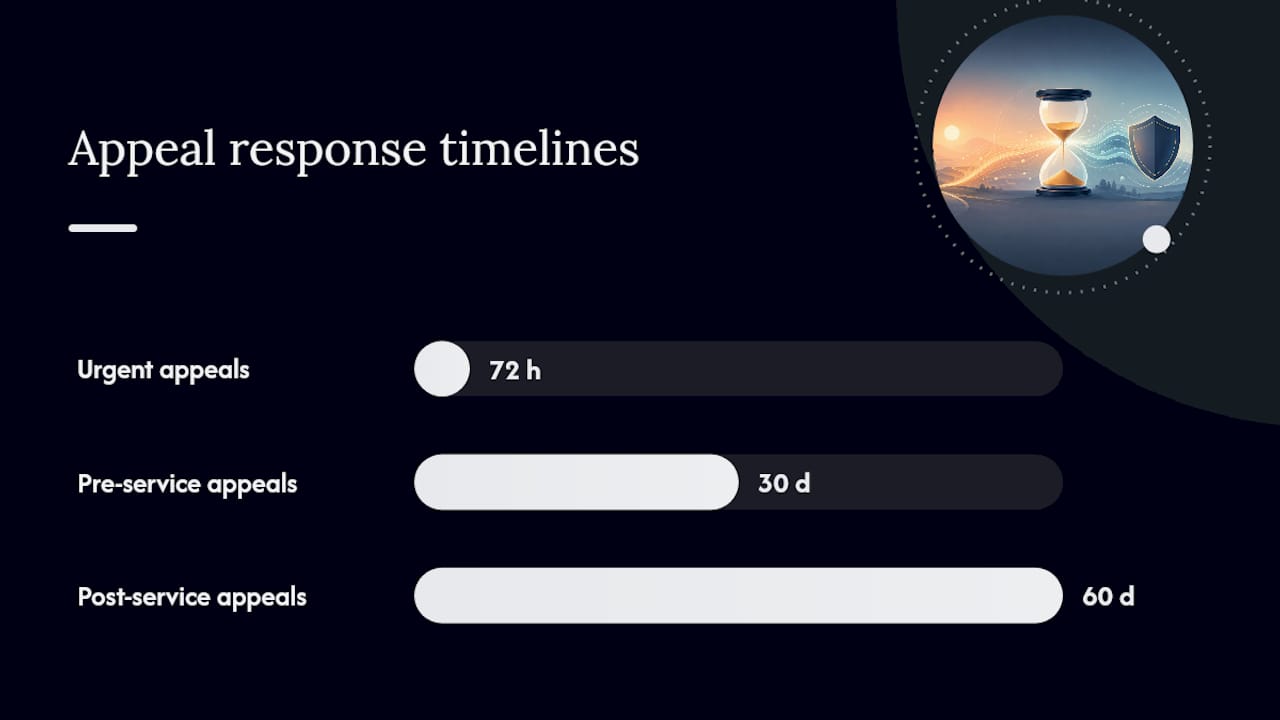
Federal rules give you a real timeline to work with. Under CMS appeals guidance, insurers must respond to urgent appeals within 72 hours, standard pre-service appeals within 30 days, and post-service claim appeals within 60 days. If your internal appeal still gets denied, you have the right to request an independent external review, where a party outside your insurance company makes the final call.
What to include with any appeal:
- A letter of medical necessity from your dermatologist, specific to your case
- Your PASI or BSA scores, ideally showing a trend over time
- A full list of prior treatments tried, with dates
- Names and reference numbers from every insurer phone call
- Copies of the original denial letter and any prior correspondence
Pro Tip: Keep a single running log, even a simple notes app entry, with every insurer call date, representative name, and reference number. When you escalate to appeal, that log turns a frustrating phone tag situation into a two-minute conversation.
Clinician involvement changes outcomes here. Many patients simply stop after one denial, but organized documentation paired with a dermatologist willing to file the appeal materially improves approval rates.
Financial Assistance Options While You Wait for Approval
Prior authorization and appeals take time, and treatment costs don’t pause just because paperwork is pending. A few concrete options can bridge that gap.
- Manufacturer copay cards: Most biologic makers offer copay assistance that can drop a monthly cost to near zero for commercially insured patients, though these programs generally exclude Medicare and Medicaid patients due to federal anti-kickback rules.
- Patient assistance programs: Income-qualified programs run directly by drug manufacturers can provide medication free or heavily discounted while you sort out formal coverage.
- Nonprofit grants: Organizations including disease-specific funds like TotalAssist’s psoriasis fund offer grants toward copays, premiums, and related costs for eligible patients, and the National Psoriasis Foundation maintains a running list of financial assistance resources and appeal letter templates.
- HSA or FSA funds: Both can be used tax free for deductibles, copays, and out-of-pocket drug costs, which softens the blow while a prior authorization is still pending.
- Clinic payment plans: Many dermatology offices will work out a payment plan for interim costs, so ask before assuming you have to pay everything at once.
How Your Dermatologist Strengthens a Psoriasis Coverage Request
The single biggest lever in getting a biologic approved quickly is what your dermatologist puts on paper. A strong letter of medical necessity leans on objective numbers, not general impressions, and PASI and BSA scores paired with dated clinical photos and a DLQI quality-of-life score make the strongest first-pass request.
Step therapy doesn’t always require actually failing phototherapy. If phototherapy is genuinely impractical, because of distance from a clinic, a work schedule that can’t accommodate two or three sessions a week, or a contraindication, that impracticality can be documented instead of forcing a patient through a treatment that was never going to work.
- Track prior authorization expiration dates and flag renewals 45 days ahead of time
- Keep a template letter of medical necessity ready to customize per payer
- Log every authorization number and insurer contact centrally, not in a random file
Pro Tip: Ask your dermatology office directly whether they track PA renewal dates for you. A well-run clinic catches a lapsing authorization before your pharmacy calls to say your refill got rejected.
A Note From Rao Dermatology on Navigating Psoriasis Coverage
Insurance denials on psoriasis treatment are common, and they are rarely the final word. Some dermatology teams routinely help patients build the documentation an insurer actually wants, file appeals when a first request gets rejected, and walk patients through what an external review looks like when it comes to that. If you’re hitting a wall with your insurer, save every letter you receive, write down every authorization number a representative gives you, and call your dermatologist’s office before you give up on a denied claim. Early advocacy from a dermatologist can change outcomes far more than waiting it out alone.
— Rao Dermatology
Get Help With Psoriasis Care and Insurance Navigation
Some dermatology practices treat psoriasis with an insurance-savvy approach: checking benefit routing during scheduling, documenting PASI and BSA scores as standard practice, and handling prior authorization paperwork directly with insurers instead of leaving patients to manage it alone.

If topicals and prior treatments haven’t controlled your flares, our psoriasis and dermatitis care team can evaluate whether phototherapy, systemic therapy, or a biologic fits your case, and start the authorization process at your first visit. Bring any denial letters, insurer correspondence, or prior treatment records to your appointment so we can build your file correctly from day one. Schedule a visit through our medical dermatology services page and ask our front desk to flag insurance verification before your appointment date.
Trusted Resources for Psoriasis Coverage and Appeals
For appeals timelines, see CMS’s appeals guidance. For patient navigation and grants, visit the National Psoriasis Foundation.
This article is general information, not a substitute for advice from a qualified doctor. Consult a qualified healthcare professional about your own circumstances before acting on anything here.
Sources
- CMS — Appealing health plan decisions (fact sheets and FAQs)
- Paying for Psoriasis and Psoriatic Arthritis Treatment — National Psoriasis Foundation
- Clinician role in appeal processes — PMC
- Getting the best coverage for your psoriasis treatment — HealthCentral
FAQ
Does Insurance Typically Cover Biologic Drugs for Psoriasis?
Yes, most commercial, Medicare, and Medicaid plans cover biologics for psoriasis once medical necessity is documented, but nearly all require prior authorization first. Approval usually depends on PASI or BSA severity scores and proof that cheaper treatments were tried or are impractical, per documentation standards clinicians rely on.
Is Psoriasis Considered a Disability for Insurance or Benefits Purposes?
Psoriasis itself is not automatically classified as a permanent disability, but severe cases with joint involvement (psoriatic arthritis) or significant functional limitation may qualify for disability benefits under Social Security’s medical criteria. Qualification depends on documented severity and how much it limits your ability to work, decided case by case.
What Does Kim Kardashian Use to Cover Her Psoriasis?
Kim Kardashian has publicly discussed using cosmetic camouflage products and topical treatments to manage visible psoriasis patches, alongside prescribed medical treatment for the underlying condition. Her approach reflects a common pattern: cosmetic coverage manages appearance while a dermatologist manages the disease itself.
Which Organ Is Most Often Linked to Psoriasis Complications?
Psoriasis is primarily a skin condition, but it’s linked to systemic inflammation that raises risk for joint damage (psoriatic arthritis), cardiovascular disease, and liver strain, particularly with certain systemic medications. This is why dermatologists often coordinate with other specialists for moderate to severe cases.
What Can I Claim If I Have Psoriasis?
You can claim coverage for medically necessary treatment, including dermatology visits, topicals, phototherapy, systemic drugs, and biologics, through your health insurance once your dermatologist documents the diagnosis and severity. If your plan denies a claim, you have the right to file an internal appeal and, if needed, request independent external review under federal rules.
Recommended
Filed under: