
Patient-focused guide to photodynamic therapy for skin. Learn trial results (up to 91% AK clearance), what to expect, pain-reduction options, and how to...
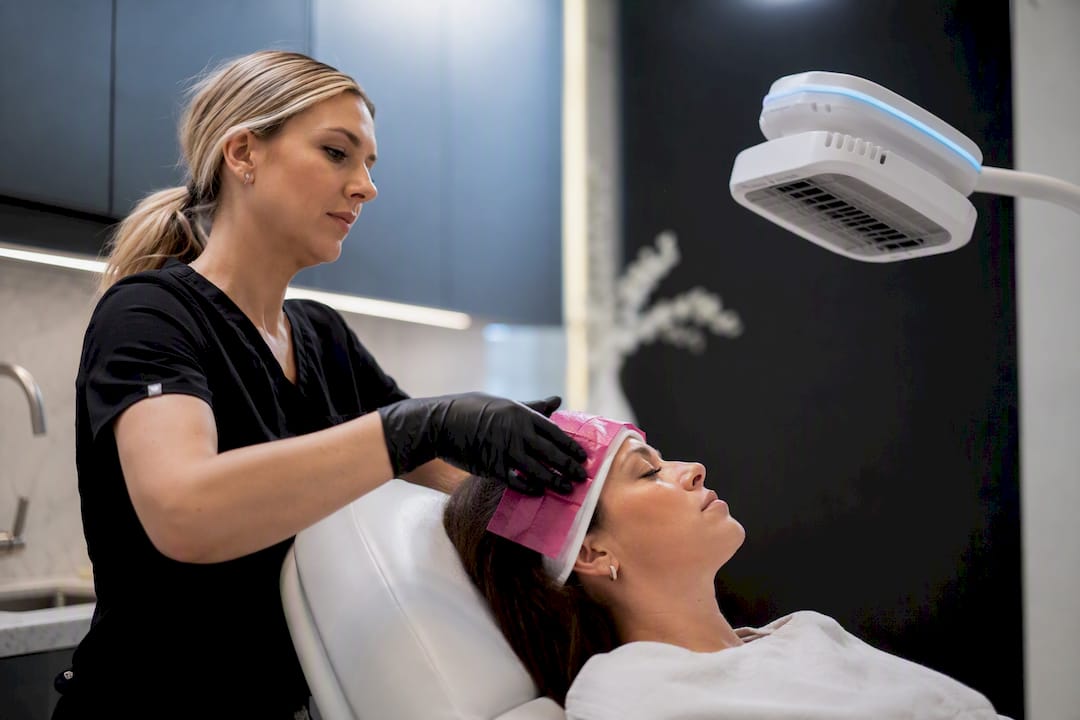
Photodynamic therapy is a two-stage, tissue-sparing procedure that pairs a topical photosensitizer with light activation to destroy abnormal skin cells. It’s a strong option for actinic keratoses, Bowen disease, superficial basal cell carcinoma, and field cancerization, delivering high clearance rates without the scarring that comes with excision. The trade-off is real: burning or stinging pain during the light exposure and a strict window of avoiding sun and bright indoor light afterward.
TL;DR:
- PDT achieves up to 91% lesion clearance at 12 weeks for actinic keratoses, though effectiveness decreases with thicker, hyperkeratotic lesions.
- The procedure causes burning during illumination and sunburn-like skin reactions afterward, with redness lasting one to two weeks.
- Daylight PDT significantly reduces pain compared to conventional protocols, especially for thin, surface-level lesions on the face and scalp.
- Thicker lesions may require pretreatment like curettage or laser disruption to improve photosensitizer absorption and clearance rates.
- PDT is best suited for superficial or confined lesions, with biopsy recommended for suspicious or deeper growths before considering this treatment.
Table of Contents
- How Does Photodynamic Therapy Work on Skin?
- What Conditions Does PDT Treat?
- What Happens During a PDT Appointment?
- How Effective Is Photodynamic Therapy for Skin Conditions?
- What Are the Side Effects and Risks of PDT?
- Are There Less Painful Ways to Do Photodynamic Therapy?
- How Do You Know If PDT Is Right for Your Skin?
- Rao Dermatology’s Approach to Photodynamic Therapy
- What Dermatologists Want Patients to Understand About PDT
- Ready to Explore Photodynamic Therapy? Here’s How to Start
- Where to Learn More About PDT
- Sources
- FAQ
How Does Photodynamic Therapy Work on Skin?
Photodynamic therapy runs on a simple chain reaction. A photosensitizing drug is applied to the skin, where damaged and precancerous cells absorb it faster and in higher concentrations than normal tissue. Inside those cells, the drug converts into protoporphyrin IX, a compound that sits dormant until it’s hit with light of a specific wavelength. Once activated, protoporphyrin IX generates reactive oxygen species that damage and destroy the targeted cells from the inside out.
That selective uptake is what makes PDT a tissue-sparing alternative to surgery for the right lesions. Because abnormal cells absorb more photosensitizer than the healthy skin around them, the light activation step does most of its damage exactly where it’s needed, sparing surrounding tissue and improving cosmetic results compared with cutting the lesion out.
Patients will encounter a handful of photosensitizer names in clinic paperwork:
- ALA (aminolevulinic acid): the most widely used agent in the United States, approved for actinic keratosis treatment
- BF-200 ALA: a nanoemulsion formulation of ALA designed for better skin penetration
- MAL (methyl aminolevulinate): a related agent used more commonly outside the U.S. and in daylight protocols
What Conditions Does PDT Treat?
Actinic keratoses are the primary, guideline-backed use for photodynamic therapy, especially when a patient has several lesions scattered across sun-damaged skin rather than one isolated spot. That pattern, known as field cancerization, is where PDT earns its reputation: it treats the whole affected area at once rather than one lesion at a time.
Beyond AKs, PDT has a solid track record for two other conditions:
- Bowen disease (squamous cell carcinoma in situ): PDT works well here because the abnormal cells stay confined to the top layer of skin
- Superficial basal cell carcinoma: effective for thin, surface-level BCCs, but not for nodular or deeply invasive subtypes
- Field cancerization on the scalp, face, and forearms: broad treatment of sun-damaged skin to reduce future lesion formation
Dermatologists also use PDT off-label for acne, certain skin infections, and general skin rejuvenation, though the evidence base for those uses is thinner than for actinic keratosis treatment and results vary more from patient to patient.
What Happens During a PDT Appointment?
Preparation starts before you ever sit in the treatment chair. For thicker or scalier actinic keratoses, dermatologists often recommend several days of a keratolytic cream, or perform gentle curettage right before the photosensitizer goes on, because removing that hyperkeratotic scale significantly improves how much photosensitizer the abnormal cells absorb.
The appointment itself follows a fairly consistent sequence:
- The skin is cleansed and, if needed, lightly debrided to remove scale.
- The photosensitizer is applied directly to the treatment area and sometimes covered with an occlusive dressing.
- You wait through the incubation period, anywhere from 15 minutes for shortened protocols to an hour or more for conventional ones.
- Eye protection goes on, and the treatment area is exposed to the chosen light source for several minutes.
- The area is cleaned, and a dressing or soothing ointment is applied before you head home.
Aftercare is where PDT asks the most of the patients. Strict avoidance of direct sunlight and bright indoor light for at least 48 hours is non-negotiable, since residual photosensitizer in the skin can react to light exposure and cause a severe burn-like reaction. Expect a follow-up visit within a few weeks to check healing and decide whether a second session is needed.
Pro Tip: Bring sunglasses, a wide-brimmed hat, and a light scarf to your appointment. If you’re treating a large facial area, arrange a ride home. Stepping straight from a dim exam room into bright afternoon sun on the drive home is one of the most common ways patients accidentally undo their own aftercare.
How Effective Is Photodynamic Therapy for Skin Conditions?
Clearance rates for photodynamic therapy on actinic keratoses are genuinely strong. Field-directed trials using BF-200 ALA have reported complete lesion clearance rates as high as 91% at 12 weeks compared with placebo, and repeated field treatment meaningfully cuts down the number of new lesions that appear over time.
By the numbers: Field-directed BF-200 ALA photodynamic therapy has achieved complete AK clearance rates up to 91% at 12 weeks in randomized trials, a figure that drops as lesion thickness increases.
That last point matters more than the headline number. Thicker, more hyperkeratotic lesions clear less completely and recur more often than thin, early-stage AKs, which is exactly why pretreatment scale removal and photosensitizer choice carry so much clinical weight. For patients weighing PDT against excision, the cosmetic case is compelling: PDT tends to produce better cosmetic outcomes than surgical removal when treating the face or large treatment areas, largely because there’s no incision to heal. The realistic trade-off is that some patients see temporary or, rarely, lasting changes in skin pigment at the treatment site.
What Are the Side Effects and Risks of PDT?
The illumination phase is the part patients remember most. Burning, stinging, or a hot prickling sensation during light exposure is the norm, not the exception, and it typically peaks partway through the session before easing off once the light source is removed. Over the following days, treated skin looks and feels like a bad sunburn: redness, swelling, and crusting are expected, with most of that resolving over one to two weeks.
- Common and expected: burning during treatment, sunburn-like redness, crusting, occasional blistering
- Less common: localized infection, temporary or permanent pigment changes, scarring in rare cases
- Rare but serious: systemic photosensitivity reactions in patients using systemic (rather than topical) photosensitizing agents
Pain management options have expanded considerably. Daylight PDT, shortened incubation protocols, cool air or cold compresses during illumination, and topical anesthetic can all bring discomfort down without sacrificing much efficacy for appropriate lesions. PDT isn’t right for everyone, though: pregnant patients, people with certain porphyrin metabolism disorders, and those on medications that heighten photosensitivity generally need an alternative approach.
Are There Less Painful Ways to Do Photodynamic Therapy?
Daylight PDT has changed the pain conversation for a lot of AK patients. Instead of a controlled lamp, the treated area is exposed to natural or artificial daylight for about two hours after a short incubation period, and European Dermatology Forum guidelines note this approach delivers non-inferior efficacy for actinic keratosis compared with conventional red-light PDT, with substantially less discomfort.
- Daylight or artificial daylight PDT: markedly lower pain scores, best suited to thinner AKs on the face and scalp
- Shortened incubation protocols: keeps the photosensitizer more contained inside cells, which lowers pain during illumination
- Pretreatment with fractional ablative laser or curettage: mechanically disrupts the skin barrier to let the photosensitizer penetrate deeper, raising clearance rates for thicker or hyperkeratotic lesions
- Alternative light sources (IPL, pulsed dye lasers): sometimes combined with PDT for patients who also want improvement in redness or texture, though evidence here is less mature than for standard protocols
None of these variations are universal upgrades. A dermatologist weighs lesion thickness, location, and how much discomfort a patient can tolerate before choosing a shortened or daylight protocol over the conventional version.
How Do You Know If PDT Is Right for Your Skin?
Lesion characteristics drive most of this decision. Thin actinic keratoses and superficial lesions spread across a field of sun-damaged skin are ideal candidates. Anything suspicious for invasive cancer, or a lesion thicker than about 2 millimeters, generally needs a biopsy and likely surgical treatment instead, since PDT’s effectiveness drops as depth increases.
Walking into a consultation with the right questions helps you get a protocol that fits your skin and your tolerance for downtime:
- Which photosensitizer and light source do you recommend for my specific lesions, and why?
- How many sessions should I expect, and how will you judge whether it worked?
- What pain control options are available, and would daylight PDT work for my case?
- What does my light-avoidance and aftercare schedule look like day by day?
- How will you monitor for recurrence or new lesions afterward?
If a lesion looks aggressive, has grown quickly, or doesn’t fit the classic AK or superficial BCC pattern, biopsy and surgical options deserve serious consideration before PDT is even on the table.
Rao Dermatology’s Approach to Photodynamic Therapy
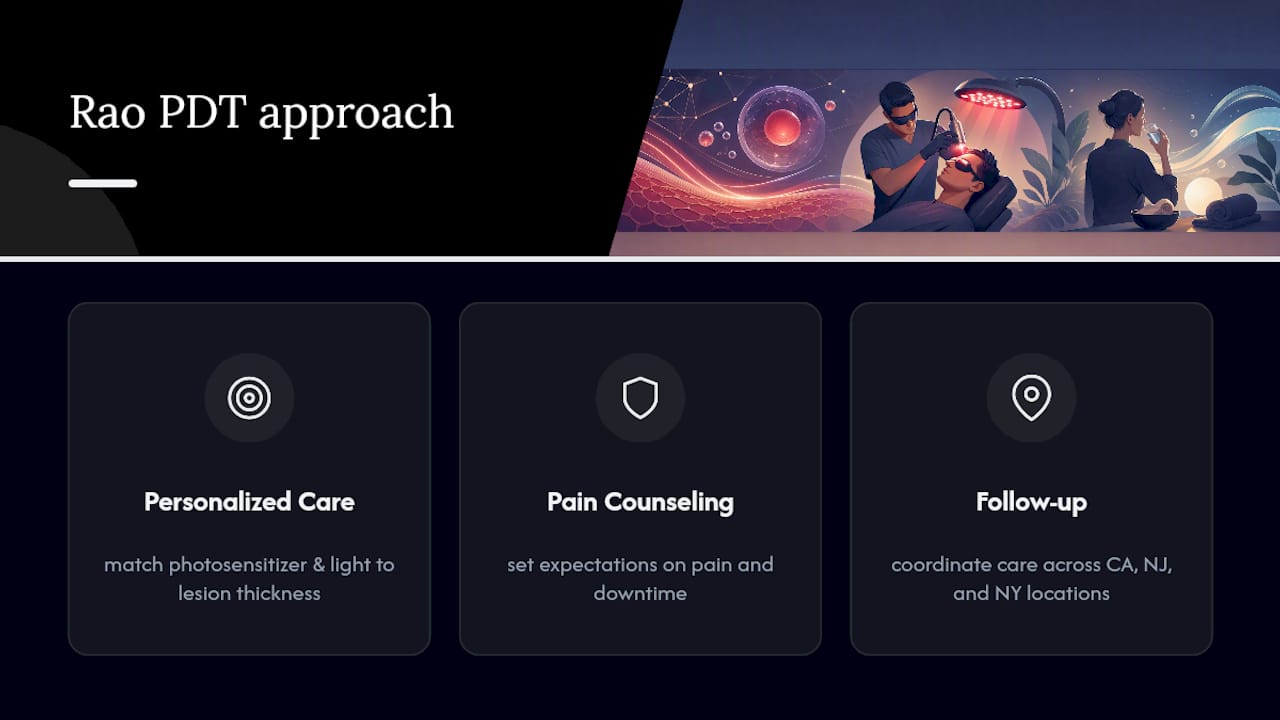
Rao Dermatology, founded by Dr. Babar K. Rao with more than 25 years in dermatology, builds each PDT protocol around the specific lesion, not a one-size template. That means matching photosensitizer and light source to lesion thickness, counseling patients on realistic pain and downtime before treatment day, and coordinating follow-up across skin cancer care locations in California, New Jersey, and New York.
What Dermatologists Want Patients to Understand About PDT
PDT excels at field cancerization and cosmetic-priority cases, but it isn’t a guaranteed single-visit cure for every lesion. Patients often underestimate the pain during illumination and overestimate how quickly redness fades. The bigger point gets missed too: clearing today’s lesions doesn’t end the need for regular skin surveillance, since sun-damaged skin keeps producing new ones.
— Rao Dermatology
Ready to Explore Photodynamic Therapy? Here’s How to Start
If you’re dealing with actinic keratoses, Bowen disease, or a superficial basal cell carcinoma, photodynamic therapy can be offered as part of a broader skin cancer prevention and treatment program, tailored to your lesion type rather than a fixed protocol.
A first visit typically includes a full skin exam, a look at your specific lesions under magnification, and a conversation about whether PDT, laser pretreatment, or another approach fits your situation best. Medically necessary PDT for precancers and skin cancers is usually covered by insurance, while cosmetic applications of light-based treatment are handled as direct-pay services. Visit Rao Dermatology’s skin cancer services page to see locations across California, New Jersey, and New York, or explore the full range of dermatology services to schedule a consultation and get a treatment plan built around your skin.
Where to Learn More About PDT
- The National Cancer Institute’s overview of photodynamic therapy covers the procedure, common side effects, and aftercare basics in plain language.
- Memorial Sloan Kettering’s patient leaflet on photodynamic therapy walks through the appointment sequence step by step.
- UCSF Health’s guide to photodynamic therapy offers practical tips on light-avoidance planning at home.
This article is general information, not a substitute for advice from a qualified doctor. Consult a qualified healthcare professional about your own circumstances before acting on anything here.
Sources
The agent and light source a dermatologist chooses aren’t interchangeable. ALA formulations are FDA approved specifically for actinic keratosis, and BF-200 ALA’s nanoemulsion base helps it penetrate thicker, scalier lesions more effectively than standard ALA. MAL sees more use in daylight protocols and outside the U.S., though its mechanism is essentially the same.
Light source matters just as much as the drug:
- Photodynamic Therapy to Treat Cancer - National Cancer Institute (NCI)
- Photodynamic Therapy - Rush University Medical Center
Incubation time, the period the photosensitizer sits on the skin before light exposure, is the variable that shapes almost everything else about the visit. Longer incubation (an hour or more) generally improves depth of effect but also increases pain, because protoporphyrin IX has more time to spread into the spaces between cells. Shorter incubation protocols keep the compound more contained inside cells, which reduces nociceptor activation during illumination and cuts pain scores meaningfully. That single choice, drug plus incubation plus light source, is why two patients getting “the same” PDT can have very different appointments.
FAQ
What Are the Downsides of Photodynamic Therapy?
The main downsides are burning pain during light exposure, several days of sunburn-like redness and crusting, and a strict 48-hour light-avoidance period that disrupts normal routines. Thicker lesions also clear less completely than thin ones, sometimes requiring a second session.
What Will My Face Look Like After Photodynamic Therapy?
Expect redness, swelling, and crusting that resembles a moderate sunburn, typically peaking in the first few days and improving over one to two weeks. Most patients see smoother, more even skin once healing finishes, though occasional pigment changes can occur.
How Long Does Your Face Stay Red After PDT?
Redness usually lasts one to two weeks, with the most noticeable swelling and crusting in the first three to five days. Daylight or shortened-incubation protocols tend to produce milder, shorter-lived redness than conventional high-incubation PDT.
Is Photodynamic Therapy Worth It?
For actinic keratoses, Bowen disease, and superficial basal cell carcinoma, PDT offers strong clearance rates with cosmetic outcomes that generally beat surgical excision, making it worth the temporary discomfort for most eligible patients. It’s less worth it for thick or suspicious lesions, where surgery or biopsy remains the better first step.
Recommended
Filed under: