
U.S. Mohs surgery costs commonly total $2,400–$5,000 (complex cases $6,000–$12,000+). Learn how Medicare's 20% coinsurance affects your bill and follow a...
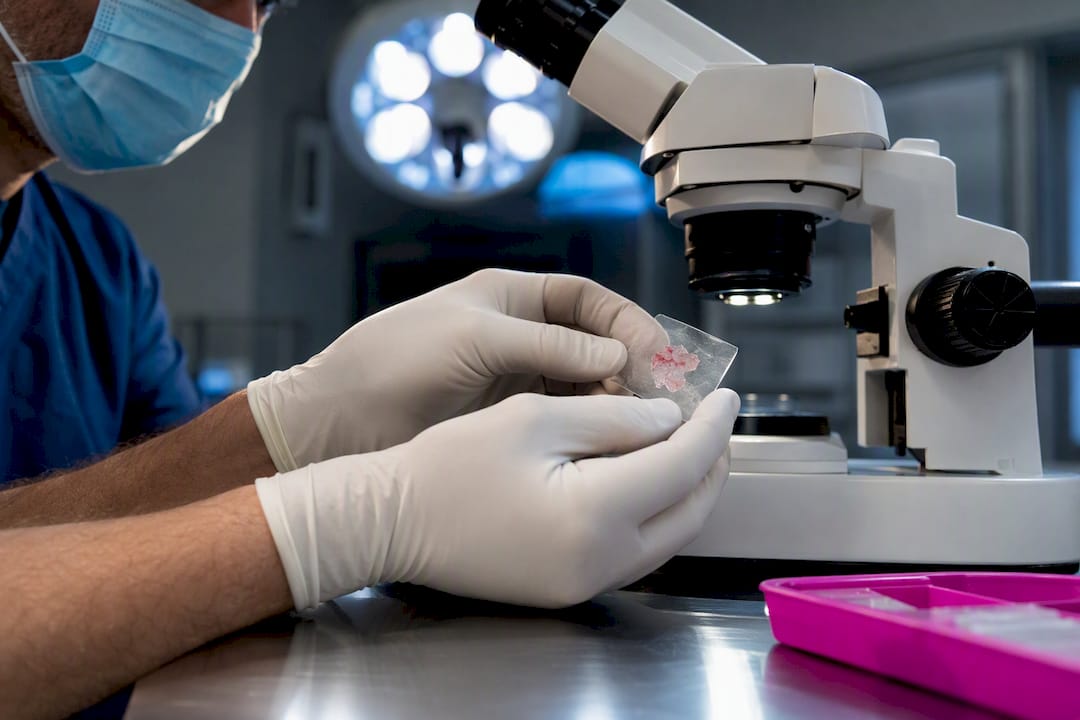
Most patients pay per stage for Mohs surgery within a wide range, with total procedure costs commonly landing at several thousand dollars when insured. Medicare and most private plans cover Mohs when it’s medically necessary, but your actual bill depends on your deductible, coinsurance, and whether your surgeon accepts assignment. Uninsured patients can face $10,000 or more for complex cases requiring multiple stages and reconstruction.
TL;DR:
- The total cost of Mohs surgery often exceeds initial estimates because the number of stages required cannot be accurately predicted beforehand.
- Reconstruction procedures like flaps or grafts significantly increase the final bill, especially if performed separately by a plastic surgeon.
- Out-of-pocket expenses are heavily influenced by the number of stages, tumor location, reconstruction type, and whether the procedure occurs in a hospital or office setting.
- Most Medicare coverage covers 80% of the approved amount, but patients must meet criteria for medical necessity, and private insurance costs vary based on plan specifics.
- Patients should obtain a detailed, written estimate that includes potential reconstruction costs and verify insurance coverage before scheduling the procedure.
Table of Contents
- Average Mohs Surgery Cost and Price Ranges
- What Drives the Price of Your Mohs Procedure
- Medicare, Private Insurance, and Your Real Out-of-Pocket Cost
- Getting an Accurate Out-of-Pocket Estimate Before You Schedule
- Office, Surgery Center, or Hospital: Where You Have It Done Matters
- How Rao Dermatology Prices Mohs and Helps Patients Plan
- Why Mohs Surgery Cost Confusion Persists
- Get a Personalized Mohs Cost Estimate From Rao Dermatology
- Where These Cost Figures Come From
- Sources
- FAQ
Average Mohs Surgery Cost and Price Ranges
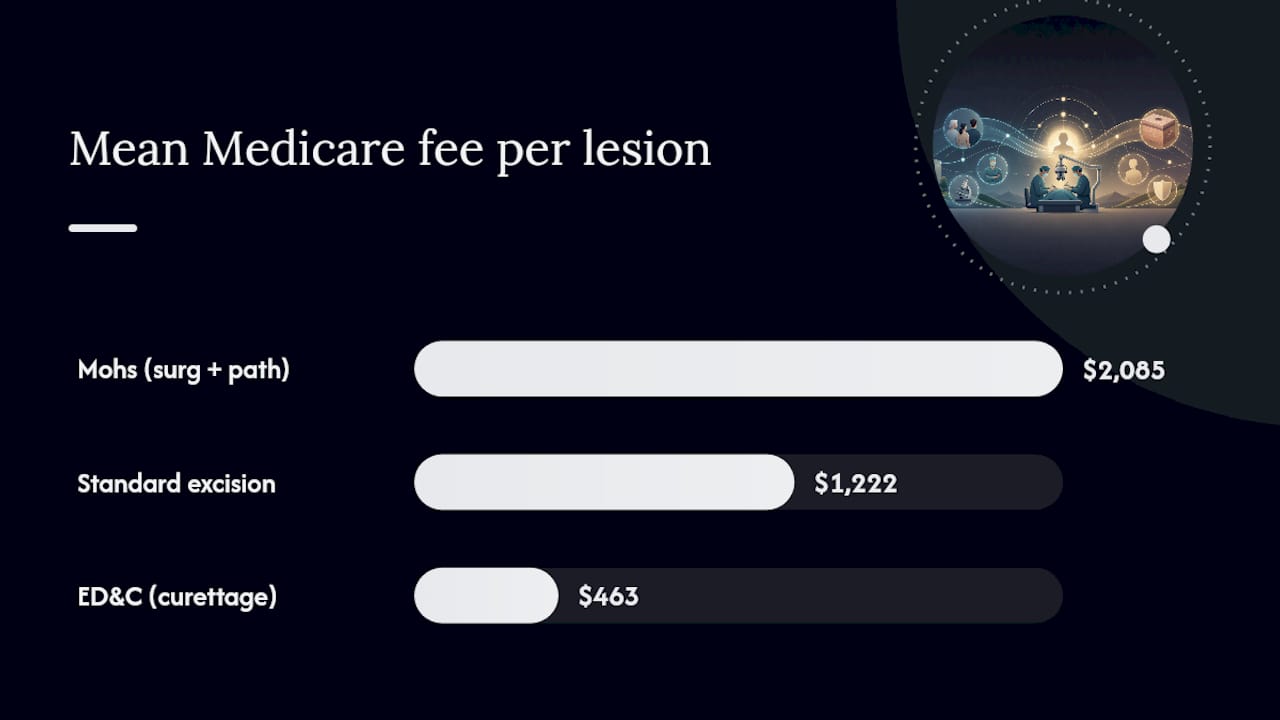
The per-stage price of Mohs surgery typically runs within a broad range, and most tumors require one to a few stages to clear completely. A 2011 fee analysis of Medicare claims found the mean fee per lesion for Mohs came to $2,085, compared to $1,222 for standard excision and just $463 for electrodesiccation and curettage. That gap exists because Mohs bills for both the surgical work and the on-site pathology review, not because the surgery itself is inherently more invasive.
Patient-reported data tells a similar story from the other direction. Survey respondents on RealSelf report an average cost around $2,575, though uninsured or cash-pay patients dealing with larger tumors or extensive reconstruction sometimes see bills reach $10,000 to $12,000.
Here’s how the numbers typically break down:
- First stage: $1,000 to $2,500
- Each additional stage: $500 to $1,500 (most cases need two stages)
- Total for straightforward cases: $2,400 to $5,000
- Complex cases with reconstruction: $6,000 to $12,000+
Quick math check: If your surgeon quotes three stages plus a flap repair, expect a total bill closer to $8,000 before insurance adjustments, not the $2,500 headline number quoted for a single stage.
What Drives the Price of Your Mohs Procedure
Four factors do most of the work in determining what you’ll actually owe.
Number of stages matters more than anything else on the bill. Mohs works by removing thin layers of tissue and examining each one under a microscope on-site until the margins are clear. One stage might resolve a small, well-defined basal cell carcinoma. A recurrent or poorly defined tumor can take three, four, or more stages, and each one adds a separate charge.
Tumor location changes the technical difficulty and therefore the price. Cancers in the “H-zone” (the central face, around the eyes, nose, ears, and lips) demand more precision and often more stages because surgeons need to preserve function and appearance in tight anatomical spaces. Hands and feet carry similar complexity.
Reconstruction type can swing your bill significantly. A simple stitched closure costs far less than a flap or skin graft, and some cases require a referral to a plastic surgeon for a separate procedure and a separate bill.
Facility and anesthesia fees stack on top of the surgical charge, and pathology may appear as its own line item depending on how the practice bills.
- Number of stages performed
- Tumor location and anatomical complexity
- Reconstruction method (closure, flap, graft, or referral)
- Facility fee and local anesthesia charges
- Separate physician and pathology billing
Pro Tip: Ask your surgeon’s office whether the same physician performs both the excision and the pathology reading. Correct billing under CPT codes 17311 through 17315 requires that dual role, and mismatched documentation is one of the more common reasons claims get delayed or denied.
Medicare, Private Insurance, and Your Real Out-of-Pocket Cost
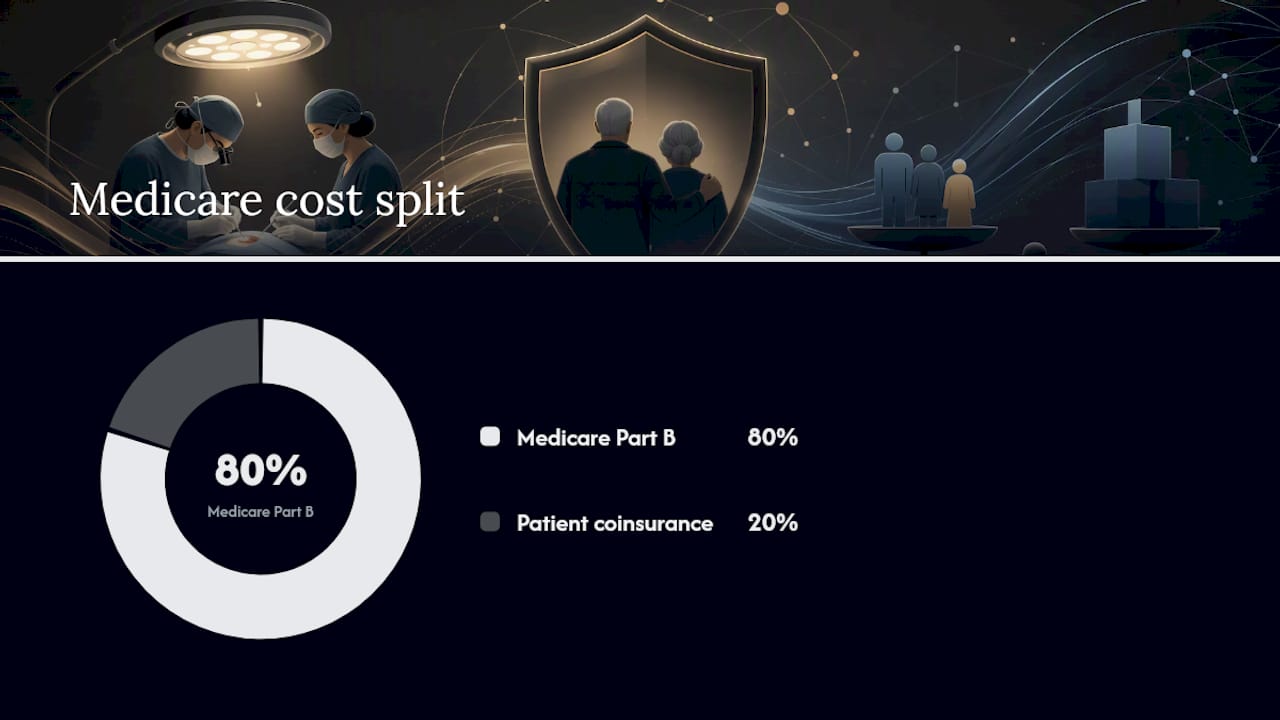
Medicare Part B covers 80% of the approved amount for Mohs surgery once you’ve met your annual deductible, leaving you responsible for the remaining 20% coinsurance. Approved amounts for a first-stage procedure typically range from about $157 to $640 depending on the tumor’s location and complexity, with each additional stage usually billed at a lower rate than the first.
Coverage isn’t automatic. Medicare’s Local Coverage Determination for Mohs surgery spells out the documentation and medical necessity criteria your surgeon must meet, generally tied to tumor size, location, aggressiveness, or recurrence. Medicare and most private insurers apply similar logic: if a dermatopathologist or biopsy confirms the cancer needs Mohs specifically, coverage follows.
Private insurance adds more variables. Your out-of-pocket total depends heavily on:
- Whether your surgeon is in-network for your specific plan
- How much of your annual deductible you’ve already met
- Your plan’s coinsurance percentage after the deductible
- Whether your plan requires prior authorization
A 2023 retrospective study in the Journal of the American Academy of Dermatology found that even as total billed costs per claim dropped between 2007 and 2019 after adjusting for inflation, patient out-of-pocket expenses climbed for most Mohs billing codes. Insurers have shifted more of the cost burden onto patients through higher deductibles, even as the procedure itself got relatively cheaper on paper. If you’re on Medicare, a Medigap policy can absorb most or all of that 20% coinsurance gap. Understanding how your deductible affects total responsibility before surgery day saves you from an unpleasant surprise afterward.
Getting an Accurate Out-of-Pocket Estimate Before You Schedule
Don’t schedule surgery based on a rough estimate. Call your insurer and your surgeon’s billing office separately, and compare what each one tells you.
- Confirm medical necessity documentation is on file, referencing the biopsy pathology report.
- Verify your surgeon’s network status directly with your insurer, not just the practice’s website.
- Ask if the surgeon accepts assignment on Medicare claims, which caps what they can charge you above the approved amount.
- Request an itemized estimate referencing CPT codes 17311 through 17315, plus expected pathology and facility charges.
- Ask how many stages are typical for a tumor like yours based on the surgeon’s experience with similar cases.
- Clarify reconstruction billing separately, since flaps and grafts often carry their own codes and costs.
Have your insurance card, biopsy report, and referral (if required) ready when you call. For uninsured patients, ask about payment plans directly. Many practices offer financing options that spread the cost over several months rather than requiring payment in full upfront.
Pro Tip: Request the estimate in writing or by email. A verbal quote over the phone has no paper trail if the final bill comes in higher than expected.
Office, Surgery Center, or Hospital: Where You Have It Done Matters
Where your Mohs procedure happens changes the bill substantially, sometimes by thousands of dollars. A study of academic hospital pricing found that cash and commercial prices for Mohs varied widely by region, and fewer than half of the hospitals studied even reported both cash and commercial rates, despite federal price transparency rules requiring disclosure.
Hospitals add facility fees on top of the physician charge, which independent offices and ambulatory surgery centers typically don’t. That’s the biggest reason hospital-based Mohs tends to cost more than the same procedure done in a dermatology office.
- Office-based Mohs: generally the lowest total cost
- Ambulatory surgery centers: moderate facility fees apply
- Hospital outpatient departments: highest cost due to facility and staffing overhead
If your tumor doesn’t require hospital-level anesthesia or monitoring, ask your surgeon whether an office-based setting is clinically appropriate. It usually is for most skin cancers referred for Mohs.
How Rao Dermatology Prices Mohs and Helps Patients Plan
Rao Dermatology performs Mohs micrographic surgery across its California, New Jersey, and New York locations, with the same physician handling both the excision and the pathology reading required for accurate CPT billing. Before scheduling, insurance benefits are reviewed and expected stages are outlined based on the specific diagnosis to provide an estimate reflective of the tumor rather than a generic average. When reconstruction is needed, coordination of the plan is done upfront instead of leaving patients to sort out a separate referral mid-treatment. Bring your insurance card and biopsy report to your consultation to help get a clearer estimate.
Why Mohs Surgery Cost Confusion Persists
Patients get frustrated by Mohs pricing because the number they hear before surgery rarely matches the number on the final bill, and that gap isn’t usually anyone’s error. It’s structural. A single-stage quote and a three-stage reality are two different bills, and most practices genuinely don’t know how many stages a tumor will need until they’re already in the room removing tissue. That unpredictability is inherent to why Mohs works so well: real-time margin checking, not guesswork.
What we think patients underestimate is the reconstruction bill, not the surgical one. A straightforward closure adds relatively little. A flap repair or a referral to plastic surgery can rival or exceed the cost of the Mohs procedure itself, and that conversation often happens after the tumor is already removed, when patients have less leverage to shop around. Ask about likely reconstruction needs at your consultation, before the pathology results force the decision.
Mohs remains the most precise option for cancers in cosmetically and functionally sensitive areas, and its higher cure rate compared to standard excision is well established for the cases where it’s indicated. Bring your insurance card and biopsy report to your first visit, and ask for a written estimate before you commit to a date.
— Rao Dermatology
Get a Personalized Mohs Cost Estimate From Rao Dermatology
If you’ve been referred for Mohs surgery and want a real number instead of a national average, insurance benefits can be checked and an itemized estimate built before scheduling.

The practice’s dermatopathology services are handled in-house, which means your pathology charges show up as part of one coordinated estimate rather than a surprise second bill from an outside lab. The team can verify network status, explain expected stages based on specific diagnosis, and note reconstruction costs before surgery day, not after. For patients weighing Mohs against other skin cancer treatment options, the consultation covers which approach fits your tumor and your budget. Reach out to schedule a consultation and request a written cost estimate before committing to a surgery date.
Where These Cost Figures Come From
- CMS Local Coverage Determination L35702: the official Medicare coverage and documentation rules for Mohs surgery.
- J Am Acad Dermatol, 2023: peer-reviewed data on national cost and out-of-pocket trends from 2007 to 2019.
- JMIR Dermatology price transparency study: hospital pricing variability across U.S. academic medical centers.
- Mayo Clinic: a clear clinical overview of the Mohs procedure and recovery.
This article is general information, not a substitute for advice from a qualified doctor. Consult a qualified healthcare professional about your own circumstances before acting on anything here.
Sources
- Medicare
- Fee Comparisons of Treatments for Nonmelanoma Skin Cancer in a Private Practice Academic Setting (PMC)
- Price transparency and variability for Mohs micrographic surgery at academic hospitals (JMIR Dermatology, 2023)
FAQ
What is the new procedure instead of Mohs surgery?
There’s no single replacement; alternatives like standard excision, electrodesiccation and curettage, and topical or radiation therapy exist, but none match Mohs’s precision for high-risk or cosmetically sensitive tumors, so it remains the preferred option when those factors apply.
Is Mohs surgery overkill?
Not when it’s used for its intended cases: recurrent tumors, cancers in the H-zone, or lesions with poorly defined borders, where Mohs’s tissue-sparing, stage-by-stage margin check offers a cure rate that other methods don’t consistently match.
What are the disadvantages of Mohs surgery?
The main drawbacks are unpredictable procedure length since the number of stages isn’t known upfront, potential need for separate reconstruction, and out-of-pocket costs that can climb quickly with each additional stage.
What do people wish they knew before Mohs surgery?
Most patients say they underestimated how much reconstruction could add to the total bill and wish they’d asked for a written, itemized estimate covering CPT codes 17311 through 17315 before scheduling, rather than relying on a single-stage quote.
Recommended
Filed under: