
Discover what dermatology insurance covers and saves you from surprise bills. Learn about covered treatments and exclusions before your appointment.

U.S. health insurance covers medically necessary dermatology care and excludes elective cosmetic procedures. That single rule drives nearly every coverage decision your insurer makes, and understanding it before you book an appointment can save you hundreds of dollars in surprise bills.
What’s typically covered:
- Diagnostic visits for suspicious or changing skin lesions, biopsies, excisions, and Mohs surgery for skin cancer
- Treatment and management of chronic conditions like psoriasis, eczema, and dermatitis
- Medically necessary phototherapy, prescription biologics (with prior authorization), and pathology lab services
What’s typically excluded:
- Cosmetic Botox and fillers for appearance, elective laser resurfacing, cosmetic laser hair removal, and tattoo removal
- Elective scar revision or skin resurfacing when no functional impairment exists
Your single most important next step: Call your insurer’s member services line, give them the specific CPT codes for your planned procedure, and confirm both your in-network status and whether prior authorization is required. eHealthInsurance notes that plan type, whether HMO, PPO, or EPO, directly affects referral requirements and what you’ll owe.
Sources that shape U.S. dermatology coverage rules include Medicare, state Medicaid agencies, and the American Academy of Dermatology.
Key Takeaways
Medical necessity is the single rule that determines whether U.S. health insurance pays for dermatology care: documented clinical need gets covered, elective cosmetic preference does not.
| Point | Details |
|---|---|
| Medical vs. cosmetic distinction | Insurers cover medically necessary dermatology; cosmetic procedures are excluded unless functional impairment is documented. |
| Prior auth and documentation | Biologics, phototherapy, and borderline procedures require prior authorization backed by treatment history, photos, and pathology reports. |
| Plan type matters | Medicare covers medically necessary care with 20% coinsurance after the Part B deductible; Medicaid scope varies significantly by state. |
| Verify before you book | Get CPT codes from the clinic, call member services, confirm in-network status, and request written preauthorization when required. |
| Rao Dermatology | The practice verifies benefits, submits preauthorization requests, and supports documentation for appeals across its California, New Jersey, and New York locations. |
Table of Contents
- Why the medical vs. cosmetic distinction drives your dermatology insurance coverage
- Dermatology services that insurers commonly cover
- Dermatology services insurers commonly exclude as cosmetic
- Borderline dermatology procedures and how insurers evaluate them
- How insurers make coverage decisions: medical necessity, prior authorization, and appeals
- How coverage varies by plan type: Medicare, Medicaid, employer plans, and Marketplace
- What dermatology care actually costs you out of pocket
- How to verify your insurance coverage before booking a dermatology appointment
- How Rao Dermatology supports patients through the insurance process
- A note on the insurance questions patients ask most
- Rao Dermatology’s insurance support: what to expect when you reach out
- Sources
- FAQ
Why the medical vs. cosmetic distinction drives your dermatology insurance coverage
Insurers don’t think in terms of body parts. They think in terms of clinical purpose. A procedure performed on the same patch of skin can be fully covered or completely denied depending on why it was done and how it was coded.
Medical dermatology addresses conditions with a documented clinical impact: acne that has failed topical therapy, psoriasis causing functional impairment, a lesion with features suspicious for malignancy. These visits and procedures are billed under diagnostic and therapeutic CPT codes tied to ICD diagnoses that signal medical need.
Reconstructive procedures occupy a middle tier. Scar revision after a skin cancer excision, for example, may be covered because it restores function or corrects a defect caused by a medically necessary surgery. The key is that the underlying reason is medical, not aesthetic preference.
Cosmetic dermatology is a different category entirely. Botox injections to soften forehead lines, laser hair removal for convenience, and chemical peels for general skin texture are elective. No insurer considers them medically necessary, and no amount of documentation changes that unless a functional impairment can be demonstrated. The AAD draws this line clearly in its patient resources, distinguishing treatments that address disease from those that address appearance.
The classification matters at the coding level. A dermatologist billing CPT 11305 (shave removal of a benign lesion) with an ICD code indicating a symptomatic, changing lesion tells a very different story to an insurer than the same CPT paired with a cosmetic diagnosis code. Coding accuracy, not just clinical reality, shapes what gets paid.
For a deeper look at how these two categories differ in practice, Rao Dermatology’s overview of medical vs. cosmetic dermatology walks through the clinical distinctions that matter most for coverage decisions.
Dermatology services that insurers commonly cover
Coverage isn’t automatic, but the following services are routinely reimbursed when documentation supports medical necessity:
- Diagnostic office visits for a new or changing lesion, including dermoscopy when indicated
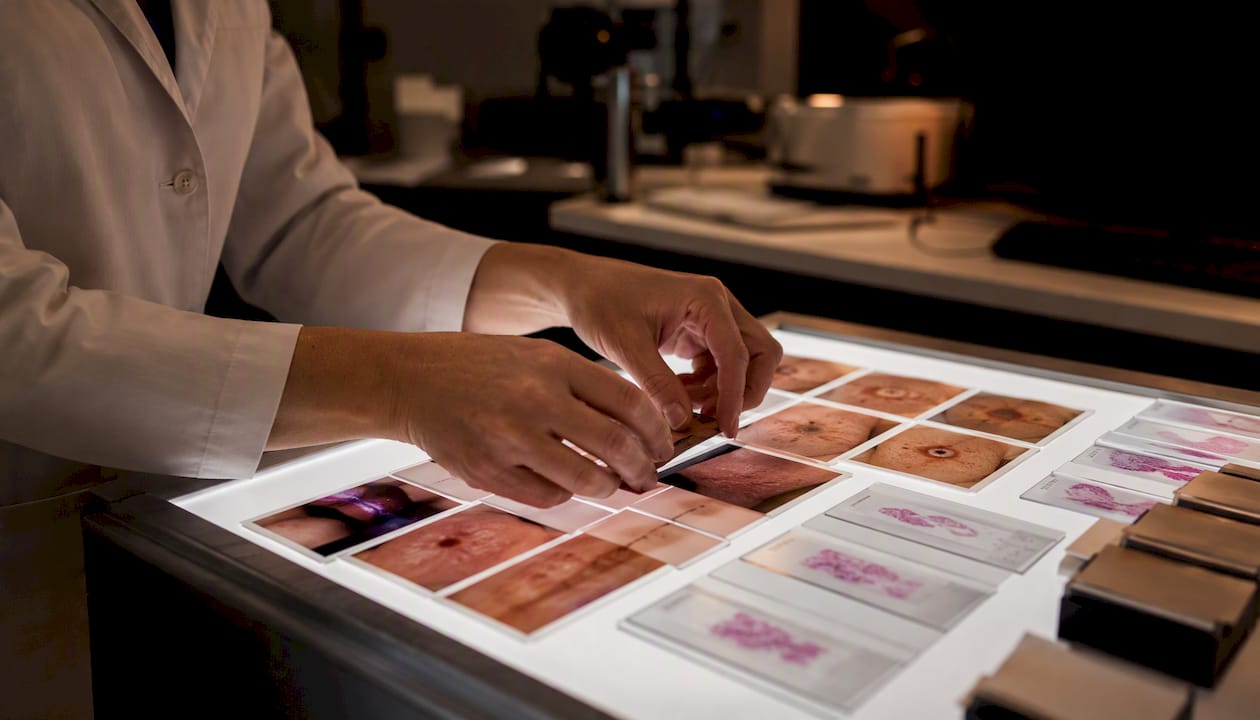
- Skin biopsies (shave, punch, excisional) for lesions with clinical concern; pathology is typically billed and covered separately under medical benefits
- Excisions of malignant or pre-malignant lesions, including squamous cell carcinoma and basal cell carcinoma
- Mohs micrographic surgery for high-risk or cosmetically sensitive skin cancers; the American College of Mohs Surgery identifies it as the standard of care for specific indications
- Chronic condition management for psoriasis, eczema, contact dermatitis, and rosacea, including prescription topicals and systemic agents
- Phototherapy (narrowband UVB, PUVA) when conservative topical therapy has failed and the clinical record documents that failure; see Rao Dermatology’s guide on phototherapy for psoriasis for what to expect clinically
- Prescription biologics for moderate-to-severe psoriasis (e.g., adalimumab, secukinumab) — almost always requiring prior authorization and step therapy documentation
- Medically necessary injections such as intralesional corticosteroids for keloids or cysts causing functional problems
- Dermatopathology and lab services tied to a biopsy or excision
The conditions attached to coverage matter. Insurers like Amerigroup specify in their medical policies that phototherapy and acne surgery are covered only after documented failure of conservative therapy. That documentation requirement is not a formality. Insurers use it as the primary gate for approval.
Pro Tip: Before any procedure that requires prior authorization, ask your dermatologist’s billing team to pull together your treatment history, objective clinical photos, and any pathology reports from previous biopsies. A well-organized prior-auth packet, with explicit ICD codes that reflect medical necessity, dramatically reduces the chance of a retrospective denial.
Dermatology services insurers commonly exclude as cosmetic
Cosmetic exclusions are written into nearly every commercial plan’s member contract. The following are routinely denied:
- Cosmetic Botox and dermal fillers for wrinkles, lip augmentation, or facial volume loss
- Elective laser resurfacing (CO2, erbium) for general skin texture or anti-aging
- Laser hair removal for cosmetic convenience
- Tattoo removal when performed solely for aesthetic reasons
- Elective scar revision when the scar causes no functional impairment
- Chemical peels and microdermabrasion for cosmetic skin improvement
- Cosmetic light and energy-based treatments for pigmentation, skin tightening, or rejuvenation
The exception worth knowing: a procedure that looks cosmetic on the surface can sometimes be covered when it corrects a functional impairment. Botox injected for hyperhidrosis (excessive sweating) is a textbook example. It uses the same drug and the same technique as cosmetic Botox, but the ICD code reflects a medical diagnosis, and most major insurers cover it after conservative antiperspirant therapy has failed. Similarly, scar revision following a skin cancer excision may be covered if the scar restricts movement or causes documented symptoms.
UnitedHealthcare’s clinical policy on light and laser therapy illustrates how narrow these exceptions are: many laser applications are classified as investigational or non-covered for cosmetic indications, while the same technology is covered for port-wine stains or hemangiomas. The procedure is identical. The diagnosis code is what changes the outcome.
Rao Dermatology’s cosmetic services page is transparent about which treatments are elective and self-pay, so patients can plan their budgets before they arrive.
Borderline dermatology procedures and how insurers evaluate them
Some procedures sit in genuine gray areas, and insurers scrutinize them closely. Here are the cases that most commonly trigger a coverage review:
- Mole evaluation and biopsy: An asymptomatic, stable mole removed for peace of mind is cosmetic. A mole that has changed in size, color, or border, or one that bleeds or itches, meets clinical criteria for biopsy. The documentation in the chart note, not the patient’s preference, determines coverage.
- Tattoo removal after radiation marking: When a patient receives radiation therapy, small tattoo marks are placed to guide treatment. Removal of those marks afterward has a medical basis and may be covered, unlike purely aesthetic tattoo removal.
- Acne scarring procedures: Laser resurfacing or subcision for acne scars is almost always cosmetic. The narrow exception is severe scarring causing documented functional impairment, such as restricted facial movement or psychological disability meeting clinical criteria.
- Phototherapy for conditions beyond psoriasis: Light therapy for vitiligo or atopic dermatitis may be covered, but insurers often require step therapy documentation. Many light and laser applications remain classified as investigational for indications outside a narrow approved list.
For borderline cases, insurers typically want a specific set of evidence before approving:
- Chronological symptom history with dates of onset and progression
- Records of prior conservative treatments and their outcomes
- Clinical photographs documenting the lesion or condition over time
- Pathology reports for any previously biopsied lesions
- Treating provider notes with explicit ICD codes reflecting the medical reason
- CPT codes that accurately describe the planned procedure
Submitting a preauthorization request without this documentation is the most common reason borderline claims are denied before the procedure even happens. A retrospective denial, where the insurer reviews a claim after the fact and decides it wasn’t medically necessary, is harder to appeal and can leave both patient and provider holding an unexpected bill. The Dermatology Payment Policy from Fallon Health notes that insurers may request repayment from providers when documentation doesn’t support medical necessity.
How insurers make coverage decisions: medical necessity, prior authorization, and appeals
The decision flow follows a predictable sequence, and knowing it helps you intervene at the right point.
Step 1: Member contract and Summary of Benefits and Coverage (SBC). Your plan’s contract defines what is and isn’t covered. The SBC is the plain-language version. Both are available from your insurer’s member portal.
Step 2: Insurer medical policy. For specific procedures, insurers maintain clinical criteria documents that define what counts as medically necessary. These policies reference technology evaluation criteria and often require documented failure of standard care before approving advanced treatments.
Step 3: Prior authorization. For procedures flagged in the insurer’s policy, the dermatologist’s office submits a preauth request with supporting documentation. Approval is not guaranteed and is not the same as a coverage guarantee, but it significantly reduces denial risk.
Step 4: Claim adjudication. After the procedure, the claim is submitted with CPT and ICD codes. The insurer checks codes against the member contract, medical policy, and any preauth on file. Modifier usage matters here: billing a separate evaluation and management (E/M) visit on the same day as a procedure requires modifier 25 and adequate documentation, per standard billing policy rules.
Step 5: Appeal. If a claim is denied, you have the right to appeal. The denial letter must state the specific reason and the clinical criteria the claim failed to meet. Internal appeals go to the insurer; if that fails, most states allow an external independent review.
Useful documentation to include in any appeal:
- The original preauth approval (if one was granted)
- Clinical notes with explicit medical necessity language
- Pathology reports and objective photos
- A letter of medical necessity from the treating dermatologist
- The specific insurer medical policy the denial cited, with a point-by-point rebuttal
Pro Tip: When you call member services to check coverage, write down the representative’s name, the date and time of the call, and the reference number for the call. If a claim is later denied for a reason that contradicts what you were told verbally, that documentation supports your appeal.
How coverage varies by plan type: Medicare, Medicaid, employer plans, and Marketplace
| Plan Type | Dermatology Coverage Basics | Key Caveats |
|---|---|---|
| Medicare Part B | Covers medically necessary visits and procedures; 20% coinsurance after the Part B deductible | Routine full-body skin exams for asymptomatic patients are generally not covered; Medicare Advantage plans add prior auth and network rules |
| Medicaid | Covers medically necessary dermatology in all states; scope and referral rules vary significantly by state | Always confirm with your state Medicaid agency; some states require a primary care referral |
| Employer-sponsored (HMO/PPO/EPO/POS) | Covers medically necessary care per plan contract; HMOs typically require a referral, PPOs do not | Network status and preauth requirements differ by plan; check the SBC |
| Marketplace (ACA) plans | Covers medically necessary dermatology as an essential health benefit; cost-sharing varies by metal tier | Bronze plans carry higher deductibles; confirm specialist copay and preauth rules |
Medicare covers medically necessary dermatologist visits and procedures, but routine full-body skin exams for asymptomatic individuals are generally not a covered benefit. Medicare Advantage plans sold by private insurers follow Medicare’s coverage rules as a floor but often add their own prior authorization requirements and network restrictions.
Medicaid is the most variable. Every state covers medically necessary dermatology, but the specific procedures covered, the referral requirements, and the prior authorization rules differ substantially from state to state. eHealthInsurance notes this variation directly: beneficiaries should confirm benefits with their state Medicaid agency rather than relying on general guidance.
State law and your actual member contract override everything written here. When in doubt, the contract is the final word.
What dermatology care actually costs you out of pocket
Understanding the cost mechanics before your visit prevents the most common billing surprises.
Key terms:
- Specialist copay: A fixed dollar amount you pay per visit, regardless of what’s done.
- Deductible: The amount you pay before insurance starts sharing costs. Many plans have separate medical and pharmacy deductibles.
- Coinsurance: Your percentage share of the allowed amount after the deductible is met (commonly 20–30% for in-network specialists).
- Allowed amount: The rate your insurer has negotiated with an in-network provider. You pay coinsurance on this amount, not the billed charge.
- Balance billing: When an out-of-network provider bills you the difference between their charge and what your insurer pays. This can be substantial and is not capped by your in-network out-of-pocket maximum.
Illustrative scenarios (these vary by plan):
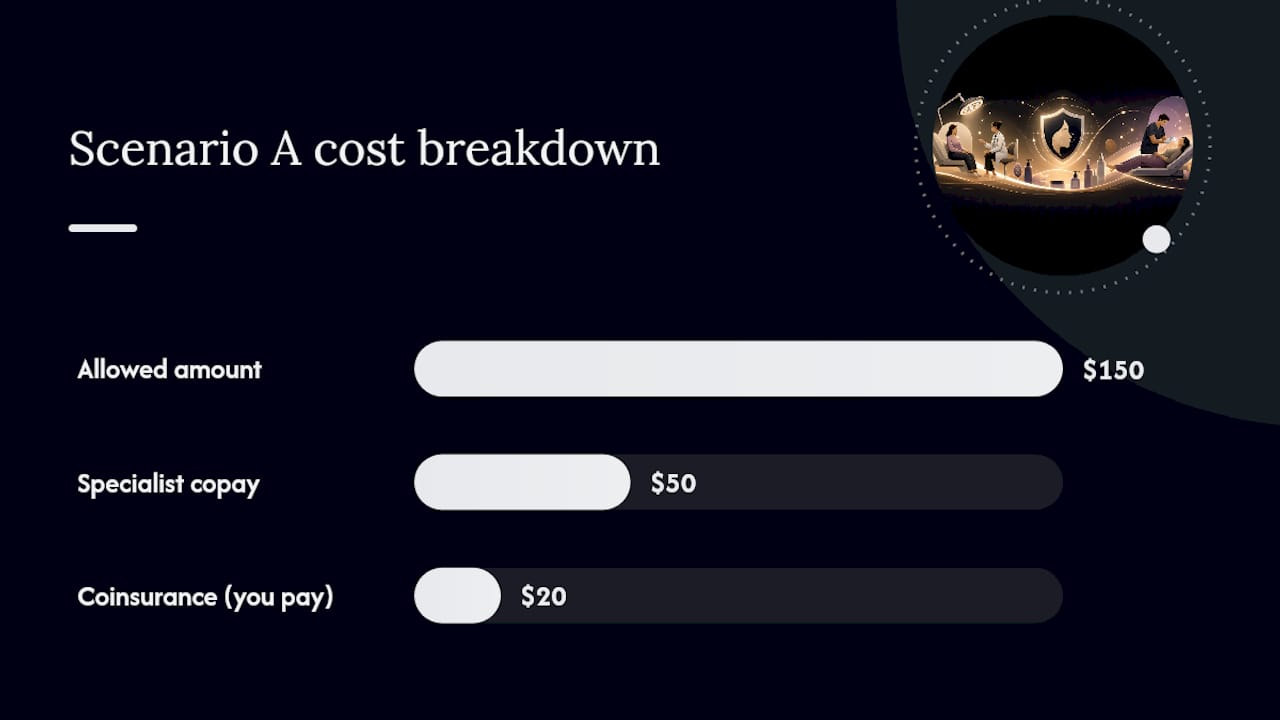
Scenario A — Office visit for a suspicious mole: You’ve met your deductible. The allowed amount for the visit is $150. You pay $50 copay plus $20 coinsurance ($10 if the copay replaces coinsurance, depending on plan design). Pathology, if billed separately, triggers its own cost-sharing.
Scenario B — Biopsy with pathology: Biopsy and pathology are often billed as separate line items. The biopsy CPT carries its own allowed amount; pathology is billed by the lab. If you haven’t met your deductible, you may owe both in full. Minor surgical procedures like biopsies typically carry a 0-day global period, meaning a follow-up visit for results is billed and cost-shared separately.
Scenario C — Mohs surgery: Mohs is billed in stages; each stage has its own CPT code. If you’re early in your plan year and haven’t met your deductible, the first several stages may be entirely out of pocket until the deductible is satisfied, after which coinsurance applies.
Pro Tip: Ask the clinic for the specific CPT codes they plan to bill before your appointment. Then call your insurer with those codes and ask for the allowed amount, your current deductible balance, and your coinsurance rate. This gives you a real pre-service estimate, not a guess.
MoneyGeek recommends exactly this approach: getting CPT codes from the provider and calling member services with them is the most reliable way to estimate what you’ll actually owe.
How to verify your insurance coverage before booking a dermatology appointment
Follow this sequence before any dermatology visit, especially for anything beyond a routine consultation.
- Pull your plan documents. Locate your Summary of Benefits and Coverage (SBC) and member contract from your insurer’s portal. Identify your plan type (HMO, PPO, EPO, POS), specialist copay, deductible balance, and coinsurance rate.
- Get the CPT codes from the clinic. Call Rao Dermatology’s billing office and ask which CPT codes they anticipate billing for your planned visit or procedure. For a biopsy, ask separately about the pathology CPT.
- Call member services with the CPT codes. Ask specifically: Is this procedure covered under my plan? Is prior authorization required? Is this provider in-network? What is the allowed amount and my expected cost-sharing?
- Confirm in-network status. In-network status can change. Verify directly with your insurer, not just the clinic’s website.
- Request written preauthorization if required. If the insurer says prior auth is needed, ask the clinic to submit it before your appointment. Get the authorization number in writing.
- Ask for a pre-service cost estimate. Both the clinic and your insurer can provide one. The insurer’s estimate is based on your actual plan terms.
- Document every call. Note the representative’s name, date, time, and call reference number.
- Bring documentation to your appointment. Prior treatment records, medication lists, and clinical photos of a changing lesion help the dermatologist build the strongest possible medical necessity case in the chart note.
- Request an Explanation of Benefits (EOB) after the claim is processed. The EOB shows what was billed, what the insurer paid, and what you owe. Compare it to your pre-service estimate and dispute discrepancies promptly.
Rao Dermatology’s guide on how to document skin lesions explains what clinical detail matters most in a chart note, which directly affects how an insurer evaluates medical necessity.
How Rao Dermatology supports patients through the insurance process
Rao Dermatology operates across California, New Jersey, and New York, and the practice’s billing team handles insurance workflows as a standard part of every patient’s care, not as an afterthought.
Before a scheduled procedure, the team performs a benefits verification to confirm plan participation, identify preauthorization requirements, and collect the CPT codes that will be billed. When prior authorization is required, the practice submits the request with supporting clinical documentation, including treatment history, objective photos, and pathology reports where applicable. This is especially relevant for biologics, phototherapy, and surgical procedures that insurers commonly flag for review.
Patients can support this process by bringing prior treatment records, a current medication list, and any photos documenting a changing lesion to their first appointment. The more complete the clinical picture at the initial visit, the stronger the documentation the practice can build for preauthorization or, if needed, an appeal.
Dr. Babar K. Rao’s 25+ years of experience across both medical and cosmetic dermatology means the practice understands where the coverage line sits and how to document cases that fall near it. Board certification through the American Board of Dermatology and the practice’s multi-state footprint reflect the clinical depth patients can expect. For an overview of the medical dermatology services Rao Dermatology provides, the services overview covers what to expect at each stage of care.
A note on the insurance questions patients ask most
The most common mistake patients make is assuming that because a procedure is medically real, insurance will pay for it. That’s not how coverage works. Insurers pay for procedures that meet their specific clinical criteria, documented in a specific way, billed with specific codes. A dermatologist can perform a clinically appropriate procedure and still have the claim denied if the chart note doesn’t explicitly connect the dots between the diagnosis, the failed prior treatments, and the chosen intervention.
The second most common mistake is skipping the preauthorization step because the procedure seems routine. Routine to a clinician is not the same as pre-approved by an insurer. Checking in-network status and bringing any prior treatment documentation to your first visit are two steps that cost nothing and prevent the most avoidable billing problems.
Rao Dermatology’s insurance support: what to expect when you reach out
Navigating dermatology insurance coverage is genuinely complicated, and the gap between what you expect to pay and what you actually owe can be significant without the right preparation. Rao Dermatology’s clinical team across California, New Jersey, and New York works with patients on both sides of the coverage line: medically necessary care that insurers should pay for, and cosmetic services where self-pay planning matters.

When you contact the practice, the billing team can confirm whether Rao Dermatology participates in your plan, identify which services require preauthorization, and help you gather the documentation that supports a strong prior-auth request. For skin cancer screening, biopsies, and surgical care, the practice coordinates directly with insurers on preauthorization. For cosmetic services, the team provides transparent self-pay pricing so there are no surprises.
Final coverage decisions rest with your insurer, but the practice’s role is to give your claim the strongest possible foundation. To review the full range of services and schedule an appointment, visit Rao Dermatology’s services page.
Sources
This article provides general information about U.S. health insurance coverage for dermatology services. It is not a substitute for advice from your insurer, a licensed insurance professional, or your treating physician. Coverage rules change; always confirm current plan terms directly with your insurer and state Medicaid agency.
FAQ
Does insurance cover dermatology visits?
Yes, when the visit is for a medically necessary reason such as a changing mole, a chronic skin condition, or a suspicious lesion. Routine cosmetic consultations are generally not covered.
Does insurance cover a mole biopsy?
Most health plans cover a biopsy when the lesion has clinical features that warrant evaluation, such as asymmetry, color change, or irregular borders. An asymptomatic mole removed purely for cosmetic reasons is typically not covered.
What does dermatology cost without insurance?
Out-of-pocket costs vary widely by procedure and location. A basic office visit costs vary widely, and a biopsy with pathology can add several hundred dollars more. Surgical procedures like Mohs surgery carry substantially higher costs.
How does insurance decide if a dermatology procedure is medically necessary?
Insurers apply the criteria in their medical policies, which typically require documented symptoms, a relevant diagnosis code, and evidence that conservative treatments were tried first before approving advanced procedures like phototherapy or biologics.
Does Medicare cover dermatology?
Medicare Part B covers medically necessary dermatologist visits and procedures. Routine full-body skin exams for asymptomatic individuals are generally not a covered Medicare benefit.
Recommended
Filed under: